The Hive reads THE HOBBIT (READALONG)
OK today (January 4th) being Tolkien’s Birthday has given me the impetus to get cracking on a project we’ve been chucking around in the Hive Team for a while – yes, we’re going on an adventure!
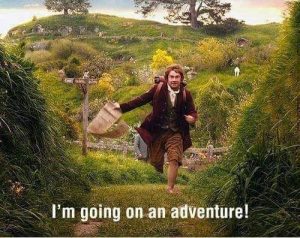
Specifically we are going to do a buddy read of the book that launched so much – Tolkien’s 1937 instant classic – The Hobbit.
As with all the best adventures, we haven’t planned this or got a clue how it’s going to work out. It might be just one compact post or it could become a bloated trilogy of unwieldy posts [Beth: trio of posts it is] that depart from the canon and indulge absurd special effects involving characters who were never in the book… oh, sorry not sure what happened there, just had a vision of Legolas dancing with stones – still offends my physics teacher sensibilities – not to mention Newton’s laws of Mavity.
Suffice to say this is about the BOOK, not Peter Jackson’s cinematic efforts (though to be fair we might reference that work! Nils: I prefer to pretend those films don’t exist!)
Joining us on the team are Queen bee Beth, Instagrammer extraordinaire Nils, and me Theo.
Qu1. So let’s introduce ourselves by remembering where we first met the Hobbit ‘cos this is a buddy re-read right?…. right?!
Give us your own Hobbit induction story…
Theo: I was 9, maybe 10 and in the days when teachers could do those things, we devoted a whole sequence of lessons to reading the Hobbit, reading around the class. I’d not heard of it before then but was immediately drawn into the magical world, lyrical prose and gently omniscient narration. I loved it enough to try reading Lord of the Rings almost immediately afterwards, but that was a much harder sell. It took another 5 years and the Avalon Hill game “War of the Ring” to impel me all the way back into Middle Earth.
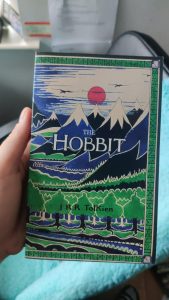
Beth: Ah I wish I’d had the chance to read it in school! When I was ten, my friend Annie was reading The Hobbit. Now, Annie was my secret nemesis; that is, we were obviously friends, but she was the classmate I secretly competed against to best. I was a complicated ten year old. Anyway I thought myself a bookworm and quite literary, but when I saw Annie reading The Hobbit, I was in awe; I’d heard of it, but thought it was a lofty adult’s book and out of my league. I didn’t actually get around to reading it til Christmas 2001, when I was fourteen, and after I’d read The Lord of the Rings trilogy. I have rectified this with my own children!
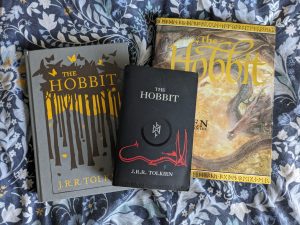
Nils: So since I was 12 my friend Adam was telling me for ages and ages to read The Hobbit and The Lord of Rings as they’re his favourite books of all time, and time and time again I refused thinking they would be dry and boring. Then he mentioned that he had a copy of the 1950’s radio play adaptation and offered to copy it for me so of course I said yes because I’d never listened to a play before. To be honest it didn’t strike a chord with me at the time but nearing my twenties after becoming utterly obsessed with the movies (and of course reading LotR) I developed a greater appreciation for The Hobbit and therefore cannot wait for this reread.
Anyway, we’ll chunk it one chapter at a time and see where it goes so let’s begin with
Chapter I: An Unexpected Party
Theo: FFS – I have only just noticed what Tolkien did there, or rather later. The first chapter of Lord of the Rings is “A Long-expected Party”
Beth: That was lost on me too Theo! For some reason, The Hobbit sticks in my mind far more than The Fellowship, and I remember the first chapter of The Hobbit but not Lord of the Rings. Same goes for the first line, I think the first line of The Hobbit is one that stays with many people:
“In a hole in the ground there lived a hobbit.”
Everything about the opening just screams cosiness, doesn’t it. We’re in the realms of wood panelled drawing rooms, stories in front of cosy fires, in unusual homes where adventures start – which is how I remember the opening of The Magician’s Nephew by C. S. Lewis, too!
Theo: For a long time after reading The Hobbit my ambition was to live in a Hobbit hole in the ground – it seemed like such a cool idea.
Beth: That’s the dream!
Theo: Funny how this opening follows so many archetypal elements of story structure, A stranger comes to town, a call to adventure, refusal of the call, meeting the mentor. It may have been written as a children’s book, but that emphasises that children need (and deserve) good story telling too.
Nils: And that’s the beauty of Tolkien’s prose, he’s an author who can write on so many levels and appeal to both children and adults alike because his main focus is to be entertaining, not to talk down to his audience.
Beth: it’s so organic, it’s as if Tolkien is telling you the story directly, rather than thinking about what would make more sense grammatically?
“The mother of our particular hobbit – what is a hobbit? I suppose hobbits need some description…”
Nils: I love that, it makes us feel so much more connected to the story, characters and even more excited for the adventure to come.
Theo: There is very much a kind of Jackanory, or The Princess Bride kind of story-teller vibe to Tolkein’s writing – as though it’s an oral retelling rather than one read on a page.
Beth: It feels like he’s made an effort to capture something of the origin of the story. My grandmother used to make up stories for my cousins and I when we were little, to keep us quiet and sitting still at dinner time, and there’s an entirely different and more magical quality to these types of stories than just a written work of fiction.
Nils: Did anyone else also love the injections of humour throughout that first chapter? Bilbo’s reaction to the dwarves and the prospect of him embracing his ‘Tookish’ side and going off on the adventure really made me laugh. I also loved Gandalf’s familiar curmudgeonliness and sarcasm, although I’ve always had a soft spot for our grey wizard.
Theo: I did enjoy the succession of dwarfs arriving and also the play on the multiple meanings of Good Morning.
Beth: Yes, I loved the picking-apart of good morning! And the dwarves all falling upon the mat, Bilbo’s confusion every time the bell rang and it wasn’t Gandalf. There’s a far more playful tone to The Hobbit than The Lord of the Rings, isn’t there.
Nils: Absolutely and that’s what I think distinguishes The Hobbit as a children’s entertaining tale and LotR being more for adults with a darkness to it.
Qu 2. OK a question for you team – who’s your favourite dwarf?
Theo: I pick Balin – he was always my favourite. I loved that he was lookout and felt so bad for him when later on Bilbo sneaked past him with the ring on! But what I hadn’t realised until this re-read was that Tolkein describes him as “a very old-looking dwarf” with a white beard. So Jackson probably got the look of him right in the film at least.
Nils: From my first read of the Hobbit I remember liking Fili and Kili, I think because they’re silly and bantery. Though this time around, I was more excited by Thorin in the opening chapter, I guess because he is more central to the quest.
Beth: Honestly, I’m not sure I do have a favourite dwarf? I always liked that Gloin was one of them, because I remembered him from the Lord of the Rings, as being Gimli’s father.
Qu 3. What about the songs/poetry? Like them or loathe them?
Theo: To be fair most of Tolkien’s songs and poetry passed me by, or rather I skipped over them. But with some, the rhythm of the songs the foreboding sent shivers down my spine, In this chapter, Far Over the Misty Mountains Cold sent shivers down my spine. It’s one of my top three bits of Tolkien poetry, right up there with The Fall of Gil-Galad and Durin’s song that Gimli sings in Moria. This was one other bit that Jackson definitely got right!
Nils: Ok confession, I usually skip the songs! But this time I’m going to read them.
Theo: to be fair, apart from the three I’ve mentioned I think skipping is the wisest option. While Tolkien’s love of an elegant language is great for the elves, his poetic gifting them such great lines as tra-la-la-lally doesn’t do them any favours!
Beth: I remember reading them on my first read and being frustrated by them? And then coming to another one, skipping it, admonishing myself, going back and reading it, and then deciding I might as well have just skipped it… We’ve been listening to the audiobook in the car with the kids, narrated by Andy Serkis, and he sang Far Over just as it sounds in the movie, which was beautiful. But then he also sang the elves’ song and that… didn’t have quite the same effect.
Chapter II: Roast Mutton
Theo: As the well-spring of all the Middle-Earth Tolkien lore that followed, it might be fun to spot the first mention of iconic names, places and concepts. Here in this chapter we get a recalcitrant Bilbo avoiding the call to adventure. “In fact he was just sitting down to a nice little second breakfast.” So there we have it the first mention of second breakfast, and now I am second guessing myself – did Pippin even say “what about second breakfast?” in LotR or did Jackson just graft that little bit of authenticity from one book to the next?
Nils: I’m wondering the same thing! But yes, I loved our first mention of second breakfast and how often Hobbits liked to eat!
Beth: Picking up my copy of Fellowship, I can’t find that line in the section when they leave Bree with Aragorn, but maybe it comes up elsewhere in the book. The line about the midges, what do they eat when they can’t get hobbit, is there though!
Nils: That’s cool!
Theo: Of course, as Beth has mentioned, each chapter is a very self-contained section of story with this being the troll chapter, with Tolkien’s inventiveness and somewhat slapstick sense of humour on show.
Beth: Again it lends itself to story-telling, doesn’t it, with each chapter being a contained session! But as you say Theo, there’s a lot of humour in this chapter. “Booby yerself!” Tolkien seems to be very conscious about the potentially scarier moments of his story, and to lift those moments with comedy or familiarity.
Qu 4: It’s always annoying though when characters do stupid things for plot purposes. Who do you think was more stupid or irresponsible in this chapter? Bilbo, for trying to pick a troll pocket, The dwarfs for rocking up one at a time and being so easily captured? The Trolls for falling for Gandalf’s wordplay? Or Gandalf for indulging in wordplay rather than just zapping the Trolls – or are they more powerful than they appear?
Nils: Unlike LotR this is a children’s book and so I do expect a few things to happen easily or conveniently. Nevertheless I still enjoyed this chapter, it’s silly but it’s also fun and a very memorable moment. I was discussing this chapter with my friend Adam and he made me realise that Bilbo had beforehand never really left the Shire, so his innocence made him careless. Although he may have known the Trolls were bad, I don’t think he realised the exact danger. As for Gandalf, he’s always used his magic sparingly and perhaps with the mention of the Necromancer in the previous chapter, he was cautious not to use his power and draw the ‘eye’s’ attention?!
Beth: I did find myself thinking seriously Bilbo?? When he attempted the pick pocket, but I could see he was trying to prove himself. What I couldn’t understand was the dwarves not being able able to tell what was happening and getting themselves captured so easily!
Theo: Absolutely agree Beth – very much the definition of stupidity – to do exactly the same thing (arrive in dribs and drabs) and expect different results!
Beth: As Einstein said, the definition of madness!
There isn’t very much talk of them being warrior-like though, is there? They sound a lot more like craftsmen?
Theo: That’s an interesting point, seeing them as professional miners and amateur adventurers does explain a lot!
Beth: And like Nils said, it is a children’s story so there needs to be exciting things happening, regardless of whether they entirely make sense.
My favourite part of the chapter is Gandalf’s word play and stirring to get the trolls argue amongst themselves. It’s actually the one part of the book that’s stayed with me the most throughout the years. This, and when Bilbo meets Gollum.
Chapter III: A Short Rest
Theo: Ok I’m going to mention a favourite quote at this point
“Now it is a strange thing, but things that are good to have and days that are good to spend are soon told about, and not much to listen to.”
Certainly Tolkien likes to hand wave over significant passages of time and I hadn’t realised that the party spent 14 days (at least) in Rivendell. Then again in LotR Frodo arrived in Rivendell on 20th October and stayed for over two months, not leaving until 25 December (I wonder why Tolkien, a devout Christian, picked that date!)
Nils: I do like how Tolkien moves forward fairly quickly but gives us snippets of important parts we may need to know for later on.
Beth: I loved that quote too, Theo, it’s so true. And you raise a valid point, it’s easy to forget just how long these adventures took!
Theo: Besides meeting the enigmatic Elrond, this is the first canonical mention of the lost city of Gondolin with Gandalf’s Glamdring – recovered from the Troll’s hoard – identified as the sword of the King of Gondolin. Now, knowing what happened to the King of Gondolin (it’s told in the Silmarillion, Nils!) it’s amazing that the sword survived, let alone got brought out of the ruin of Beleriand to end up in a troll cave! This, I guess is one of the throwaway lines – like Zaphod Beeblebrox having three arms and two heads – that causes potential headaches for authors later on. We also get a first mention of “…forgotten treasures of old to be found in the deserted caverns of the mines of Moria” as well as the name Durin making an appearance.
Qu5. Bilbo is certainly taken with Rivendell as, somewhat presciently, Tolkien writes “Bilbo would gladly have stopped there for ever and ever.” What do you like best about Tolkien’s Rivendell?
Nils: Rivendell would definitely be somewhere I’d love to live in Middle Earth. Tolkien’s depiction is that of a place of utter tranquillity and who wouldn’t want that? Looking at my colour illustration of Rivendell, the surrounding waterfall, forests, cliffs and river would be so beautiful to explore, I’d love to hear the elves singing, to learn of their race and magic, and I’d be constantly asking Elrond for stories of old.
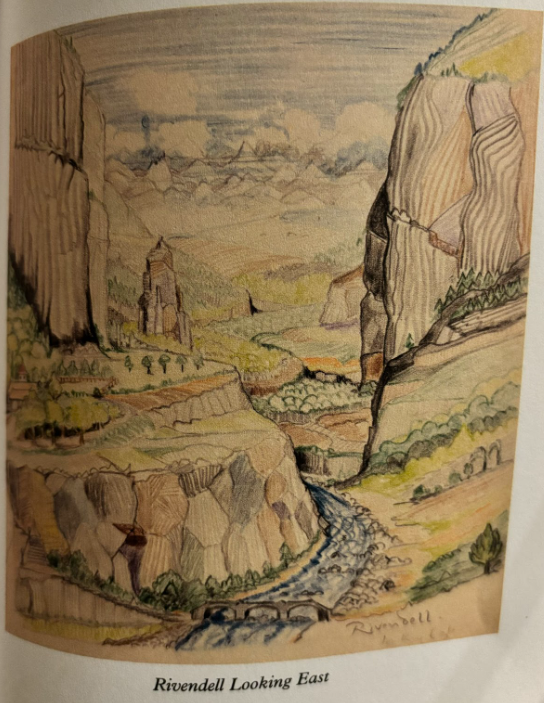
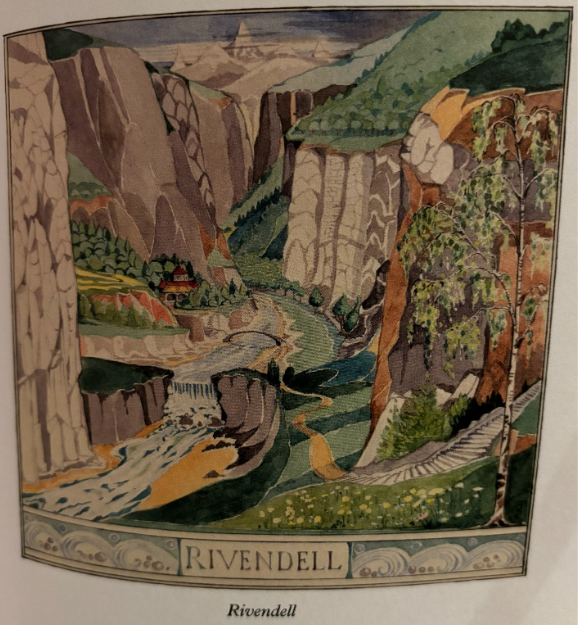
Theo: Ooh that is a beautiful illustration with the Misty Mountains puncturing the horizon. One of the strange features of Rivendell, that the film did capture quite well, is that you go down into it. It may be a valley, but it’s sort of like a rift, or Grand Canyon type thing in the midst of relatively flat-level ground.
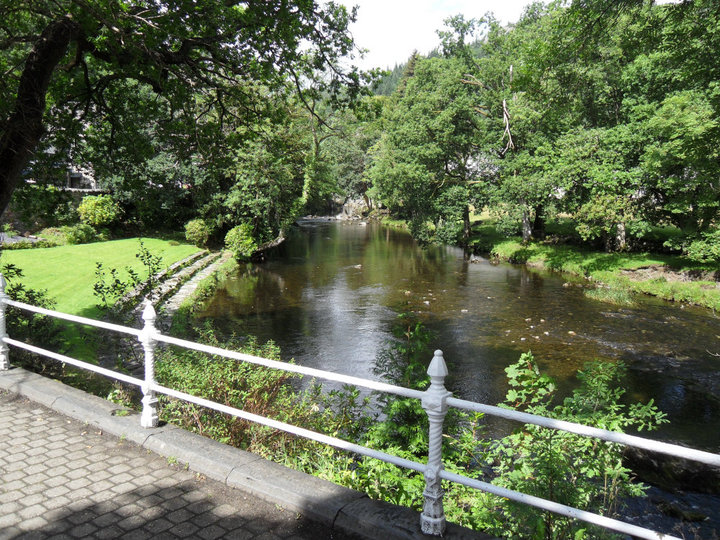
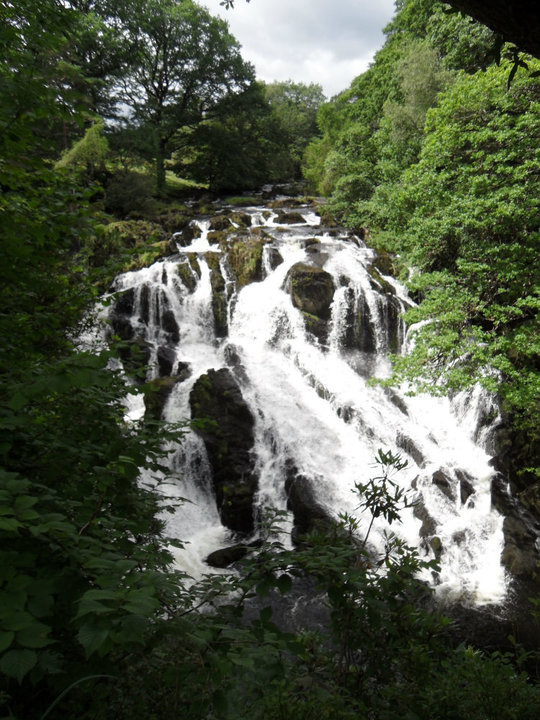
Beth: I’ve always had a longing to be able to visit Rivendell, if I could step into any fictional place it would be this one. But I think I prefer the film version – I’m not sure I could put up with the singing and teasing of the elves for too long! Tolkien’s version seems to have more of a party feel to it, whereas Peter Jackson’s felt more contemplative? Either way, I love that it’s tucked away as it is, and difficult to find. It puts me in mind of Betws Y Coed in Eryri.
Theo: Oh, Beth that does look like a cool little hidden valley place! https://www.expedia.co.uk/Betws-Y-Coed.dx10589
Chapter IV: Over Hill and Under Hill
Nils: The beginning of this chapter has such a lovely quote:
“It was a hard path and a dangerous path, a crooked way and a lonely and a long. Now they could look back over the lands they had left, laid out behind them far below. Far, far away in the West, where things were blue and faint, Bilbo knew there lay his own country of safe and comfortable things, and his little hobbit-hole. He shivered. It was getting bitter cold up here, and the wind came shrill among the rocks.”
Tolkien’s poetic prose just bursts with atmosphere and emotion. You can feel Bilbo’s longing for the Shire, the vastness of his journey and a sense of foreboding for what awaits him next.
Theo: Yes – Tolkien’s prose is gently lyrical. It’s the little word choices that make a difference – like “the wind came shrill among the rocks.” It’s that pathetic fallacy of imbuing wind with human qualities!
Beth: The writing really is very beautiful, and it’s something I’d kind of forgotten? I remember the adventures and the trials, but the actual writing itself brings so much more.
Theo: I had thought that the stone giants Jackson lavished such special effects attention on were his own invention. Actually though, they are in the text as the Dwarves and Bilbo and Gandalf brave the passes of the Misty Mountains. I also enjoyed Gandalf doing some more bad ass wizardry – rather than the previous wordplay and a kind of soft persuasive “these are not the droids you are looking for” kind of power. Tolkien is never very specific about his magic system or Gandalf’s powers, so it’s nice to see here that he can kill Goblins with a flash of fire and scurry around the Goblin corridors as stealthily as Bilbo with a ring on!
Beth: He uses it sparingly, doesn’t he, but that just means when he does use it, it’s all the more exciting. He does say later that it was a very tricky spell to do, and I had to smile at his hubris, his enjoyment of retelling how clever he was.
But I’m getting ahead, back to this chapter, I loved this moment:
“but the goblins knew their way, as well as you do to the nearest post-office”
Just in case things are getting a little too scary, there’s a quick dip back to the familiar for any children getting too invested!
Theo: Also interesting to see that, even in a Children’s story, Tolkien is channelling his world war one horrors ascribing villainy to goblins “It is not unlikely that the invented some of the machines that have since troubled the world, especially the ingenious devices for killing large numbers of people at once, for wheels and engines and explosions always delighted them.”
It is a recurring theme in Tolkien’s work to idolise the bucolic natural world epitomised by the elves, the tree ents and the forests, and to demonise industrialisation – which is identified with goblins and Saruman’s intensive resource extraction (mining) of Isengard!
Nils: I’ve always appreciated Tolkien’s fondness for the natural world and his use of industrialisation as a metaphor for corruption.
Qu6. Gandalf is for many the archetypal fantasy wizard – though he should have a blue hat not a grey one. What do you like best about him? Are there any other wizards that come close (apart of course from our own Ulesorin!)
Nils: I personally love that Gandalf isn’t all powerful, even against Goblins he has his limitations. Although there isn’t a magic system that’s detailed out at least it’s not used by Tolkien as a device to get Bilbo and the Dwarves free of every situation! Gandalf is one of those characters who is a loveable grump. Sure he often loses his temper but he also cares a great deal.
Beth: Gandalf will always be my favourite wizard; how can he not be, when he is the OG wizard? Everyone who comes after him is coloured in some form or another from his own hue. Belgarath, Sparrowhawk… even to a certain extent my beloved Rincewind. And how can you not love that gruff exterior hiding such a golden centre?
Theo: Oh yes – Rincewind is an absolute treasure – a sort of anti-Gandalf!
Beth: I always saw Joe Abercrombie’s Bayaz as the ultimate anti-Gandalf
Chapter V: Riddles in the Dark
Nils: MY FAVOURITE CHAPTER!
Theo: This is it, this is where the LotR starts – with Bilbo finding the ring and Gollum. Interestingly it’s also a chapter that had the most revisions between the 1937 original and the 1951 tie-in-with-LotR final version. There was the unfortunate need to clarify that Gollum (and his boat) were both small sized after a Finnish illustrator drew Gollum as a giant blubbery mountain.
Beth: Really?! This is a brilliant fact Theo!!
Theo: More tellingly though is the revision of the nature of the contest between Gollum and Bilbo – which was originally a much more civilised affair, but had to become much darker to fit with the greater significance of the ring. You can read more about the changes in this excellent article here – http://tolkien.cro.net/tolkien/changes.html
Nils: I did think Gollum mentioning throttling and eating Bilbo a bit gruesome for a children’s tale but perfect for LotR!
Beth: Oh that explains quite a lot, doesn’t it! Something that struck me was the explanation that Gollum talks to himself and calls himself my precious, because of course he also calls the ring precious?
Nils: I always thought he was talking to and addressing the Ring, so that came as a surprise to learn he called himself my Precious.
Qu7: Did you get the riddles at all? I am sure such things were all the rage in the 1930s or even Tolkien’s youth – but tbh, they made no sense to me at all then – or now! A lost art form I guess.
Nils: I got the riddle for teeth and water but the others were lost on me!
Beth: I always loved the riddles! My grandmother and I used to tell each other riddles, and I had a book my grandfather sent me of nursery rhymes and riddles, and both the teeth and the egg riddle are in that. Ffion keeps trying to catch us out with riddles too, so I’m not sure they’re entirely out of fashion. But they were certainly a common element of my childhood.
Qu8: Did you feel sorry for Gollum, I mean let’s be honest, Bilbo did cheat!!
Nils: I don’t think Bilbo intentionally cheated, he just panicked and accidentally asked an impossible question whilst rummaging in his pocket! As much as I love Gollum’s character, I did not want to see him eat Bilbo, so I don’t really pity him. Besides, without Bilbo’s taking of the Ring we’d not have the catalyst for LotR!
Beth: I found myself judging Bilbo quite harshly this time round. We can say it was the influence of the ring upon I suppose, though I’m not keen to excuse him too much for that. But as he stands in the tunnel with Gollum blocking his way and weeping, and pitying him, I wondered, couldn’t you have given it back at this point? Let him live quietly and peacefully in his cave and avoid an awful lot of future bother…
Nils: The Ring has a will of its own… 😂
Beth: Oh and did you clock the description of the ring’s effect on Gollum? How he found after so long, he couldn’t bear to wear it on his person anymore and that’s why he kept it hidden on his island? It really put me in mind of Frodo by the end of Return, his talk of how heavy the ring had become.
Nils: Yes!!! I noticed that too. Do you think that’s something Tolkien went back and added so he could tie it to LotR?
Theo: Very possibly he did, that chapter got a lot of editing between 1937 and 1951. I wonder if we can source the original version somewhere? (Ask and Google shall deliver! https://www.ringgame.net/riddles.html – A side by side comparison of the two versions, and helpfully the bits that are different are easy to spot as they are highlighted in blue)
Chapter VI: Out of the Frying-pan Into the Fire
Theo: I think Beth had commented earlier on how each chapter was an event and the story structure was definitely constructed as a sequence of challenges hanging a string like pearls on a necklace. One could almost (but not quite) forgive Jackson for the rather tedious monotony of his crisis-resolution-crisis-resolution film structure, because it does ape the book a bit. Still – we meet the eagles in their first appearance as Gandalf’s (and Tolkien’s) get out of jail free card.
So the king of the eagles is later seen with the gift of a Golden Crown, and his lieutenant have Golden Collars – did Tolkein not know how dense and heavy Gold was, or what it would do to an eagle’s airspeed. Though I suppose the question is – is it an African great eagle or a European great eagle?
Beth: And are they carrying coconuts? (Theo: 😂)
This was the part of the book that started to get quite hazy for me. I knew we had Beorn coming up, and spiders in the forest, but being chased up into the trees by wargs and getting rescued by the eagles had escaped my memory, and I thought in the films this was a construct on PJ’s half. They were quite literally into the fire!
There were a lot more songs to skip in this chapter again…
Qu9: How far do you think Tolkien used a similar structure in LotR – with alternating challenge/refuge? Eg The Hobbit has Party-Trolls-Rivendell-Goblin mines-Refuge with Beorn while LotR has Party-barrow wights-Bombadil-Ringwraiths-Rivendell-Moria mines-refuge with Galadriel? Was he trying to stick to a winning formula?
Beth: That’s the thing with adventures though, isn’t it, you’re not going to be safe for very long! It would be a boring story if they were never in any peril, but it would be an exhausting one if they never had any respite! I think it’s a winning formula for any storytelling!
Qu10: OK, a different take on an old question buuuut… why didn’t the eagles just fly them across Mirkwood all the way to the Lonely mountain?!
Nils: No Theo! No! This question proper winds me up whenever I hear it!! I’ll copy and paste what I wrote on WhatsApp!
The Lord of the Eagles would not take them anywhere near where men lived. “They would shoot at us with their great bows of yew,” he said, “for they would think we were after their sheep. And at other times they would be right. No! we are glad to cheat the goblins of their sport, and glad to repay our thanks to you, but we will not risk ourselves for dwarves in the southward plains.”
For all those stupid people who say why didn’t the Eagles just fly them to Mordor or to the Lonely Mountains!! It’s because the Eagles would only help as and when they see fit. The Eagles are only interested in what affects them, they enjoy getting one over on the goblins, but why would they take any further risks for Dwarves on a quest for gold? It would be all risk and no reward. They wouldn’t risk their race nor are they Middle Earth’s taxi service!
Beth: The fact it wasn’t safe for them either made a great deal of sense!
And so ends our first part for our Hobbit readalong!
The discussion will continue later this week, but in the mean time, if you’d like to join in we’d love to hear your thoughts on any of the above questions!