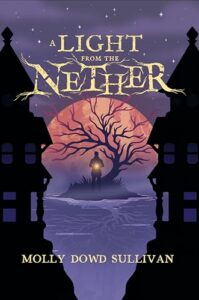
SPFBO 11 Finalist Review A LIGHT FROM THE NETHER by Molly Dowd Sullivan
Here at the fantasy-hive the SPFBO team have been reading through the nine other finalists that have been put forward by the other blogs alongside our own selection of THE HALLOWS and we are now posting our reviews, on an intended fortnightly schedule up to the end of December and the conclusion of SPFBO 11.
We do have to give scores at this stage and we’re also aware that the scores can tend to average out and congregate around the middle so we’ve tried to make a conscious effort to distinguish between each book in the scores we give and the implicit order that we are placing on them – which may mean some scores veer towards the upper and lower ends of the range.
However, we have been impressed by the professionalism and quality of this year’s finalists field and also how so many of them have done something different with their story ideas and maybe trodden into spaces where traditional publishers might fear to go.
Hopefully there will be enough in our reviews to give you a flavour of each book and a sense of whether it would appeal to you or not which – after all – is what reviews should be about.
So on to our sixth finalist review of A LIGHT FROM THE NETHER by Molly Dowd Sullivan where the judges will comment (as always) under the headings of worldbuilding, Prose, Character and Plot, before giving their pithy one line conclusions and scratching their heads to come up with a numerical score for this fortnight’s finalist.
Worldbuilding
Theo: The worldbuilding here is really right up my bailiwick. Sullivan gives us an alternative contemporary world in which people with particular talents (sophonts) can enter and explore the interior of people’s minds (phrens) which typically present as malformed versions of favourite homes/places filled with memories. I mean I just love this playing with memories and two minds in one head kind of stuff, replacing those dully conventional inner monologues with some feisty inner dialogues. Then Sullivan throws in a notion of a kind of ethereal other world (the Nether) raging at the borders of all those human minds that is filled with monsters (flukes) which sometimes break into people’s minds (phrens) through breaches (fissures) with the Nether and drive the living humans into fatally destructive behaviours. I found it all a very cool idea and it did give scope for some fun surreal descriptions of what the inside of a warped/damaged mind might look like. Within the ‘real’ world, I liked Sullivan’s characterisation of Shoalport – where most of the action is set. Both the place
Downtown Shoalport isn’t how Liam remembers it. The architecture is the same: stuck in time, pretty, and smug about it
And the people
These are retired adults who have temper tantrums at minimum wage service workers when their coleslaw needs more mayonnaise.
Cat: I loved the opening up of the alternate reality of this book from the first moments – stepping into someone else’s mindscape (phren) and seeing how negative emotions distort it, causing breakdowns in the ‘real’ world. The Small-Town America aspect was a sharp contrast to the beginning Big City surroundings, but I appreciated that this was appropriate as a location for our hero to go in order to essentially cut himself off from both realities. Like it or not, this was the place he had gone home to for healing, and that opened up his character beautifully too. The contrast of the dark and light aspects of our personalities is reflected in the world in such a skilful manner, I was absolutely hooked.
Vinay: I would like to split the worldbuilding into two parts, one of which worked better than the other. The setting of Shoalport was fantastic – moody, atmospheric with more than a hint of mystery and tragedy in the air. It felt like a place where time stood still. Shoalport with its moody houses and a sense of horror tragedy with its kind of insular residents was simply fabulous. The part around the magic was the one where I struggled despite trying to read/ re-read multiple times and I found myself dragged out of the story a few times due to that. It just never stuck – I guess it’s more of a me issue but I did try hard
Prose
Theo: Sullivan’s prose flows smoothly with some nice lines and turns of phrase that catch the eye. We see things mostly through the eyes of our deeply troubled third person protagonist Liam, which imbues the narrative with a sardonic lilt.
As if to admonish him for lying, memories laced with stale emotion, unlock as they move down the upstairs hall:
The edges of her Phren radiate simplicity. He doesn’t have to delve inside to know her mind is colorless. Exotic as a Kmart. Fun as a twelve hour layover in Newark.
Cat: I really enjoyed the writing style in its blunt realism contrasted with the evocative beauty of the mind. The everyday world is never described quite as sharply as the phren-scapes, which makes us see through Liam’s eyes more effectively as to what’s important to him; the everyday = dull, frustrating, dirty, whereas the phren = beauty, tangibility, (almost) magic. I don’t believe ‘magic’ as such is every really mentioned; this reality is just what it is, and the writing reflects that in how matter-of-fact it is combined with the subtext of wonder.
Some moments genuinely made me tear up with their emotion: ‘You did save him. If it wasn’t for you, there wouldn’t be a memory of playing basketball. He wouldn’t know my nickname was Sparky. He wouldn’t be able to feel anything at all. You saved parts of my dad for me.’
The explanation for why this is all the way it is strikes simply: ‘All we know is that being alive is just harder for some people.’ And then shortly after: ‘I don’t know if life is easy for anyone. And we are privileged in countless ways. But yes, some of us do seem rather cursed.’
It’s not easy at all being who Liam is, experiencing the world as he does, and this is beautifully expressed even in the darkest moments.
Vinay: The writing has a smooth flow to it even as it builds upon the urgency. There’s a Freya Marske-Ian element to the writing and building of the tension especially between characters and I genuinely enjoyed that a lot. The romantic tension gets conveyed quite well & you can naturally see the characters grow and become comfortable. The banter is snappy when it needs to be & like the world building, the writing conveys a lot quite effortlessly
Makoto’s mind is a lake beneath a mountain, glassy and clean. It’s a fitting counter to Liam’s, which Makoto once described as “a storm on a sea.” Liam thinks “fire in a dumpster” is more accurate.
Characters
Theo: The story centres on and is carried by Liam, a talented Sophont who works as a Wedge – which means going into people’s minds to heal/close fissures and expel flukes. Liam’s international fame stems from his exceptional ability as a Trypanon, which means, in addition to going into other people’s minds (Phrens) he can travel through fissures into the Nether itself and return from it. Liam has had a lot of trauma in his life, both in a past life changing incident that he struggles to remember in any detail, and in the events of the opening prologue which prompt him to give up work and return to his dead Grandparents’ house in Shoalport. He arrives with a lot of grief, mental baggage and personal doubt that he spends a lot of time wallowing in, even as various disasters come to Shoalport, so I did find him difficult to like at first. He can also be cruel to others – though I guess that makes him a more realistic angst-ridden PTSD protagonist than many fantasy heroes. I found Jasper, when he put in an appearance, made a fun foil to Liam and brought him out of his shell more as a character and a person.
Cat: Going into this blind, I was fully on board for the team of Liam and Makoto – so the initial swerve when we lose one of our protagonists struck me hard, and continued throughout the book. This is absolutely appropriate, as Liam is haunted by the loss of his friend right up to the final act, and this loss equates to an intense burn-out that makes for a bumpy ride. I was so impressed by how Liam’s journey is portrayed throughout this book, walking a fine line between making him unlikeable versus genuinely damaged, and his willingness to get up and help others is heroic at heart. He feels his humanity intensely in a way that others can’t, which made me feel for him.
Perhaps my only complaint with the book is that a lot of the other characters are unnecessarily vindictive and angry at Liam in a way that didn’t always seem warranted – but then at the conclusion, we see why and I’m willing to let it go. Also this made his true friends shine all the more brightly, even just as drinking buddies and listening ears which bring him back to life in the present – something his ‘otherworldly’ contacts cannot do.
Vinay: Liam is our eyes to this world and he’s quite a character, almost damaged, to follow around. The book really lives and dies by how you feel on his voice. He does have a fatalistic, cynical streak to him which combined with a sense of sadness makes reading certain portions tough. The start of the book pushes him further into his own grief and darkness and coming back to Shoalport opens a lot of wounds. His history, shrouded at first, is one of the most intriguing parts of his character and in a way his interactions with a character later both drive his sense of belonging and his pain. As I mentioned earlier, the character work, the hesitation, the flaws all of them are almost in a Freya Marske- manner and easily the best parts of the book to follow
Plot
Theo: There is an almost cinematic structure to the plot with a prologue that shows Liam’s opening trauma in his work in Chicago leading to his search for obscurity through a return to his childhood home in Shoalport. Once there, Sullivan plays to another of my favourite themes in turning this into a murder mystery, with an unknown rogue Trypanon invading people’s Phrens and allowing various flukes to drive them to destruction. This is the central plotline – which Liam spends a lot of time refusing to engage in to the frustration of the local police force (and this reader!). Alongside that there are two backstories to be resolved. There is Liam’s own blurrily remembered childhood event which propelled him on his impressive career path, and there is the hundred year old tale of ‘the man who drowned waiting’ who is somehow linked to Liam and to the current flurry of fissure related deaths. It does make for an intriguing set of interconnected problems and twisting theories that keep you turning the pages to find out what happens and what happened.
Cat: This is a multilayered story told very well, skipping between past and present, otherworld and everyday, and the fact that it holds its ground without getting confused is a great achievement. I’m glad we only follow Liam, as any extra character perspectives would’ve been too much; this is one man walking his path to bring a lot of plot-threads together, and it was deeply engaging for me as he fights through the darkest depths. I suspect that the author knows what depression feels like, and Liam’s breakdown is sensitively portrayed without detracting from the main plot. Also I did guess some of where the story was going but by no means all – I wasn’t sure quite ‘whodunnit’ right up until the final reveal! So altogether an intense and engrossing ride that I absolutely loved. This may well make my Indie Books of the Year list.
Vinay: Damaged man comes back to his home & finds more damage – simplistic but effective. Adorning this plot with an older mystery as well as the mystery of Liam’s powers makes this quite effective. While I did struggle with the nature of the magic, the central mystery was quite effective while the uncovering of the history and its mystery kept me hooked all the way through. The reveal of the killer was fantastic as was Jasper’s journey – the sense of danger was always felt & some portions felt positively screwy in a squeamish way, that you had to read the page even when you wanted to not read
Conclusion
Theo: A mind bending murder mystery where memories can be invaded and everyone is an unreliable witness.
Cat: Worlds collide in an otherworldly whodunnit that dives deep into who we are when grieving.
Vinay: A murder most deadly catches the attention of a damaged hero and Jasper, his friendly ghost
Score |
/10 |
Theo |
8 |
Cat |
9.5 |
Vinay |
7 |
Average |
8.17 |
Final score (rounded to nearest 0.5) |
8 |