
Suldrun’s Garden by Jack Vance
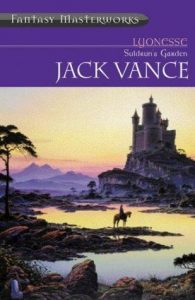 I’ve had a very mixed experience with this book, which wasn’t entirely unexpected given that I’d heard glowing reviews about it from some people and less-than-glowing ones from others. When I was around a hundred pages into the story I was very tempted to put the book down: I felt that the plot was all over the place, the characters were shallow and uninteresting, and the prose was very dry. But I stuck with it, and thankfully ended up enjoying the final third of the book almost enough to make up for the weak (or so I felt) beginning.
Suldrun’s Garden is an interesting historical fantasy mash-up, set in the fictional realm of the Elder Isles (now sunk beneath the sea, but once located near France and Britain). At the beginning the story is mainly concerned with establishing the conflict between the lands of Lyonesse and Troicinet, but this eventually becomes more of a backdrop to the main events of the story. As well as the overall war we have long-lost princes, rebellious princesses, talking mirrors, magicians, Arthurian references, curses, ogres, torture, rape, torture-rape, curse-rape-torture, ogre-rape, and fairies.
I found the fairy-story aspects of the novel interesting, but over-used and occasionally irrelevant. Sometimes the descriptions felt very Tolkien-esque and twee, while at other times they were as gleefully violent as a Grimm fairy tale; the inclusion of the latter do help to give the novel its pervasive undertone of dark threat (which was sometimes a bit heavy-handed, particularly with regard to the continual misfortunes that befell many of the characters). I felt that the semi-historical element of the setting was also interesting, and nicely balanced out the inclusion of the fae world, but was used so minimally that it may as well have not been mentioned at all. I don’t know if it becomes more prominent in future novels, though.
I realise that my criticisms might be a bit controversial, as it seems Vance is revered as one of the forerunners of modern fantasy. Speaking personally, though, I didn’t enjoy his writing style very much, at least not at first. I found the way he related events to be very dry and dull, and felt that the characters were not developed as thoroughly as they might have been. Since this is very much a plot-driven story, I felt disconnected from events in a way that I don’t when I’m reading more modern, character-based fantasy. Modern fantasy authors I’ve enjoyed recently (particularly the likes of Joe Abercrombie, George RR Martin, Mark Lawrence, John Gwynne, Brent Weeks, Patrick Rothfuss, Steven Erikson, etc., etc.) engage the reader by persuading us to invest in their characters just as much as in their stories, which is something I felt was lacking in Suldrun’s Garden. For instance, we’re often told that a character is doing something, but we’re not always shown their thoughts and motivations for doing so; similarly, we may be told that a character is angry, or sad, but are shown very little of their behaviour or their reasoning. In this way it reminded me a little of Mary Stewart’s Merlin trilogy, with a lot of unnecessary elements and prolific use of narrationrather than storytelling. (Yes, there’s a difference. In my mind at least.) It’s this sense of distance from the characters that kept me distanced from the book, at least for the most part.
The other issue I had was with the writer’s use of language. Characters don’t seem to have distinguished voices – the adults speak in mostly the same way as the children, and vice-versa: for example, when insulting and threatening the press-ganged/enslaved Aillas, the overseer uses the word ‘fiddity-didjet’ to describe his behaviour. For me this jarred with both the situation and the other events in the book: a lot of it is quite dark and tragic, yet the language in no way reflects this.
One more minor criticism I have is plot-related. I found that characters were doing elaborate and irrelevant things simply for the sake of doing them. An example of this would be when the magician Shimrod is coerced into entering a dangerous magical realm and having to complete an arbitrary set of tasks, all as part of a ruse so that someone else could go to his house and steal his “magical stuff”. This style of writing put me in mind of Jonathan Strange and Mr Norrell, which also tends to slot in events simply because the author wants to. This works for a lot of people, but not for me in this particular case.
Criticisms aside, I found myself enjoying the book quite a lot towards the end. Once the author focused on two or three main characters and gave each one a clear sense of purpose the story became very engaging. If the majority of the book had been like this I would have been able to recommend it; sadly, it wasn’t, and I can’t.

I loved this book and recommended it to someone else who ended up reading all three in the series. I found Vance’s prose delightful, inventive and often wryly humorous. I liked it so much I just started the second book. He’s writing a fairy tale basically so the characters don’t have the depth one might be used to, but I still found myself very invested in the characters. There are so many moments in the book that are absolute gems; often they are not integral to the plot. The digressive nature of it is a welcome break from traditional norms of plotting and gives it a dream-like surreal quality. I’m surprised to hear there are negative reviews. This has got to be one of my favorite fantasy novels!