
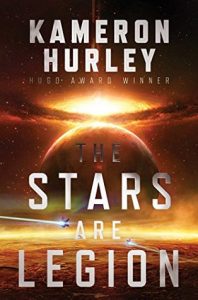
The Stars are Legion by Kameron Hurley
 When you understand what the world is, you have two choices: Become a part of that world and perpetuate that system forever and ever, unto the next generation. Or fight it, and break it, and build something new.
The former is safer, and easier. The latter is scarier, because who is to say what you build will be any better?
But living in servitude is not living. Slavery ensures one’s existence, but there is no future in it.
Zan and I believed in the future.
Kameron Hurley’s The Stars Are Legion (2017) is an ambitious and exciting space opera, at once a blistering subversion of space opera’s hyper masculine clichés and a celebration of everything that makes the genre such mind-popping ludicrous fun. Set on board a fleet of decaying, world-sized living generation ships at the edge of the galaxy and featuring an entirely female cast, the novel’s thrillingly original setting and premise inform its explicitly feminist outlook. The Stars Are Legion is a celebration of the sheer range of possible roles for women in this story and this society, and an attempt to create a feminine alternative to the patriarchal assumptions that run through Joseph Campbell’s monomyth as imagined in Hero with a Thousand Faces (1949). It’s a passionate howl of rage against the injustices of our society, a book that rails against the self-perpetuating power structures and offers hope for a future in which we can do better. And, not least, it’s a pulpy action adventure story packed with space battles, gore and excitement.
The Stars Are Legion opens with its protagonist Zan waking up with no memory on board Katazyrna, a generation ship which is part of the Legion, a fleet of such ships stranded at the edge of the galaxy. The Katazyrnas tell Zan that they are her family, and that she is the only one who can capture the Mokshi, the only ship with the power to leave the Legion. However the Katazyrnas’ bitter rivals, the Bhavajas, also desperately want control of the Mokshi. When an arranged marriage to broker peace goes awry, the Katazyrna is seized, Zan’s lover Jayd is held hostage and Zan is thrown to the recycler monster at the heart of the ship. If she wants to save Jayd and end the bloodshed, Zan and her gang of motley survivors must go on a perilous journey through the myriad layers of the ship to reach the surface before it’s too late.
With its entirely female cast, The Stars Are Legion is a riposte to all the casually sexist SF and space opera books that either blithely ignore the existence of women entirely or relegate them to love interests or traditionally feminine roles, while men get to have all the excitement and adventure. Focusing entirely on women allows the novel to make an important rhetorical point. The Stars Are Legion explores pregnancy and child bearing as one role for women; it also features women warriors, fighter pilots and engineers. Hurley shows women can do all of these jobs, regardless of whether they are deemed traditionally ‘masculine’ or ‘feminine’ jobs, and indeed in the society she depicts there is no such distinction.
Equally important is the portrayal of women in a variety of narrative roles. Jayd is captured by someone more powerful than her like a traditional damsel in distress; her story arc explores how through cunning and manipulation she is able to exert her will in a situation in which she has limited agency. However the protagonist battling monsters to save her is also a woman, as are the engineers, warriors and outsiders she encounters on her journey. Hurley deftly shows how women can not only perform any role in society but also in the narrative, showing up the lack of imagination in writers unable to find a variety of roles for women in their SF stories.
This puts The Stars Are Legion in dialogue with Ann Leckie’s Imperial Radch trilogy (2013 – 2015), another passionately feminist space opera. However whereas in Leckie’s books, the Radch don’t discriminate between gender but use ‘she’ as the default pronoun, allowing Leckie to explore ambiguity towards gender and the cultural assumptions that come wrapped up in it, Hurley’s entirely female cast allows her to emphatically make her statement of female empowerment. Both writers force readers to confront prejudices about traditional values assigned to gender and the assumptions behind what writers and readers consider ‘default’.
The subversion of masculine expectations in The Stars Are Legion goes further than this, however. The novel is also in dialogue with decades of masculine space opera, much of which is built on or takes its cues from Joseph Campbell’s attempt to create a universal monomyth, Hero with a Thousand Faces. Campbell identified what he saw as recurring motifs throughout myths and popular culture, the structure of the Hero’s Journey being most triumphantly demonstrated by the original Star Wars (1977). Campbell’s universal mythic arc focuses on a male protagonist, who rises from obscurity to answer a call to adventure in a magical realm, which builds up to an epic confrontation, from which the hero returns victorious. With its focus on the desires and fantasies of male characters, and its slow build up to a powerful climax, it’s not difficult to see the Hero’s Journey as a Freudian celebration of male generative power. Space opera frequently compounds this with its fixation on phallic imagery, from ray guns to laser swords to rocket ships.
The Stars Are Legion sees Hurley developing a feminine mythic alternative to the Hero’s Journey, both in terms of structure and imagery. Rather than outwards, the object of Zan’s quest for identity is internal, her lost memories. Her journey up through the concentric layers of the Katazyrna sees her overcoming various obstacles and so appears as a linear build up, but is actually a series of circles as she progresses to the next layer; indeed the signs and hints that her previous self has left behind for her show that this is not even the first time she has been through this loop. Rather than culminating in an external confrontation, Zan ultimately breaks the cycle of violence and oppression by deciding an internal struggle about the kind of woman she wants to be. This is reflected on a thematic level by the replacement of phallic imagery with yonic imagery. Rather than the traditional rocket shapes, the ships of the Legion are shaped like giant ova, with tentacles to capture objects from outside. Zan’s journey through the bowels of the Katazyrna sees her travelling through fleshy caverns and subterranean rivers, underground marshes and forests.
This is further reflected in how all the technology in the book, from the spaceships to the cephalopod guns, is organic. Biotechnology takes the stereotypically sterile male tech fetishism of much SF and brings it back to the messy, organic realm of female generative power. The women in The Stars Are Legion don’t just reproduce by parthenogenesis, they reproduce spare parts for the organic ships, and in special instances, the ships themselves. The novel explores an ambiguity towards pregnancy. On one hand, it is this enormous life-sustaining physical power, an atavistic emblem of matriarchal authority; Rasida Bhavaja can literally birth entire worlds. However, Hurley also explores it as a source of body horror, one’s own body being hijacked to feed and sustain a parasitic life form. A particularly memorable sequence sees Arankadash, a warrior woman who accompanies Zan on her journey, give birth to and lovingly nurture a pulsating organic cog until it is taken by the ship.
The Stars Are Legion is a thoroughly angry book. It portrays a society literally stratified, with people living on different layers of the Katazyrna looking down on those below them or utterly unaware of their existence. The Katazyrna family, playing its game of politics on the surface layer, have no idea that they are putting the lives of a wealth of diverse civilisations at risk through their actions. Arankadash’s people regard people from lower levels as mutants who must be killed on sight. Everywhere ordinary people suffer as foolish, headstrong leaders make rash and ill-informed decisions. However, it is also a book that believes passionately that there is a better way; that cycles of oppression and violence can be broken. Zan and her friends are ultimately able to choose to build a better world, to escape the death and decay that plague the Legion, but only by choosing to change themselves.
