
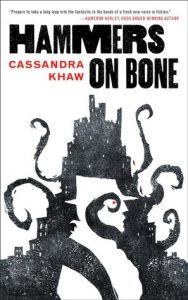
Hammers on Bone by Cassandra Khaw
 “Please. You’re the only one who can help.”
“What makes you say that?”
“Because you’re a monster too.”
Cassandra Khaw’s Hammers On Bone (2016) is a wonderfully inventive mix of Lovecraftian cosmic horror and hardboiled noir. These two genres are not the most obvious of bedfellows, but they do have more in common than at first appears. Both are highly stylised literary forms that were born in the pulps, but have endured as popular forms of literature, film and TV. Cosmic horror and noir are particular in that they have a specific philosophy or world view that is integral to how they work as a genre. Cosmic horror is all about the insignificance of humanity in the face of the vastness of the universe; whilst noir immerses itself in the language and feel of the streets, and asks if it’s possible for humanity to have any kind of workable moral code in an inherently amoral world. More problematically, both cosmic horror and noir have a history of racism and misogyny, from the work of genre pioneers H. P. Lovecraft and Raymond Chandler and onwards.
Part of what makes Hammers On Bone so incredible is the way Khaw subverts the narrative patterns and tropes of these historically white, masculine genres to explore perspectives usually excluded from the genre – that of survivors of domestic abuse in multicultural working class London. The novella manages to successfully combine the flavours of these two different genres into a story that is both uplifting and genuinely frightening, the tools of pulp fiction repurposed to examine human endurability in the face of malevolence.
Hammers On Bone tells the story of John Persons, a private investigator and seasoned monster hunter who is hired by a ten-year-old kid to kill his abusive stepdad, McKinsey. As Persons investigates, he discovers that McKinsey, as well as being abusive and unpleasant, is also harbouring a horrific alien infection which he is spreading throughout London. Fortunately, Persons himself is an ancient monstrous being from beyond time and space, exactly the right kind of monster to set against a monster.
Persons is an imaginative take on the standard noir anti-hero detective, an archetype we can trace from Dashiell Hammett’s Sam Shade in The Maltese Falcon (1930) through to Rorschach from Alan Moore and David Gibbons’ Watchmen (1987). This character is a broken man, trying to live by his own code in an inhumane world and desperately hold on to his own humanity, even as he feels alienated and detached from the rest of the human race. Khaw cleverly externalises these aspects of Persons’ character by making him an Eldtrich Abomination living inside a human body. Only by maintaining his human shape can Persons carry out his job of protecting a human world he can only exist on the fringes of; he is constantly in danger of unleashing his true form and losing his humanity altogether.
In this way, the dilemma of the noir detective – should he take justice into his own hands, or does fighting the criminals in their own way only serve to make him into the very thing he is fighting? – becomes an existential, cosmic horror dilemma. It also serves to underscore the dehumanising effects of violence. Persons can only fight McKinsey by tapping into the side of him that is utterly inhuman – this is the only arena in which these two powerful beings can confront each other. Committing violence will literally cause Persons to cease to be human.
Both cosmic horror and hardboiled noir share the exploration of the removal of agency. In the cosmic horror story, nothing humanity can possibly do matters, because they are faced with such vast and uncaring threats. Human action shrinks into insignificance in the face of the unforgiving vastness of the universe. In noir, the protagonist’s agency is limited by the society he finds himself living in; there’s always a cop, government minister or other authority figure willing to take a bribe to look the other way. The system itself is corrupt, so any form of moral agency on behalf of the detective protagonist or the victims he is working for is removed.
Persons, as an alien entity with incredible powers, looks like the kind of character who would have agency, however the further he gets into the case, the more he realises he’s being manipulated by forces outside his control. Removing the victim’s agency and sense of personal control is also one of the ways in which domestic abusers exert their power over their victims. One of the most powerful moments in the novella occurs when we realise that Abel and James, McKinsey’s stepchildren, have taken back their own agency by manipulating McKinsey and Persons into a confrontation. Hammers On Bone ultimately becomes the story of victims of abuse fighting back against their abuser, and the result is intense and cathartic.
The corruption spread by McKinsey acts as a metaphor for how the aftershocks of acts of abuse spread throughout society like ripples. Persons interrogates the foreman at the factory where McKinsey works. The foreman is being consumed by a ghastly body horror corruption that sprouts eyes and mouths all over his neck. However, just as repulsive is his attitude towards McKinsey; the foreman clearly knows that the man is an abusive monster and has a fair idea of what’s happening in the man’s house, but rather than condemning him or helping Persons to protect McKinsey’s vulnerable wife and stepchildren, the foreman shrugs it off, saying that he’s seen far worse than McKinsey.
Khaw examines how complicity in keeping quiet about abuse allows victims to be kept in danger, how society conspires to perpetuate abuse. In this scenario, she deftly conflates the moral repugnance the noir detective experiences when he exposes the seedy underbelly of the society he lives in with the visceral fear of alien infection so beloved of cosmic horror. Similarly, when Persons tries to interrogate Sasha, the woman who works at the Caribbean restaurant, to find more information about McKinsey, he uses his psychic powers to enter into her mind and extract her experiences. Sasha calls him out for this, pointing it out as the act of violation that it is. Persons’ toxic masculine entitlement, which in a traditional noir narrative might manifest as him physically taking advantage of a female victim, is externalised as part of his set of powers as an alien monster, something that he can use as a tool to express his own agency at the expense of others. The conversation with Sasha makes him realise that part of retaining his humanity will involve having enough empathy to respect other people’s humanity.
Hammers On Bone is a richly imagined and vividly drawn story. It is set in a diverse, multicultural, working class London, showing people from a range of different backgrounds living together in a vibrant city. Its characters, from Persons, who is dark skinned in his human form, to Sasha and the staff of the Caribbean restaurant, to the women and children, are the kind of people who would frequently be overlooked or portrayed as stereotypes in works by Lovecraft or Chandler; here they are characters with their own stories and rich interior lives.
Khaw manages to invoke the disparate narrative tone of both noir and cosmic horror, whilst maintaining her own voice throughout, no easy task. The novella is seeped in the twilight atmosphere of the meaner streets of London, yet it is also suffused with a palpable sense of cosmic dread. Khaw has a vivid imagination, and her take on Eldritch Abominations and body horror are stomach-churningly lurid and a whole bunch of fun. She manages to get the patter of noir, the particular ebb and flow of the inner monologue of a 1930’s private dick, just right, and her use of the extended Lovecraft Mythos shows that she has an excellent command of how cosmic horror works.
However, she handles the subjects of domestic abuse with care and consideration – the most horrifying passage of the book is simply Persons looking in the window of McKinsey’s house and sadly watching the progression of a normal night for the household. This section is well-observed and sensitively written, Khaw’s empathy for the victims and her understanding of the way trauma shapes people’s lives evident. It is this part of the story that shows us exactly what Khaw is doing; by using the tropes of genre fiction to distort the world around these acts of abuse, she is able to show abuse to us through a fresh perspective, to emphasise how something that becomes mundane and accepted is in reality utterly horrific and abominable. Compared even to vast, unknowable and malevolent cosmic entities, this simple act of human violence and transgression is the most inhuman, repulsive and frightening thing in the book.
This review appeared on Fantasy-Faction on December 13, 2016.
