
Kojiki by Keith Yatsuhashi
 “Power is more than strength. It’s the ability to save or destroy.”
Keith Yatsuhashi’s debut novel Kojiki (2016) is a wide-screen epic fantasy, a coming of age story that draws as much from Myazaki’s Studio Ghibli films as it does from Tolkien or American Gods (2001). Drawing heavily from Japanese mythology, in particular the Kojiki, the 8th century text containing the Japanese creation myth, Yatsuhashi creates a fun, action-packed narrative about an ancient struggle between the Kami, elemental spirits, and Keiko, the girl who is pulled into their battle after the death of her father and doesn’t realise her importance to the story. Kojiki is chock full of inventive set-pieces and exciting battles, yet it never loses sight of its characters. In particular, Yatsuhashi’s villains are well developed and sympathetic, and he is not afraid of writing his heroic characters with tragic flaws.
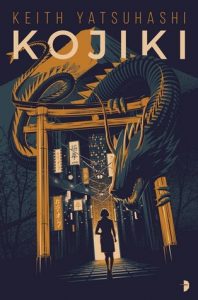
The book tells the story of Keiko Yamada, who finds herself in Tokyo after her father dies suddenly leaving her only a one-way ticket to Japan, a suicide note and instructions to find the Gate with his camera. At a torii gate, she accidentally steps between worlds, where she sees Vissyus, the fire Kami, who is about to escape from his thousands of years of imprisonment. As Vissyus’ Guardian, the powerful dragon Fiyorok, wreaks havoc on Tokyo, Keiko escapes with her guide, Yui Akiko, into the castle White Spirit. There she meets the other Kami, who have been preparing for Vissyus’ return since his imprisonment. The deranged fire Kami nearly destroyed the world last time; now, the other Kami must find a way to stop him for good. Meanwhile, Keiko discovers that, through her father, she has a stronger connection to Yui and the world of the Kami than she realised, and that she may have an important part to play in the upcoming struggle.
A lot of what makes Kojiki striking is the way it draws on Japanese mythology and culture. In the novel, the myths laid down in the Kojiki, describing the creation of Japan and the birth of the Kami, are a metaphor passed down through the ages to preserve the real story of what happened. Both stories feature gods unable to conceive a child and the fire god bringing death and destruction. In Yatsuhashi’s book, Aeryk, Kami of the Air, and Seirin, Kami of the Water, fall in love and want a child. However, they are forbidden by Takeshi, on the grounds that the mixing of powers in the child’s body could be catastrophic. Desperate, she enlists the help of Vissyus, their close friend, who enjoys experimenting and has always been frustrated with Takeshi’s rules. However Vissyus’ experiments drive him insane, and with his madness his powers become unleashed on the world, splitting the continents and creating Japan. Together, the other Kami succeed in exiling Vissyus to another world, where he is trapped by the Boundary, at the expense of trapping Seirin and many of the other Kami as well.
Yatsuhashi’s playful use of the Japanese creation myth is fresh and exciting in a fantasy context. He has a lot of fun exploring all the Kami’s different elemental powers and how they use them. This naturally leads to some thoroughly imaginative fight scenes, Seirin taking on Lon-Shan, Kami of Shadows, being a particular highlight. Yatsuhashi is not afraid to mix elements of science into his magic system, the Kami having an affinity for manipulating the molecules of their element, for instance. Each Kami also has a Guardian, a lesser spirit that acts as their counsellor and assistant, and takes the form of monstrous animals, from sea serpents to dragons to stone giants. Much of the action is set in Japan, especially in Tokyo, or in Takeshi’s magical White Spirit Castle. All this helps to give Kojiki its unique flavour.
As well as drawing on Japanese mythology, Kojiki also draws on Japanese popular culture. Yatsuhashi is an admitted fan of the original Godzilla films, which is apparent in the lovingly described scenes of cities being torn apart by Guardians run amok. Yatsuhashi’s love for anime also shines through the book. The book is peppered with references and shout outs to Spirited Away, Princess Mononoke and Myazaki’s other films, as well as fantasy adventure anime series such as CLAMP’s Magic Knight Rayearth. Indeed, with its sympathetically developed antagonists, its naïve yet precocious protagonist, and its flashbacks to furnish its characters with depth and backstory, the book takes much of its structure and scaffolding from anime tradition as much as epic fantasy.
Kojiki’s merging of the different storytelling traditions of Western epic fantasy and Japanese mythology and pop culture is perhaps most interestingly demonstrated in the way Yatsuhashi portrays his villains. Both Vissyus and Lon-Shan’s powers, fire and darkness, lend themselves to villainous alignment. They are the kind of powers you would expect a Dark Lord to wield. Lon-Shan’s castle, hidden in perpetual shadow, grimy and mouldy, populated by his paranoid and treacherous henchmen, is a typical villain’s lair. In contrast, Seirin and Aeryk’s powers are more traditionally heroic, water and air being more nurturing than destructive, and both of them live in gorgeous, ornate, airy castles. Because of the way the story is set up we go into it with expectations about who the heroes and villains are. However, Yatsuhashi plays with our preconceptions, revealing that although his characters are effectively gods, his heroes are much less pure than we might think, and his villains come from places of good intentions.
Vissyus is driven mad trying to achieve Seirin and Aeryk’s dream. His reckless experiments are driven by his desire to make his friends happy. In trying to create life, his hubris brings about destruction, but unlike most characters in that position he is acting for his friends rather than selfishly. Vissyus is the book’s most complex character, and his fall is vividly and movingly conveyed, in perhaps the book’s most powerful sequence. Madness can be a difficult thing to portray sensitively and effectively, yet Yatsuhashi’s portrayal of a once great man losing pieces of himself is both powerful and moving, and makes the destruction that he unleashes all the more tragic.
Lon-Shan is one of Vissyus’ closest friends; as a less important Kami he feels ignored and patronised by all the others, apart from Vissyus who treats him as a friend and equal. Lon-Shan’s slide into hatred and evil is driven by his feelings of betrayal – he alone believes that Vissyus can still be saved, but the others opted for punishing and imprisoning him. These tragedies deepen our understanding of the novel’s villains, whilst our understanding of the story’s heroes gives them more depth, and adds an element of redemption to their struggle against Vissyus, as they are coming to terms with their roles in causing all this destruction.
However for all the resonance of its other characters, the book’s heart and soul belong to Keiko. Keiko and Yui have a strong student-mentor relationship, and their friendship develops over the course of the book. As Keiko discovers more about herself and her powers, she proves herself more and more of an asset to Yui. However, whilst Yui is a strong fighter, Keiko never develops in that direction. She learns that she can achieve just as much with reason and kindness instead, becoming the conscience to the rash, impulsive Yui. Although her family is Japanese, Keiko has spent her entire life in America until her father’s death forces her to travel to Japan. She is thrown into a world she does not understand, but she gradually learns the truth about her father and the incredible powers that she will inherit.
In many ways, Kojiki is a metaphor for discovering your heritage and engaging with your roots, especially as a second-generation immigrant. Rooting the novel in Keiko’s real world, relatable struggles gives the story depth and helps anchor its wonderful flights of fancy.
