
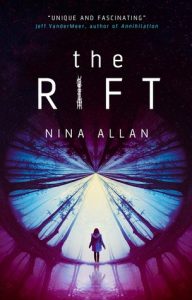
The Rift by Nina Allan
 “Remember when we were small, Selena, the worlds we made? I was happy then, at home in the world in a way I’ve never been since. Perhaps it was my dis-ease with the world that lost me my place in it.”
“No book is completely true or completely a lie. A famous philosopher at the Lyceum once said that the written word has closer relationship to memory than with the literal truth, that all truths are questionable, even the larger ones.”
Over the course of four short story collections, a handful of novellas and her debut novel The Race (2014), Nina Allan has established herself as one of the finest writers in the field, her writing combining exquisite prose and an inventive approach to genre. The Race used its bold fractured narrative structure to ask questions about perception and our relationship to reality.
Allan’s second novel, The Rift (2017), is somehow an even more accomplished exploration of the themes of perception, memory and identity that have haunted her work. Allan’s work has always straddled the literary and the genre worlds, for the betterment of both. The Rift demonstrates how the tools and tropes of genre fiction can be used to give literary fiction a more vital, immediate and relevant focus, and how the quality of prose and depth of characters from literary fiction can be used to make genre fiction even more strange and unsettling.
The Rift tells the story of Selena Rouane, whose sister Julie disappeared when she was seventeen. The police were never able to find anything, and she was declared a missing person. Selena grew up witnessing the disintegration of her family around this traumatic event. Now, twenty years later, a woman turns up claiming to be Julie, saying that she has spent the intervening time on the planet of Tristane, in the Sour System of the Aww Galaxy. Is Julie who she says she is? What really happened to her? Selena has to decide how much of her sister’s story she is able to believe.
The trope of a person being abducted by aliens, or spirited away by fairies, is familiar in both science fiction and fantasy. Part of what makes The Rift special is the sheer range of emotions and ideas Allan rings from the subject. The novel is split between the narrative voices of the two sisters. Selena’s story, as the sister who is left behind, is grounded in realistic and nuanced emotion. Bringing the same raw emotional honesty and empathy displayed in her exploration of caring for a parent with dementia in her novelette “The Art of Space Travel” (2016), Allan movingly and unflinchingly portrays the Rouane family’s collapse following Julie’s disappearance.
Grief affects us all differently. A series of flashbacks show us how the sisters’ mother and father react to the disappearance of their daughter, the trauma developing into an irreconcilable rift between them. Allan’s portrayal of their father’s decline in physical and mental health is both wise and sad, a profound and moving exploration of loss. The book also explores Selena’s survivor’s guilt; her life has been profoundly shaped by the loss of Julie, and by the loss of safety and security her disappearance represents. Hers is a life of quietly getting by, avoiding the opportunities for love or adventure she might otherwise have been tempted to try. This is subtly shown through Selena’s interaction with the world around her.
Julie’s story of alien abduction and her other life on Tristane is more obviously science fictional. The interesting thing is how this does, or doesn’t, link up to the more straightforwardly realistic parts of the book. One of the suspects in Julie’s case was Steven Jimson, a convicted murderer and rapist. In Julie’s story, she escapes from Jimson and then passes out and wakes up on Tristane as the result of falling through a rift in space-time. However she tells the story in reverse, beginning with her life on Tristane and circling back to the trauma of her abduction by Jimson. Is her story about life on another planet a delusion she has created to cope with the trauma of her abduction?
Julie certainly seems to believe entirely in Tristane and her life there. Also, her description of Tristane is incredibly detailed. It is a planet with a fully realised geography and history, with different climate zones and economically competing city states. Rather than a simple two dimensional dream world, Allan has created a believable and compelling alien world for Julie to be spirited away to.
Cally and Noah, the brother and sister couple that Julie stays with in Tristane, are well developed and believable characters. They know Julie from her life on Tristane before; they are convinced that she has always lived and belonged there with them. Julie is caught between the life she finds herself in and the memories of the person she thinks she is. Whether on Tristane, unable to square her memories of Selena and the Rouanes with the world apparent before her, or back on earth with memories of a world no one else will believe in, she is unable to align who she thinks she is with who she is meant to be.
It is this sense of doubt and uncertainty that Allan explores with aplomb. There are echoes of the shifting realities and perspectives of The Race, but in a much more subtle and insidious way. As Selena points out, why do the aliens in Julie’s story look human and speak English? Julie pretended to like Marillion whilst in Steven Jimson’s van, is this the source of Cally’s name, pronounced ‘Kayleigh’, and the planet’s only ocean, Marrillienseet? Why does Julie recognise Cally from walking past her on the street on the way back from her teacher’s house? How did Julie come into possession of the pendant which genuinely appears to be made on another planet if she was never on Tristane? Whether or not Tristane is a mere reflection of our own world conjured up as a safety mechanism by Julie for the trauma she’s experienced on Earth, or vice versa, becomes increasingly complicated to unpick. The book is full of references that help reframe or shift the argument.
Julie’s school essays from before her disappearance reveal a fascination with disappearances and assumed identities. She writes about Peter Weir’s film of Picnic at Hanging Rock (1975), about the one girl who returns from a group of vanished schoolgirls with no memory of what happened to her or her friends, and Franziska Czenstkowaska, a Prussian peasant girl who claimed to be Anastasia, the daughter of Tsar Nicholas rescued from execution by loyal soldiers. After establishing them as a metaphor for hidden secrets, climactic scenes in the book intersperse zoological notes on catfish of Earth with equally realistic sounding notes on catfish of Tristane.
Allan names Julie’s section of the novel after A Voyage to Arcturus (1920) by David Lindsay, an early fantasy novel that sends its protagonist on a psychic journey to a distant planet which reveals to him the true nature of the universe through a series of richly symbolic encounters. In the end, Allan is more interested in what the spaces between the different unresolved possibilities can tell us than any closure that might be gained from a pat ending.
On Tristane, The Mind-Robbers of Pakwa by Linus Quinn is considered either a factual account of the final shuttle to return from its sister planet Dea or a work of science fiction. In it he describes his friends being devoured from within by a giant isopod parasite called the creef. This strikes me as being a deeply pertinent metaphor in Allan’s exploration of identity and memory. Infection with the creef causes madness and eventual death, as the adult isopod emerges from your empty husk. Identity and personality are malleable and impermanent; none of us are the same person that we were five years ago. Our consciousness provides us with the illusion of continuity, but for better and worse, more or less convincingly, it remains an illusion. Memories are the link we form with previous versions of ourselves, yet memories can be forgotten, distorted and altered, and the most powerful tool we have for doing this is the stories we tell about ourselves.
Is Julie the same person as the girl who disappeared twenty years ago? The only answer that makes sense in the end is perhaps is: as much as Selena is the same girl whose sister went missing twenty years ago.
This review appeared on Fantasy-Faction on July 19, 2017.
