
The Thousand Names by Django Wexler
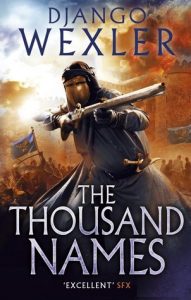 The first thing I noticed about The Thousand Names – after the distinctive cover – was the map. Now, it’s a fairly simple map, but I looked it and I thought, “that’s Egypt. It’s even got a River Nile.” OK, the country is called Khandar and the river is the Tsel – but that first impression stuck, and events in the story did vindicate my initial impression.
I like history. I think history has a lot to teach us in politics and society – mistakes we should try to avoid repeating, that kind of thing. But I also think history has a lot to teach us as writers and readers of fantasy. The subject is a veritable goldmine of inspiration for any writer, as readers of George R.R. Martin’s work quickly realise.
The Thousand Names is another book where, alongside the fantastic story, there are historical allusions aplenty to find and enjoy.
The story starts in the colony of Khandar, where rebellion is afoot. The forces of the old colonial power and their local puppet ruler have been forced to flee the capital by an uprising of unlikely allies: desert nomads, local army auxiliaries, and a band of religious zealots. In that sense, Wexler’s story seems to draw on The Indian Mutiny, the Boxer Rebellion and the travails of the French Foreign Legion as depicted in Beau Geste. The prevalence of cannon and musketry puts this in the flintlock fantasy subcategory, but – it being fantasy – there are other powers at work.
Wexler’s story initially appears to be various soldiers’ experiences of a campaign of impossible reconquest. However, the subjugation of a rebellion is really only a cover for much larger agendas.
We see events play out through a variety of combatants’ and non-combatants’ points of view. Captain Marcus d’Ivoire – the officer with the most local experience – plays something of the Dr Watson to his sharply intellectual and theoretically-minded new Colonel. Janus bet Vhalnich Mieran is a captivating mix of stern commander and boyish enthusiasm for the new. Within the ranks, Private Winter has more reasons than most to want privacy – it is no great spoiler to reveal that the private is a woman masquerading as a man in a rather cruel man’s world. To that extent, there are a few shades of Disney’s Mulan – or even Terry Pratchett’s Monstrous Regiment – in The Thousand Names. However, Wexler resists the temptation to make much by way of comedy out of this situation. Winter’s plight is well handled, and her dilemmas and her backstory enticingly teased out – which may be why she is my favourite character.
We also get glimpses from those within the enemy camp; both sides have their own internal divisions and challenges to deal with, so – in the best tradition of military campaigns – nothing is either simple, or quite as it seems.
Wexler delights in showing us a number of set piece battles, and has an eagerness to convey not just the tactical and strategic problems, but the front-line desperation of people trying to hold their own in the face of insurmountable odds. For most of these encounters, magic takes a back seat to acrid gunpowder and cold steel as the colonials form up in defensive squares and circles reminiscent of Waterloo – or Rourke’s Drift in the film Zulu. The battles are exciting to read, but bloody and wearying affairs for those caught up in them.
If I were to quibble with the story, there are perhaps two points of contention – the first, that it seemed silly (to me) for anyone to have dug a canal and yet left a point where it could be forded by men getting little more than their feet wet. Such a point would make the waterway impassable to shipping – surely defeating its object? The second is that, while Wexler’s tale has its twists and turns, some of them were not quite sharp enough for my taste. That is to say, I ended up overthinking which way the story would turn.
The final denouement takes us from the serried ranks of the battlefield to a gripping subterranean climax, where characters of whom we have grown quite fond must wrestle for survival against superhuman foes.
I did enjoy The Thousand Names enormously, though, and at the end I understood Wexler’s tendency to treat his corporals with such fondness and respect. You see, much of the book – and indeed the series – is an homage to that original “little corporal”: Napoleon Bonaparte himself. The French general’s launch pad to fame and fortune involved an invasion of Egypt, a battle by the pyramids, followed by an opportune political crisis back home that would catapult him into power. I am curious to see what other echoes of Napoleon’s career might be revealed in future books in the series – a reprise of the March on Moscow? Or a different kind of Waterloo?
All of which serves as a reminder of what rich veins of inspiration can be mined from the depths of history. It is not just a matter of the Yorks and Lancasters from The Wars of the Roses being transformed into the Starks and Lannisters of A Song of Ice and Fire. Like the Vikings of old and their raiding of monasteries, fantasy authors could always profit by raiding the history books… though perhaps with less bloodshed than the Vikings!

I personally like empowering books! Maybe fantasy belongs in the past and real life magic can be hoped for and achieved in a different choice of litterateur?