The Tower of Living and Dying by Anna Smith Spark
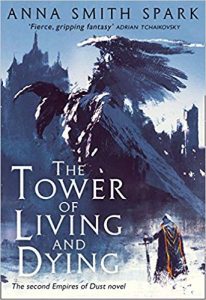 With The Court of Broken Knives, Anna Smith Spark made a glorious and inventive debut. The courses of some very diverse lives converged on the bronze walls of Sorlost, behind which an ancient city empire decayed into political intrigue and decadence. With shades of Rome, Byzantium, Carthage and Troy, Sorlost provided the glittering stage on which Smith Spark introduced her characters.
By the end of the first book those characters had – in political and geographic terms – travelled a long way from their starting points. The Tower of Living and Dying picks up immediately in the aftermath of its predecessor’s climactic final battle.
Smith Spark’s second book adheres more closely to convention. We have two parallel plot lines: that of Marith, aiming to follow in the footsteps of his ancestor Amrath the world conqueror of Urlast, and that of Orhan, striving to bring pragmatism though not exactly morality to the emperor’s rule in dangerous strife-riven Sorlost. The two stories proceed in parallel but almost independently. The loose medium of rumours from one connects with and disrupts the course of events in the other – like a pair of stars exerting a gentle pressure on each other through the strength of their respective stellar winds.
Marith’s story is the brighter star, Orhan’s tale its fainter companion gravitationally locked to its partner. But each story strand has its own satellite subplots: Tobias, the curmudgeonly sellsword bobbing in Marith’s wake; Nilesh, servant to Orhan’s wife Bilale, a below-stairs witness to the glamour and grandeur of Orhan’s grandiose risk-taking.
Many people seek to control Marith; they think they have the measure of him, and yet all too often find their ambition ruined on the rocks of his caprice. He is in many ways a monstrous antagonist – similar to Mark Lawrence’s Jorg in his amorality – not so much choosing wrong from right as being indifferent to any distinction between the two, the loyalty of his followers more a tool to be used than a prize to be treasured, reinforced, preserved.
Which does at times make the reader wonder why so many follow him. Smith Spark conveys a sense of his charisma, and Marith’s odyssey echoes many tales from antiquity. I found echoes of Alexander the Great – the first historical “world conqueror” – haunting Marith’s battles, which Smith Spark describes so vividly at both a personal and strategic level. Just as Alexander’s energy confronted enormous odds in a campaign to snuff out a variety of decayed empires, so too Marith confronts a series of adversaries in battles of increasing desperation.
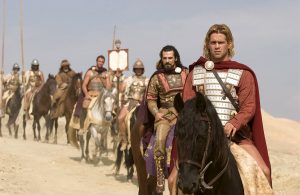
Colin Farrell as Alexander the Great (Alexander, 2004)
Another historical analogue, as Thalia follows Marith through vagaries of terrain and conflict, is of Anthony and Cleopatra – two great lovers weaving a thread through history and leaving the observer constantly unsure as to who has the upper hand in an affair that shatters continents. I was also reminded of “Apocalpytic Montessa and Nuclear Lulu” by Mercedes M Yardley, which depicts another pairing of strangely empowered individuals (albeit in the very different context of contemporary America): a serial-killing truck driver and the nightclub dancer he inadvertently rescues, drawn into a self-fuelling vortex of violence. And perhaps there is something of Bonnie and Clyde in Thalia and Marith’s spree of warfare, too.
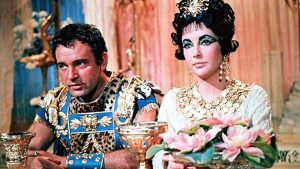
Richard Burton and Elizabeth Taylor as Antony and Cleopatra (1963)
While Thalia is more passive and at times more compassionate, one wonders at the end if she is not the more dangerous of the two. In following Marith, however, the reader experiences a delicious uncertainty – a fear, almost – of what he will do next. Around him no one and nothing is ever safe.
Marith’s motivation is hard to discern – he strives for a place in history. He shares Alexander the Great’s streak of hedonistic decadence – but while Alexander the Great built, Marith’s talent is for destruction. Sometimes his generalship resembles General Haig sending cannon fodder over the top from the First World War trenches, at other times he is a charismatic champion to rival Lancelot or King Arthur, with an edge to his sword that none can defy. It is an intoxicating mix.
Two years ago, on a panel at BristolCon, the author spoke of the “eroticisation of violence” – a phrase that stuck more strongly in my memory than the original question did. In The Tower of Living and Dying bloody acts are boldly but baldly described, and the focus instead is on minds that rejoice in the violence. At times the carnage seems more important, more precious than which person – friend or foe – it is inflicted on.
There is humour too, from Tobias and Orhan more so perhaps than Marith. A world-weary perspective that punctures the grandest of endeavours with “an old sell sword’s tip” or a politician’s self-deprecation. All this conveyed in elegant prose that sweeps the reader along, sometimes breathless, always readable – painting pictures with the rich depth of oils more than the subtlety of watercolour.
In Sorlost the end of a period of splendid isolation draws ever closer, the city suddenly vulnerable to enemies more mundane than swords, more pervasive than politics. Smith Spark portrays the fetid claustrophobia of a desert city, its populace in thrall to class and religion and the myth of an immortal emperor. Orhan presents a sharp contrast to Marith: more human, more compassionate, weighed down by duty and guilt, always striving to do the right thing in a world that is fundamentally wrong.

The ancient Moroccan city of Aït-ben-Haddou
Both Orhan and Marith play for the highest stakes, each making the most of their very different talents. It is almost a clash of mottos: Who Dares Wins versus Nothing Without Effort. Or perhaps it is the contrast of the human and the other-than-human. Orhan is most definitely a man cumbered by responsibility, human desire and physical limits. While Marith meets with triumph and disaster and treats those two imposters both the same, it appears he is more than a man (my son). King Ruin his followers call him, and yet still they follow.
 Second books can be a challenge, the middle child in a trilogy. Sometimes nothing much fundamental happens beyond a journey to put the characters where they need to be for the denouement volume – like a period of positional play in snooker before the frantic pot-fest of a big closing break. As such, second books have been known to disappoint (mentioning no wise men).
While Marith and Thalia’s thread in this second book is certainly a journey, it is an entertaining and illuminating one, revealing more of who they are and what they face. I found The Tower of Living and Dying an even more satisfying read than The Court of Broken Knives. The tangled threads of the first book have resolved themselves. The reader can relax and enjoy the ride, drawn – moth-like – to Marith’s incandescent aura.