
The Raven Tower by Ann Leckie (Book Review)
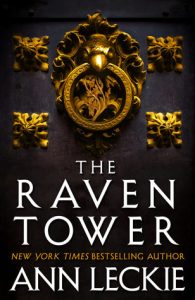 Warning: this review may contain spoilers!
What do you say about a book like The Raven Tower? It comes with a lot of hype, the first fantasy novel from award-winning author Ann Leckie, whose Hugo- and Nebula-winning debut pushed science fiction across new boundaries. What would she do with fantasy?
Well, it turns out, much the same thing. Which is great.
Fantasy can be quite a conservative genre. Whether that means clinging on to some ideologies that are a bit passé (from obvious things like hereditary monarchy to more insidious assumptions, like the implicit racism of fantasy “races”), or just embracing same tropes year after year, I think it’s fair to say that fantasy is a boat that is generally content not to be rocked. That’s not to say there isn’t a long history of boat-rocking books and authors out there, it’s just that they are often shuffled to the sidelines, or the “literary” fringes.
This book should certainly make a big enough splash (what’s with the water metaphors?) – both because of who wrote it and because of how it’s written – but it’s certainly not a mainstream fantasy. And that’s no bad thing, for me, nor what we should have expected. I think all that sort of expectation is a lot to live up to, so keeping that in mind, I think it largely succeeds.
And, apart from trying to critique it too much (and it’s the sort of book that invites critique), I will say that I definitely enjoyed it. Sometimes this sort of book makes a lasting impression, but while you are glad you read it you don’t necessarily feel you’ve “enjoyed” it, and yet, I could hardly put it down.
So, what sort of book is it? Well, the story itself is fairly simple, even familiar, in outline. The priest-king of Iraden is missing, his brother sits on the bench (throne), and his son and heir, Mawat, returns to the Tower (with his trusty right-hand man, Eolo) to figure out what’s gone wrong. There are complications involving foreign dignitaries, local politicians, and enemies on the border, but so far, so familiar.
However, this is a book about gods as well as people – much more literally than many fantasy books are. Many may posit that gods are real, and plentiful, but Leckie really takes that and runs with it in, as you might expect, a science-fictional way. In fact, much like her non-human narrator in the Ancillary books, the narrator here is in fact a god (very slight spoiler). This gives the author a neat excuse to play with omniscient narration, a first-hand account of events in eons past, and also sets up the other stylistic twist.
This book starts in second person.
I hadn’t heard anything about it beforehand, but I expect it’ll be one of the hottest-discussed aspects of a book with many discussable aspects. It can definitely be a bit jarring if you aren’t used to it – and who is? It’s not a common style, especially for novels, so I’d imagine it will put some readers off right away. Which is a shame, because it’s actually this clever artefact of the first-person omniscient narration, where the story is being told (in first person) but often directly *to* someone else (in second person), rather than the normal diary or epistolary style of first person. So the “you” is not “you, the reader”, but it does put you in that person’s shoes. And I think it’s very important that it does.
That person is Eolo, who is a warrior from a humble background now serving as close friend and advisor to Mawat, the heir to the bench (throne). He’s insightful, pragmatic, humble, determined, quietly confident, but a bit naive in they ways of gods and politics. He’s also clearly trans, established (subtly) quite early on and otherwise never really discussed or “important to the story”. This is also quite unique for a major fantasy novel (sadly), but at the same time I don’t want to make a big deal out of it, because, you know, why shouldn’t he be?
However, I can’t decide whether the use of second person was a brilliant way to force the reader into the perspective of someone they may not normally identify with, or whether the use of the pronoun “you” somehow covers up, or abdicates, what seems to be one of the key issues in trans activism: correct pronouns. To be fair, Eolo is never mis-gendered, even by the villains, in the entire book, but he’s also called “you” far more than “he”. I’ll leave that for others to comment on, because I’m not best placed to.
One other thing about this first-into-second person style is that it keeps most of the characters at a distance. You get glimpses into Eolo’s mind but only through surmises by the god-narrator (“you might have thought this” or “you seemed unwilling to do that”), and the other characters are even more opaque at times. That’s not to say there’s no characterisation, but it’s very subtle, and readers who like to identify emotionally with characters, or paint clear pictures of people, may find them a bit remote. I didn’t.
It’s hard to say more about the book without spoilers. From Eolo’s “perspective”, we get a fairly straightforward murder mystery – with the twist that the victim is importantly *not* dead because his sacrifice is vital for their god’s survival. In the first-person sections, we learn of the history of the narrator god, and others, on this world, how they interact with humans, and how they are the major drivers of geopolitics (as you might expect, with gods). The two plotlines, as it were, eventually begin to interweave, with some of the key reveals skillfully timed (though I anticipated one or two, at exactly the right time, that just proves how well-handled they were). Ultimately, they come crashing together at the end.
And that brings me to my one slight reservation and disappointment with The Raven Tower. The ending comes very abruptly, with the big reveal (that’s possibly not that big by that point if you’ve followed along) and then just a few rushed paragraphs to wrap everything up. Some of this is to do with the narrator’s position and role in all this, but it did leave me feeling a bit unfulfilled. Reflecting on it, it’s no doubt appropriate and not as vague as it appears (gods in this world cannot lie, so what the narrator says will happen next almost certainly will), but it’s not what you are used to.
And that about sums up The Raven Tower: not what you are used to, yet familiar; thought-provoking and challenging, yet enjoyable; fantasy through-and-through, yet tinged with science fiction. It’s definitely a book that delivers on both what it seems to set out to do, and on the expectation heaped upon it. It’s reminiscent of Ursula K Le Guin and N K Jemisin rather than Robin Hobb or Jen Williams – not to put either of the latter exceptional writers down, just by way of a hopefully useful comparison of style. It’s definitely in that award-winning class, for me, but I also recognise it won’t be everyone’s cup of tea.
For those of us who like something a little different now and then, however, it’s definitely not to be missed.

[…] Read the full review over at The Fantasy Hive. […]