
What Not by Rose Macaulay (Book Review)
“I don’t care how many people we murder, the secret will leak out. Things always do leak out. Never, in the course of twenty-nine years of endeavour, have I been able to keep anything shady from coming to light sooner or later. It isn’t done. You ought to know that, as a government servant. Has any government ever succeeded in keeping its own dark doings secret for long? No; they come out like – like flowers pushing up towards daylight; and then there’s the devil to pay. All our shadiest departmental transactions emerge one by one; nothing is hid that shall not be revealed.”
Rose Macaulay’s What Not: A Prophetic Comedy is a feminist speculative fiction dystopian novel about social engineering that was written in 1918; upon its first publication it was subjected to censorship for its depiction of the press attempting to blackmail a minister and was rereleased in 1919 with these sections rewritten. The book went on to influence Huxley’s Brave New World (1932) and Orwell’s Nineteen Eighty Four (1948), and so through them dystopian literature throughout the 20th and 21st centuries. Handheld Press have reissued Macaulay’s dystopian classic, with the censored sections restored for the first time, and reading it today shows how relevant its concerns about government and media control, social engineering and ministerial corruption remain.
 The novel is set a few years in the future, where the Ministry of Brains has been set up in the UK to improve the intelligence of the British population by mandatory education courses and controlled breeding. Kitty Grammont works in the Ministry under the charismatic Minister of Brains Nicholas Chester, where the two fall in love. However, Kitty is certified A for breeding purposes but because of Chester’s twin sister, who has been certified mentally deficient, Chester is uncertified and so banned from marrying and reproducing. Despite this they embark on an affair and get married, but the Ministry of Brains’ dictatorial power over the people of Britain is challenged by forces in the press, who see in Kitty and Chester’s relationship a scandal that could break the Ministry.
One of the things that immediately sets What Not apart from the more well-known dystopias that owe it so much is the tone. Macaulay’s prose is drily witty and amusingly cynical, and What Not, for all the heaviness of its subject matter, is a joy to read throughout because of this. Her pithy wit is a large part of why the book is so effective. Rather than revelling in the book’s plentiful dystopian horrors, What Not slyly shows us a world that has adopted ghastly eugenic policies because it lives in the shadow of World War I, just ending as Macaulay was writing it. Intelligence is eulogised because no one wants to repeat the destructive stupidity of the Great War. Behind the dry wit, Macaulay effectively shows us a traumatised Britain, full of soldiers who have returned maimed or shell-shocked from the front, a social order that has been entirely upended, and overshadowed by the haunting presence of a generation of dead sons and husbands. The understandable desire to avert another Great War underpins the whole novel. However, Macaulay never shies away from the horror of the Ministry’s eugenics policies. Babies deemed not intelligent enough are abandoned by families who cannot afford to pay the taxes they would incur, people’s lives are trampled over and crushed by government bureaucracy, civilians are stripped of their rights and dignity.
Nor does she shy away from Chester’s inherent hypocrisy – for all his so-called principles and how much he claims to believe them, he is incapable of keeping the behaviour he demands from the rest of the country. On their honeymoon, Chester sees a beggar and is viscerally disgusted by her stupidity. He then launches into a hateful rant about his developmentally challenged sister and how he thinks babies born like that should be left to die of exposure. For all his façade of respectability, and the fact that we see him almost entirely through the eyes of people who admire him, Chester’s flaws are very clearly brought out.
The role of media in political discourse is a major theme of the novel. What Not explores the media as a tool for dissemination of government propaganda, a power capable of bringing down the government by informing the public, and as a sleazy circus run by self-interested profiteers. As such it explores the range of roles the media is able to play. Macaulay satirises many of the UK’s leading broadsheets and tabloids directly, but there is also the Hidden Hand, the slyly named propaganda rag of the government, and Stop It, which is happy to cheerfully call for an end of anything going. The sections involving the press are frequently humorous, which makes the impact of the blackmail scene all the more stark when it arrives.
What Not is also very good on the workings of the British civil service. Macaulay dedicates the novel “To civil servants I have known”, and this is telling. Her satire on how government ministries work is well informed and perfectly aimed, from the endless circulation of memos and briefings to the making of promises it can’t possibly keep. This extends right down to its employees, and the disconnect between their personal beliefs and the policies they are enforcing. Indeed, Kitty as a character is almost defined by her cynical detachment from her work, the way she is able to work in the Ministry of Brains whilst wryly observing its foibles. As a character, she is a compelling lead, full of agency and determined to live her life to the fullest. She works to support herself but refuses to be defined by her job. It is easy to see how her forbidden romance with Chester influenced the relationship between Winston and Julia in Nineteen Eighty Four, or John and Lenina in Brave New World, although she is more in charge of her own destiny than either of those female leads.
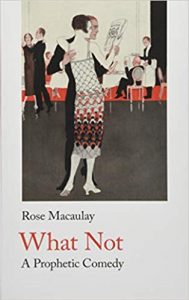
Handheld Press’s wonderful new edition of What Not restores the censored text of the original, which is helpfully marked and footnoted so the reader can observe the changes between versions. As with their superlative edition of Sylvia Townsend Warner’s Kingdoms Of Elfin, the cover art is beautiful, the text is helpfully and informatively annotated, and there is an in-depth introduction from Sarah Lonsdale of City University London.

Thanks for the review! As a historian of trauma and naturally drawn to stories about soldiers returning home and trying to reintegrate into society, this sounds right up my alley. I’m assuming that the government flails around, unable to administer the scarred souls returning from the front?
I push it closer to the top of my to acquire list.