LOST OBJECTS by Marian Womack (Book Review)
“And then came the giant insects, like dark angels who had climbed up from hell by mistake. The centipedes, the caterpillars, the moths and the butterflies, huge and ugly, brightly coloured, pot-bellied. The forms and shapes of the eyespots on their wings were not recognisable as those of any catalogued species.
That late and lengthy summer had not been a period of truce for the exhausted human race. Even after the waters went down there was less to eat. The unexpected heat led to old diseases, which had been cured generations ago, returning now to decimate the population.
And then came the eternal autumn, in which he had been born. They ploughed the fields once more, they reverted to the old wisdoms. But it was too late, many people thought.
The butterflies disappeared then almost entirely; the caterpillars buried themselves in the earth so as never to come again.”
– ‘Orange Dogs’ by Marian Womack
Marian Womack’s debut short story collection Lost Objects (2018) marks the arrival of a powerful and unique new voice in speculative fiction. Over ten stories and around 130 pages, Womack proves herself an original and compelling author of admirable range and talent. However, Lost Objects is more than just a collection of very good stories. Across the carefully selected and sequenced stories, each of which is quite different, there is a powerful thematic build-up that leads to the collection feeling like more than the sum of its very good parts. Womack’s stories are about a loss specific to the Anthropocene. These stories deal with landscapes that have been transfigured by humanity’s carelessness and hubris, worlds in mourning for everything we have so casually destroyed. They serve as a vital and timely reminder of our current climate crisis, and the responsibility we have to both the world and ourselves. The Weird and the uncanny are effectively weaponised to bring home the enormity of our heedless destruction of our planet, and the strength of our connection to the landscapes we inhabit. Gaia will not take this lying down, nor will we emerge from our wanton destruction unscathed.
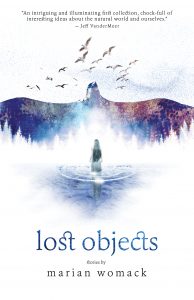 Lost Objects opens with ‘Orange Dogs’, which sets the tone nicely for what follows. The story starts out feeling like an incredibly well realised post-apocalypse tale, with Womack’s intense and evocative descriptions of a post-climate change England anchored by her realist depictions of everyday characters and their domestic lives. However, as the story progresses, it evolves into something much more strange. Dreams and reveries begin to seep into reality. The boundaries between the character’s external environment and their interiority become blurred. The effect is twofold: the encroachment of the subconscious dreamworld on the outside world renders the natural world strange and unfamiliar, highlighting its uncanny beauty, and also demonstrates how our subjective viewpoints shape what we perceive around us. The psychic distortions of Womack’s protagonists show humanity altering and rewriting the world around them in their own image, even when they do not intend to. Similarly, they cannot help but be shaped by the transfigured environment around them.
These themes recur throughout Womack’s stories, making them gloriously hard to categorise. Thus whilst ‘Black Isle’ and ‘Frozen Planet’ may veer more closely to science fictional, and ‘Little Red Drops’ has fairy-tale elements, the former two stories are rich with fantastical imagery and mythical allusions, whilst the latter story is set in a vividly realistic post-apocalypse Russia. ‘Stones’ sits halfway between folk horror myth and alternate history. ‘The Ravisher, The Thief’, in its fantastical approach to life on an alien planet, almost recalls the genre games played by Gene Wolfe in The Book Of The New Sun. This willingness to experiment with genre is part of what gives these stories their individual flavour, and the way they trip up the reader’s expectations and push them out of their comfort zone makes them get under one’s skin and leaves one thinking on them long after finishing the book.
As implied by the title, the collection is haunted by a palpable sense of loss. This is a loss both personal and cultural. The individuals in Womack’s stories are haunted by the loss of friends, of loved ones, of relationships, of miscarried births, and these losses shape the psychic spaces they inhabit. But they are also haunted on a grander scale by the loss of the environment, the loss of a way of life, the loss of their natural places in the world. Frequently there is an implied link between the two levels of loss. Nowhere is this more apparent than in ‘Kingfisher’, where the loss of bird and animal wildlife in the protagonist’s world is echoed by the collapse of her relationship with her husband, culminating in his grotesque transformation into a bird.
These threads run through the whole collection, creating much of its powerful momentum. We share moments with people who dream of what it would be like to touch a cat, or what the dawn chorus would sound like. Animals have a totemic importance in these stories, and illustrate much about our relationship to nature. Womack movingly evokes the intense loneliness of existing on a planet where we have destroyed our animal kin, the sickening emptiness of such a blighted existence. The rain of tarnished, dead genetically engineered animals in ‘Black Isle’ is the stuff of nightmares. In ‘Frozen Planet’, the beasts that haunt the rewilded ice serve as a reminder of the environment’s hostility to us, its burning resentment for what we’ve done to it. In ‘Little Red Drops,’ absent animals tell us more about ourselves than we could know. Most movingly, in ‘A Place For Wild Beasts’, at the end of the collection, the protagonist abandons her house to nature in the guise of a deer. We must make space for nature and not the other way round, and we must do it before it is too late.
Throughout Lost Objects Womack demonstrates her admirable skill as a writer. Her prose is gorgeous and her writing is both startling and evocative, all the more impressive given that she writes in both Spanish and English, and runs a small press printing speculative fiction in translation in Spanish and English as well. In what is shaping up to be a great year for exciting new speculative fiction, Lost Objects has risen near to the top of my list of favourites, and Womack has become one of my writers to watch. Given the power, the originality and the sheer brilliance of these stories, I can only wait in fevered anticipation for what she does next.