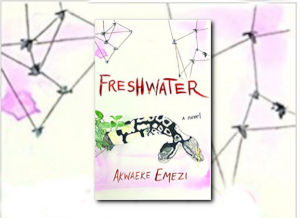
FRESHWATER by Akwaeke Emezi (Book Review)
“It was difficult to accept not being human but still being contained in a human body. For that one, though, the secret was in the situation. Ọgbanje are as liminal as is possible – spirit and human, both and neither. I am here and not here, real and not real, energy pushed into skin and bone. I am my others; we are one and we are many.”
 Freshwater (2018) by Igbo and Tamil author Akwaeke Emezi just won this year’s Otherwise Award and was the first book nominated for the Women’s Prize for Fiction written by a nonbinary author. As such, I knew I was in for an interesting and unusual read, but I was not prepared for just how intense, powerful, and original Freshwater is. Emezi’s debut novel is a semi-autobiographical coming-of-age tale like no other, one that defies genre boundaries and assumptions as easily as it disrupts Western ideas around identity, spirituality, and gender. The novel is as formally ambitious as it is unflinching in its exploration of sex, abuse, attempted suicide, and mental illness. As such it is an intense read, but a thoroughly rewarding one. Emezi’s captivating and unique narrative voice makes the story utterly compelling even through its darkest moments.
Freshwater tells the story of Ada, who is born in Umuahia, Nigeria. Unbeknownst to her human parents, Ada is ọgbanje– a vengeful spirit born to torment human parents by continually dying and being reborn, but she lives and survies into adulthood. She is the daughter of the snake god Ala, and has multiple gods imprisoned in her human flesh. The story is told from the point of view of the gods who are trapped inside Ada’s body – the entwined Smoke and Shadow and the ravenous Asughara – and Ada as Ada only takes control of the narrative at specific points in the story. The narrative follows Ada and the beings in her head through her childhood in Nigeria to her time in college in the USA. The spirits in Ada’s head are initially dormant, but are each awakened by traumatic experiences. The novel explores Ada’s intense relationship with these beings in her head as she struggles to come to terms with her identity as a multitude.
Freshwater is rooted in Igbo cosmology, a different way of looking at the world than many Western readers are familiar with. Emezi includes sections of their journal within the narrative, as well as fictionalised instances from their life, disrupting the boundary between fiction and autobiography and calling into question whether we can see Freshwater as a work of speculative fiction or fantasy at all, or just a different lens on reality from the one we are used to. Like its protagonist, the novel revels in exploration of split perspectives. Smoke and Shadow narrate their sections of the book together, in a detached, mythic tone that highlights the elements of folk tale and mythology that infuse the novel. Asughara, on the other hand, narrates her sections in conversational tone, rich with Nigerian dialect and slang, though in her voracious appetites and her casual disregard for humanity, she still remains an uncanny and decidedly nonhuman voice. Ada undergoes various traumas, from rape to attempted suicide, but we are presented these events from the point of view of these nonhuman god characters, who see and experience them very differently than a human viewpoint might. Thus they are able to provide some protection and distancing to Ada herself.
The novel revels in dismantling binaries. Although Ada is brought up under the influence of her Catholic father, the beings in her head encourage her to reject the Christian viewpoint and embrace the cosmology of her Igbo heritage. This allows her to embrace the fluidity of her identity as multiple beings, as a person of colour who has immigrated to the States, as a child in Nigeria with mixed Malaysian and Nigerian heritage. Whilst Ada is assigned female at birth, she shares her head with another spirit, Saint Vincent, a male presence who encourages her to explore her gender identity outside of the binary of male and female, as she takes male and female lovers and undergoes gender reassignment surgery so that her body becomes more androgynous, less easy to categorise by these alien criteria that don’t apply to her.
Ada struggles with self-harm, violent mood swings and a suicide attempt when Asughara and the other spirits attempt to return to the spirit realm inhabited by their brothersisters. She rejects attempts to pathologize her world view or to see herself in terms of Western psychological medicine. Over the course of the novel, she is able to overcome her traumas and come to terms with her identity as ọgbanje. For this she must return to Nigeria and embrace her Igbo heritage, and it is only after this that she is able to assert herself, not as an individual but as a collection of beings.
Freshwater is a vital and haunting debut, a novel that challenges the reader’s preconceptions and explores what it is to live in liminal spaces, to refuse categorisation. As such, its experimental approach to narrative perfectly suits its deeper themes. The end result is a powerful and unique novel, and one that establishes Emezi as a distinctive new voice.