
Women’s Weird 2: More Strange Stories by Women, 1891-1937 – Edited by Melissa Edmundson (BOOK REVIEW)
“I knew all the time that for a man who had gone to bed in a commonplace hall bedroom in a very commonplace little town such surmises were highly ridiculous, but it is hard for the human mind to grasp anything but a human aexplanation of phenomena. Almost anything seemed then, and seems now, more rational than an explanation bordering upon the supernatural, as we understand the supernatural.”
Mary E Wilkins Freeman, ‘The Hall Bedroom’, 1905
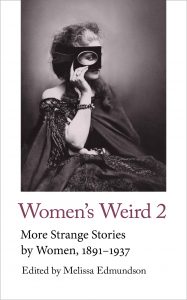 Last year, Handheld Press released Women’s Weird, an excellent anthology edited by Melissa Edmundson highlighting the neglected role of women writers in the development of weird fiction. This year, Edmundson and Handheld Press return to give us an eagerly anticipated second volume. Like the first, Women’s Weird 2 contains 13 stories of the weird and supernatural by women writers spanning the formative years of the genre. Once again we get an eclectic mix of tales, some of them from writers such as Mary E Wilkins Freeman and Mary Elizabeth Counselman who were well known at the time for their supernatural fiction, and others who remain more well known for their writing outside the genre. Stella Gibbons, author of the classic comic novel Cold Comfort Farm (1932), and Lucy Maud Montgomery, best known for children’s novel Anne of Green Gables (1908), both make appearances. This time the anthology casts its net wider than the UK and the US to include writers from Australia, Canada, Ireland and New Zealand. The quality of the stories remains as high as the first volume, and once again we are indebted to Edmundson and Handheld Press for bringing more of these excellent and underappreciated stories to light.
As in the previous volume, the domestic appears as a source of the uncanny and the strange, but in the second batch of stories the tension between society’s expectation of domestic roles for women and women gaining more agency for themselves is made more explicit. The protagonist and narrator of Edith Stewart Drewry’s ‘A Twin Identity’, Madame Marie Lacroix, is a brilliant French police woman who solves a murder mystery thanks to supernatural aid. ‘The Blue Room’ by Lettice Galbraith tells the story of a room haunted by a demon that claims the life of any woman who sleeps in it, but the mystery is solved thanks to the courage and tenacity of Miss Erristoun, an intelligent and resourceful woman who has no need of being coddled by the men who surround her. Miss Montague and Miss Kent in Sarah Orne Jewett’s ‘The Green Bowl’ travel together on various adventures with no male chaperone, much to the surprise of the house guests they entertain, and enter into a friendship with a witch they meet on their journeys. However the domestic still retains its uncanny pull – in Katherine Mansfield’s ‘The House’ a young woman is consumed by the past domestic bliss of the house’s previous occupants, and in Mary E Wilkins Freeman’s ‘The Hall Bedroom’, the tenant of a dismal boarding house is tempted into an alternate realm by a magical painting, never to return. Marjorie Bowen’s ‘Florence Flannery’ explores the converse, a domestic relationship so abusive and destructive it recapitulates down the centuries. Lucy Maud Montgomery’s ‘The House Party At Smoky Island’ focuses on a marriage haunted by the unexpected death of the husband’s previous wife, a haunting that can only be put to rest by a further haunting.
The stories in this volume also explore how, in the shadow of British colonialism and the horrors of World War I, the context of the domestic becomes warped into something frightening and sinister. Bessie Kyffin-Taylor’s ‘Outside The House’ sees a wounded soldier return from the front and fall in love with his nurse, only to be utterly unable to fit into his fiancé’s family’s domestic life. The family has a garden that must not be seen or interacted with once the evening draws in, and Major John Longsworth becomes unhealthily obsessed with the dark revelations he must not see. As a metaphorical exploration of damaged soldiers returning from the front and the brutal return of repressed trauma, it is an incredible piece of writing and one of the most powerfully unsettling stories in the collection. Bithia Mary Croker’s ‘The Red Bungalow’ is another highlight, telling the story of a British military family that relocates to colonial India, only to invite tragedy by moving into the Red Bungalow, which is rumoured to have been built on the site of an indigenous temple destroyed by the colonisers. This story similarly uses the weird to effectively explore the return of trauma, in this case the killing and dispossession of the Indian population by the British. The doomed family are utterly unable to read the signs of the world they blithely think they can walk in and own. These threads can be seen in other stories in the collection that address these ideas less directly. Barbara Baynton’s ‘A Dreamer’ explores the hostility of the Australian landscape. Though short on supernatural elements, the landscape itself becomes a malevolent force preventing the protagonist from returning to her Australian home which is tragically no longer a home. ‘The Black Stone Statue’ by Mary Elizabeth Counselman is perhaps the most traditionally weird story in the collection, featuring a bizarre gelatinous alien creature that turns all it touches into black stone, found in the Brazilian jungles. The story focuses on the disorder unleashed by this alien creature displaced from the jungles to the familiar terrain of New York, again uncovering colonial anxieties.
The remaining two tales show the weird recontextualised in women’s coming of age tales. In Stella Gibbons’ ‘Roaring Tower’, the dreamlike folk horror of the tale coincides with the narrator overcoming a broken heart. Whilst the monstrous figure of the beast trapped in the roaring tower frightens away all the local villagers, the narrator’s empathy for the creature’s misery allows her to help free it and in so doing free herself. Helen Simpson’s ‘Young Magic’ is a far more sinister affair, in which a girl’s imaginary friend changes from something empowering and affirming in youth to something violent and destructive in her womanhood that subsumes her connection with her boyfriend.
Taken together, the stories in Women’s Weird 2 once again highlight the important contribution women writers have made to the field of weird and uncanny fiction, and demonstrate the variety of ways in which the weird tale can reflect women’s concerns. In keeping with the high standard of all Handheld Press releases, the volume contains wonderful cover art, another fascinating introductory essay by Melissa Edmundson further illustrating the context of these stories and their place in the weird, and extensive explanatory footnotes from Kate Macdonald. This is another essential purchase for fans and scholars of weird fiction alike.
Women’s Weird 2: More Strange Stories by Women, 1891-1937 is released on 27th October 2020 from Handheld Press. You can pre-order on Handheld’s site here.
