THE OLD DRIFT by Namwali Serpell (BOOK REVIEW)
“Indeed, the workings of animal biology seemed to mirror the workings of human society. Joseph’s ecology lecturer introduced the students to three terms for how organisms coexist: ‘Parasitism,’ he intoned, ‘is when one organism benefits, while the other one is harmed – this is what viruses do. Mutualism is mutually beneficial, like when the plover bird cleans the crocodile’s teeth or scraps. And commensalism,’ he concluded, ‘is when one organism benefits another without affective it, like the lice that eat human skin flakes or the vultures that trail lions for carcasses.’
Later that day, using the hotspot at the Mingling Bar campus café, Joseph googled the term commensalism on his phone and found out that it came from the Latin commensalis, or ‘sharing a table’. Hey looked up at the open-air canteen, students clustered around square grey tables with red brick bases, sharing their meals under the concrete overpasses that criss-crossed campus like intestines. Here we all are, he thought, sharing our lives in a former colony, each of us filled with bacterial colonies whose edges are as fixed as the borders of the country – which is to say, not very fixed at all.”
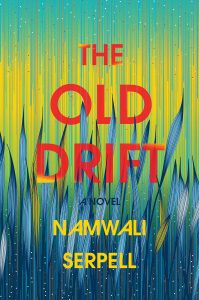 Namwali Serpell’s The Old Drift (2019) was the deserved winner of last year’s Clarke Award. Epic in scope and dizzying in its execution, the novel spans three generations of Zambian families and over a hundred years of real and speculative history to deliver a powerful meditation on colonialism, resistance and revolution. The Old Drift weaves together the lives of its various characters, showing how historical actions have real world impact on people’s decisions in the present and future, and how we are all interlinked in a complex web of interpersonal interactions. Drawing from the fantastic, the historical, and the speculative, the novel defies easy categorisation as it carves out bold new ground for each of these genres. All the more impressive then that this is Serpell’s first novel.
The Old Drift starts in 1904, when a Victorian English gentleman following in the footsteps of Livingstone arrives at Victoria Falls on the Zambezi River and becomes involved with the building of the Kariba dam by a settlement known as the Old Drift. The novel then follows the lives of three families for three generations, from the building of the dam through Zambian independence and ending in a near-future where mosquito-like drones inject people with AIDS vaccines. Over the course of the novel, we get the viewpoints of Africans involved in the fight for Zambian independence, the afronauts involved in the Zambian Space Programme, and Italian, English and Indian immigrants. The novel is split into three main sections, covering the grandmothers, the mothers and the children of the three families, who are drawn together by the tides of history and circumstance. As Zambia emerges as a nation and confronts the legacy of its colonial past, so all of Serpell’s characters are caught in an interweaving net of history, identity and influence that shapes their lives and their perspectives on each other.
The Old Drift has elements of a historical novel, and the level of detail that Serpell manages to convey almost entirely through character work is simply incredible. This is particularly notable in the grandmothers’ sections, where we get insight into the struggle of African and European socialists during the fight for Zambian independence, the drowning of the native villagers during the construction of the dam, and Zambia’s space programme led by eccentric revolutionary Edward Nkoloso. Through the viewpoints of a blind English woman who moves to Zambia to marry her Zambian husband, an Italian woman whose lover murders his brother and steals his identity, and a teenage girl who runs away to join the space programme, Serpell gives us a fascinating glimpse into the history of the country and uses the disparate viewpoints to highlight the connections between Italian fascism, English colonialism and the West’s attitude towards Africa. Serpell has clearly done loads of research, and her attention to detail is astonishing but never gets in the way of the characters.
The novel also contains elements of the fantastical woven into the historical and the mundane. Sibila, the Italian grandmother, is covered with hair that won’t stop growing. Matha, the first female afronaut, is physically unable to stop crying after her boyfriend leaves her. Agnes, the English wife of the Zambian student, has her dreams of tennis stardom dashed when she goes blind but other characters feel her gaze on them through her myriad freckles. With these elements, reminiscent of the magical realism of writers like Gabriel Garcia Marquez, Serpell seamlessly weaves the fantastical and the otherworldly into the same canvas as the historical and the realist, bringing the historical context of colonialism into the context of myth and legend. They also sit well with Serpell’s extraordinary writing style, in which her incredible command of the language allows her to build complexly shifting metaphors and strikingly memorable imagery.
Although the speculative element mainly enters towards the end of the book with the children’s section, where we move into the near future, the way in which these technological developments are interweaved with the social history of Zambia leave no doubt that Serpell is doing something original and important within the context of science fiction. The Old Drift shows how the future Serpell extrapolates cannot help but be informed by the historical and social context of the individuals involved. Indeed, the science fictional aspects of the novel would be incomplete without the historical and social context that Serpell has so carefully built up over the proceeding pages, just as the novel’s rhetorical thrust would be lessened without the extrapolation into the future. The children’s section of the novel focuses on Joseph, descended from Zambian and English families, a young microbiologist working on an AIDS vaccine; Jacob, grandchild of the original two afronauts, who is working on miniaturising drones, and Naila, the revolutionary half Indian half Italian student who dreams of changing the world. Cyberpunkish elements mix with rigorously researched biological and engineering extrapolation as Joseph, Jacob and Naila are drawn together in their respective struggles to find a place for themselves and their country. The ultimate coming together of the three families brings about the novel’s destructive finale.
Throughout The Old Drift, there is a Greek chorus of mosquitoes, who appear at the beginning and end of each section to bring out the main themes and tie the different characters’ narratives together. Serpell points out how the mosquitoes can be read as a site of resistance to colonialism, their spreading of diseases such as malaria and yellow fever to the colonising Europeans shaping the fate of the colonial efforts. The mosquitoes eventually merge with Jacob’s miniaturised drones, forming their own collective machine/insect consciousness. Thus the mosquito drones finish up as a site of revolutionary potential, of the technology of the oppressor subverted to the cause of justice. But more importantly, the mosquitoes surrender themselves to the chaos they represent, the drift of interweaving lives, circumstance and error that shape the world around us. It is this that makes them the ideal icons for Serpell’s wonderful novel.