WETWARE by Rudy Rucker (BOOK REVIEW)
“’We’re going to start making meat bodies for ourselves, Cobb,’ said Loki. ‘So we can all go down to Earth, and blend in. It’s fair. Humans built robots; now the robots are building people! Meatboppers!’
‘You two are asking me to help you take Earth away from the human race?’
‘Meatboppers will be of an equal humanity,’ said Berenice smoothly. ‘One could legitimately regard the sequence human-bopper-meatbop as a curious but invevitable zigzag in evolution’s mighty stream.’”
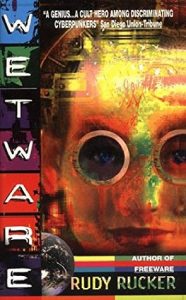 In Software (1982), Rudy Rucker drew the connection between computer software and the human brain, suggesting that the human mind could be uploaded onto a digital medium. In the sequel Wetware (1988), Rucker draws parallels between the human genetic code of DNA and computer code, and imagines robots being able to encode themselves as biological organisms. Like its predecessor, Wetware is a wondrously bonkers mixture of complex mathematics, explosive cyberpunk adventure and Rucker’s Beat-derived humour. Like its predecessor, it won the Philip K. Dick Award. Written after the release of William Gibson’s genre-defining Neuromancer (1984) and Bruce Sterling’s iconic Mirrorshades anthology (1986), Wetware plays with more explicitly cyberpunk ideas than Software, without diluting Rucker’s immediately recognisable style. The novel continues Rucker’s destabilisation of the boundaries between human and machine, introducing the world to the meatbops, superhuman entities born of human DNA infused with bopper software code.
Ten years after the events of Software, Sta-Hi Mooney, now just Stahn, is working as a private detective on the city of Einstein on the moon, now controlled by humans after they kicked out the boppers and forced them underground. Stahn is hired by Max Yukawa to find missing lab assistant Della Taze. Della finds herself drawn into a bizarre bopper conspiracy when she is impregnated by the boppers with altered DNA and winds up giving birth to Manchile, the first meatbop, whose role is to spread meatbops across the Earth by impregnating as many human women as possible. Meanwhile the sinister corporation ISDN strikes back for humanity by using Stahn as a vehicle to release the chipmold, a fungus that infects boppers, transforming all the boppers into the shapeshifting part fungal, part robot mouldies.
Wetware’s plot is as complicated as it is bonkers, taking the reader on a rollercoaster ride involving the drug Merge which melts people together, people who have had half their brains removed and replaced by technology so they can be controlled by boppers, and Happy Cloaks which can augment human brains by hooking up to your nervous system. Stahn’s attempts to stay sober are disastrously derailed by both his gruelling job as a private eye and both the bopper’s and ISDN’s sinister plans for him. Manchile tries to messianically spread the message of human/robot love, resulting in a bloody assassination. In the end the boppers and Stahn have to bring old Cobb Anderson out of digital storage to clean up the mess.
If Software posits the idea that there’s no real difference between brains stored digitally or organically, Wetware further expands on the idea that all life, whatever form it takes, is just as valid. In the end, biological organisms are just machines running on a different substrate. The bopper/human conflict outlined in Software has led to intense prejudice against robots amongst humans, as well as intense paranoia, as can be seen by this conversation between Della’s parents and her cousin Willy:
“’Those robots aren’t conscious,’ insisted Mom. She’d had a lot of red wine in the kitchen, and now they were all back on the champagne. ‘They’re just a bunch of goddamn machines.’
‘You’re a machine, too, Aunt Amy,’ put in Willy. ‘You’re just made of meat instead of wires and silicon.’”
The forces driving evolutionary chaos in all its glorious, messy beauty find themselves in conflict with the forces of conservatism, those who are afraid of new and different ways of being and consider them less than human. One of the recurring themes in Wetware is that humans, boppers and meatbops alike are all capable of kindness and empathy but also cruelty and capriciousness, and it is not always the humans who behave most “human”.
The crystallisation of cyberpunk as a distinct genre happened between the release of Software and Wetware, and as a result, Wetware contains more traditional cyberpunk elements than its predecessor, from the giant corporations pulling the strings behind the scenes to Stahn Mooney’s job as private detective, to the character of Max Yukawa, who is based on an exaggerated version of William Gibson himself. But in typical Rucker style, rather than being played straight, all these aspects are combined in Wetware’s chaotic milieu with typical gonzo humour. Stahn’s private detective sections, rather than reading as straight noir, are frequently bizarre and comic. The whole thing feels just as much a Rudy Rucker novel as Software, from the grotesque body horror of Merge, which renders psychedelia’s dream of merging humanity with deadpan literalness, to the chapter in which Manchile is implanted in Della’s womb, a stream-of-consciousness set piece that recalls Rucker’s hero William Burroughs in its formal experimentation and its striking use of language. Wetware further complicates Rucker’s vision of post-humanity, and his celebration of evolution and biological messiness in tandem with technology. It remains a classic and vital cyberpunk text.