
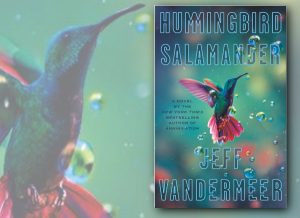
HUMMINGBIRD SALAMANDER by Jeff VanderMeer (BOOK REVIEW)
“Silvina wrote that even through the poisoned landscape, we must love it. We must love what has been damaged, because everything has been damaged. And to love the damage is to know you care about that world. That you’re still alive. That the world is alive.
How did I not see the damage for so long?”
“When you find the world you live in unfamiliar, alien, it’s nothing to slip into another.”
Hummingbird Salamander (2021) is Jeff VanderMeer’s latest work, a continuation of his project to use the Weird to interrogate the Anthropocene and explore the nonhuman perspectives under threat from humanity’s destruction of the environment. In contrast to the radical formal experimentation of his previous adult novel Dead Astronauts (2019), Hummingbird Salamander sees VanderMeer adopt the format of the thriller for a more accessible genre fiction novel. But because this is VanderMeer, more accessible does not mean less Weird, nor does it mean that Hummingbird Salamander dilutes its language or its message in the hopes of reaching a larger audience. Hummingbird Salamander is a wonderful, thought-provoking and confounding read, one that is unmistakably the work of VanderMeer. At its heart, as with much of VanderMeer’s fiction, is the struggle to envision new ways of being that are less destructive, that respect the natural world around us and allow us to co-exist as a part of nature rather than looting or destroying it.
 Hummingbird Salamander begins when ‘Jane Smith’, a security consultant and ex-wrestler, receives an envelope with a number and a key inside it, which lead to a storage unit with a taxidermied hummingbird and a cryptic message inside that reads “Hummingbird .. .. .. Salamander’. The message has been left for her by Silvina Vilcapampa, a suspected ecoterrorist and daughter to a powerful and corrupt Argentine industrialist. As ‘Jane’ tries to track down the corresponding taxidermied salamander to find out the rest of Silvina’s message, she finds herself and her family increasingly under threat. Soon she is involved in a race against time to find Silvina’s secret legacy before the various other interested parties can get their hands on it.
The above description of the plot might make one think that Hummingbird Salamander is a simple, direct, plot-heavy book. It does not suggest the levels of complexity and intellectual interrogation that VanderMeer achieves. The thriller format gives the book its shape but only in the broadest sense; VanderMeer’s novel is constantly pushing against the edges of the genre, even as it embraces some of the tropes. We see the world though the perspective of Jane, a woman who is desperate to tell her story to someone, but who refuses to give her real name. This is just one of the many ways she holds the reader, and indeed any other person she interacts with, be they her husband, her daughter, or her father, at arm’s length. The novel’s other key character, Silvina, is missing presumed dead throughout the entire course of the narrative, yet as Jane becomes increasingly obsessed with Silvina and her mission, she exerts a powerful presence over the whole book. Perhaps recognising her isolation from other people as something similar in herself, Jane becomes entangled in Silvina’s philosophy, seeing the world around her in a new light. Is Silvina, as Jane and the others following her trail seem to believe, some kind of dark messiah, an avenging angel for the natural world, or is Jane falling for a charismatic cult leader’s delusion?
In stark contrast to Borne (2017) and Dead Astronauts, which portray a ruined world transfigured by biotech so powerful it feels like magic, or VanderMeer’s iconic Area X trilogy (2014), which chronicles the spread of an alien force that disrupts the world around it, with Hummingbird Salamander it is much more difficult to put your finger on what exactly the Weird aspect is. After the uninhibited rococo bizarreness of Borne and Mord, Hummingbird Salamander very much feels like a change of pace. It takes place in a world that is recognisably our own, without any sentient biotech or bizarre, unknowable alien presences. Nevertheless it remains a profoundly Weird book. The novel serves to highlight just how alienating and bizarre late period capitalism is, that the Weird is the only form of fiction strange enough to help us engage with our current reality. Hummingbird Salamander takes place against a disconcertingly recognisable backdrop of constant climate crisis, rolling pandemics, the collapse of governments. The novel’s creeping sense of unease makes us look at the current state of the world with all its horrors afresh. It’s entirely understandable that Silvina and Jane both reject the world around them in favour of Silvina’s utopian vision of a world in which the ongoing train of death and destruction can be stopped. As Jane gets sucked deeper and deeper into Silvina’s web of conspiracy, the world in which she has been living, working as a manager at a digital security firm, being a mother and wife in a middle-class family, makes less and less sense to her. A powerful sequence in which Jane goes to a work conference shows just how ridiculous the worldview of modern day capitalism is in the face of our disintegrating world. These revelations run through Hummingbird Salamander and situate it firmly within the Weird, whilst demonstrating just how powerful the Weird can be as a tool for defamiliarizing the increasingly bizarre aspects of our lives we are in danger of coming to terms with.
At the heart of the novel is the twinned metaphor of the hummingbird and the salamander. The hummingbird Silvina leaves for Jane is an extinct species, one that has undergone increasingly epic migration journeys as its natural habitats are destroyed, heroically trying to carve out a life for itself as the world it understands falls away. This echoes where humanity is now, desperately trying to recoup the life we used to lead in a world where this is increasingly impossible. The salamander is an indicator species used by scientists and ecologists as a warning about danger to the environment. It absorbs oxygen directly through its skin, a more intimate relationship to the ecosystem around it that puts it at danger of poisons in its environment. Silvina’s vision, which Jane may bring about, is of a world where humans share this direct interface with their environment, where we feel viscerally that the damage we do to the environment we do to ourselves. It is this perspective that we must share with the salamander if we are to survive instead of causing our own destruction.

Excellent review. I’ve been meaning to try some of the author’s work for years, feels even more like a good idea now!
Interesting! I liked the Southern Reach trilogy so I think I would like this. Thanks for the great review!