
BIRDBRAIN by Johanna Sinisalo (BOOK REVIEW)
“This is how humans function. This is precisely how humans function. You know what lies behind the horizon, but you have to carry on in the same direction because that’s what you’ve been doing, that’s what you’ve decided, and changing direction or turning back would be a sign of giving in, of letting go of everything you’ve achieved so far.
You keep going, fast, although you know only too well what lies ahead.”
Birdbrain (2010) is the second of Johanna Sinisalo’s books to be translated into English, following her remarkable debut novel Not Before Sundown (2003), although Sinisalo had published two novels and a short story collection in her native Finnish in between. Birdbrain is just as striking as Not Before Sundown, and similarly defies easy categorisation. Interweaving extracts from Joseph Conrad’s Heart of Darkness (1899), the novel is an intense investigation into humanity’s relationship with nature. Its powerful evocation of the Australian, New Zealand and Tasmanian landscapes recalls the hallucinatory intensity of Joan Lindsay’s Picnic At Hanging Rock (1967) whilst the way it uses the Weird to deconstruct the arrogance of anthropocentric attitudes anticipates Jeff VanderMeer’s Southern Reach Trilogy (2014). It is a vital and deeply troubling work of modern speculative fiction.
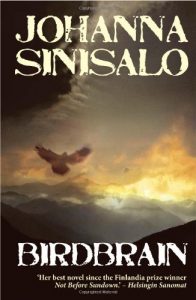 Young Finnish couple Heidi and Jyrki are backpacking across Australia and New Zealand. On the lookout for ever more pristine and unspoiled wildlands, Jyrki learns about the South Coast Track in Tasmania, a hiking journey off the beaten track and away from the casual tourists that will truly challenge them. But as they go deeper and deeper into the unforgiving wilderness, events begin to spiral out of control. As tensions grow, the cracks begin to show in Heidi and Jyrki’s relationship. Items go missing from their meticulously planned backpacks, only to turn up again at the next campsite. In this atmosphere of paranoia, Heidi beings to suspect that something is following them.
Heidi picks up a copy of Conrad’s Heart of Darkness during the journey, and Conrad’s novella burns itself into her brain, as shown by the extracts from it that punctuate each section of the book. Birdbrain is heavily in dialogue with the Conrad text, to the extent that Heidi and Jyrki are engaged in their own journey into the heart of the wilderness, one that will challenge their imperialist and colonialist mindset. Sinisalo dissects Jyrki’s enthusiasm for finding the most challenging and remote areas of wilderness to explore by likening it to the colonial attitudes of Western explorers and the entitlement that caused them to claim the “virgin wilderness” of indigenous peoples’ land for themselves. Jyrki seeks out more and more remote and difficult hiking trips, being scornful of the well-travelled “tourist traps” because he has this image of himself as a great white explorer, his hiking prowess showing his mastery over nature, which he defines as in opposition to his “civilised”, Western life. This arrogance and entitlement manifests itself in his relationship with Heidi, the way he constantly belittles and patronises her. The alternating viewpoints between Heidi and Jyrki demonstrate just how oblivious he is of this.
Splitting our perspective between Jyrki and Heidi’s viewpoints also allows us to get deep into the characters’ heads. The novel is unflinchingly critical of the privilege of white European backpackers blithely setting out to see the world, but it is also an in-depth character study. Sinisalo points out how conceptions of “nature” and “wilderness” are always subjective, by displaying Heidi and Jyrki’s quite different reactions to the land they traverse. Whilst Heidi feels the vulnerability of being away from the comforts of civilisation, Jyrki is frustrated by the tourists who surround them, seeing it as not proper wilderness unless the two of them are the only people for miles. Yet Heidi has a much more grounded perception of what it means to be in a remote location hundreds of miles away from any infrastructure, something that comes to the fore as more and more starts to go wrong with their journey – she realises that if one or both of them is injured, there will not be much they can do about it. Jyrki’s blithe dismissal of Heidi’s concerns is emblematic of his white male privilege. As a man, he is utterly unaware of the practical issues Heidi faces whilst traveling as a woman, from getting her period whilst on the trail to everything she had to sacrifice in order to give up three months of her life to go off traveling with him.
A fascinating aspect of Jyrki’s arrogance is how his environmental consciousness and concern for nature is so tightly wrapped up in his deep desire to conquer and dominate it. He is forever thinking of the environmental impact of his journey, whether from the plane emissions involved in getting him from Finland to the Antipodes, or his insistence on carrying their waste with them until it can be disposed of back in the city where it won’t sully the wilderness. Sinisalo shows how his passion for caring for the environment is borne not from a respect of it, but a desire to preserve it in a “pristine” condition so that he can be the one to show his dominance over nature. This can be seen in the sequence where Heidi and Jyrki see a rare parrot – Jyrki’s thoughts are largely on the bragging rights this will get him with other European backpackers the next time they’re in a bar.
Interweaved into the story of Heidi and Jyrki’s conflict with the wilderness is a storyline that highlights the animality of humans. We are introduced to Heidi’s reprobate brother Jesse early in the story, a feckless loafer who takes joy in wanton destruction. At various points in the book we are giving short sections that appear to be narrated by Jesse, where he chronicles his and his friends’ gleeful casual violence. Towards the end of the book, these sections are replaced with the viewpoint of the kea. The kea is a parrot native to New Zealand, known for its intelligence and problem solving skills but also its destructive attitude. By drawing parallels between the kea and Jesse, Sinisalo shows that the dividing line between humans, so frequently characterised as our intelligence and our destructive mastery of our surroundings, is not as clear as we may have thought. The kea comes to represent the destructive, aggressive side of the natural world, one whose intelligence and awareness and viciousness can match humanity’s. and so all the forces that Heidi and Jyrki think they are the master of but has been working against them for their entire journey. In the end, it is not even the case that nature refuses the dominion of mankind, but that humanity and nature are part of the same thing.

[…] Jonathan @ the Hive: Birdbrain by Johanna Sinisalo […]