
DAWN by Octavia E. Butler (BOOK REVIEW)
“But what was the problem? You said we had two incompatible characteristics. What were they?”
Jdahya made a rustling noise that could have been a sigh, but that did not seem to come from his mouth or throat. “You are intelligent,” he said. “That’s the newer of the two characteristics, and the one you might have put to work to save yourselves. You are potentially one of the most intelligent species we’ve found, though your focus is different from ours. Still, you had a good start in the life sciences, and even in genetics.”
“What’s the second characteristic?”
“You are hierarchical. That’s the older and more entrenched characteristic. We saw it in your closest animal relatives and in your most distant ones. It’s a terrestrial characteristic. When human intelligence served it instead of guiding it, when human intelligence did not even acknowledge it as a problem, but took pride in it or did not notice it at all…” The rattling sounded again. “That was like ignoring cancer. I think your people did not realize what a dangerous thing they were doing.”
Dawn (1987) is the first novel in Octavia E. Butler’s Xenogenesis trilogy, one of the key works of speculative fiction of the 1980s. Over the course of the trilogy, Butler’s alien invasion story subverts the standard genre expectations to deconstruct ideas around gender and sexuality, colonialism and invasion, and how we relate to the nonhuman. Dawn is a vital tale of alien encounter, one that is interested in humanity’s troubled relationship to the alien Other. Butler expertly weaves a complex tapestry around one woman’s intensely personal encounter with aliens, in which echoes of humanity’s history of colonialism and destruction of indigenous peoples are recontextualised. Butler asks deep and probing questions about the nature of humanity, one which unflinchingly stares into the darkest parts of human history but still manages to return with hope for the future.
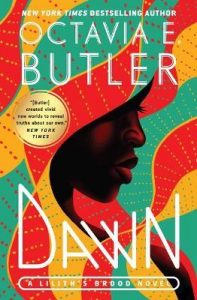 Dawn opens with Lilith Iyapo, and African American woman of Igbo descent, awakening on an Oankali ship orbiting the Earth some 250 years after humanity almost destroyed itself in a nuclear war. The Oankali are alien gene traders with three sexes, male, female and ooloi. The ooloi are master genetic engineers who can combine the genes of their male and female mates and manipulate the genetic traits of the offspring. The survival of the Oankali depends on them finding new species to mate with. They intend to carry out this process with Humanity which will produce a race of Human/Oankali hybrids or “constructs”, who will live on the Earth that the Oankali have healed. Lilith is chosen by the Oankali to prepare the first batch of humans to return to Earth and accept the Oankali as mates. The novel follows Lilith’s emotional journey, as she struggles to relate to her new Oankali family and tries to prepare humanity to survive whilst being seen as a traitor by her own people.
In Dawn, Butler plays with and subverts both the trope of the malevolent alien invasion from 1950s B-movies and books like Robert A. Heinlein’s The Puppet Masters (1951), and also the SF trope of the benevolent aliens who come to save humanity, as seen in novels like Arthur C. Clarke’s Childhood’s End (1953). Are the Oankali benevolent saviours from beyond the stars, arrived to give humanity a second chance if they alter their destructive ways? Are they a sinister, manipulative presence who only desire to consume humanity and take the planet as their own? The answer is much more complicated than either simplistic solution. The Oankali are not malevolent parasites sent to consume us. They show up and rescue humanity after it has destroyed itself through nuclear war. They want to merge with humanity and gaining humanity’s trust and consent is important to them, as is preserving humanity’s original culture. However, there is an incredible power differential between the space traveling Oankali and the scattered, shellshocked remnants of humanity that they rescue, and one of the key themes of Butler’s novel is whether or not consent can truly exist across such a large power differential. Can the humans ever really refuse the Oankali? Lilith struggles with this throughout the book, and while she agrees to help the Oankali train the surviving humans so they can live on Earth again, she is doing this because she feels she has no choice, and is constantly looking for opportunities to escape or subvert Oankali control.
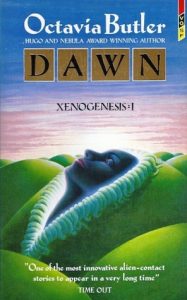 And in the end, the Oankali are offering not just survival for humanity, but a way for humanity to evolve beyond the selfish, destructive tendencies that led it to almost wipe itself out. The Oankali are a fascinating alien creation. Covered in tentacles like a large sea slug, the appearance of the Oankali is so off-putting to humans that Lilith must spend much time overcoming her visceral reaction of fear and disgust at them. The three gender system of male, female and ooloi allows Butler to subvert ideas around binary gender and the nuclear family in profound and fascinating ways. And the Oankali exist in a much less destructive way than humans do – they have an intimate relationship with the world around them, absorbing and learning from other life forms, and they have sex by linking directly into each other’s neural networks. As such their behaviour is driven more by empathy and sympathy than what the Oankali call the Human contradiction – our intelligence subservient to our hierarchical instincts. The Oankali offer novel posthuman ways of being that will be realised in the Oankali/Human construct offspring.
But Butler never lets the reader forget the all-important issues of power and consent. Lilith wakes up with new scars across her abdomen:
“What had she lost or gained, and why? And what else might be done? She did not own herself any longer. Even her flesh could be cut and stitched without her consent or knowledge.”
Because Lilith is an African American woman, the reader is immediately put in mind of the ways in which black female bodies have been used as a site of medical experimentation without their consent. She learns that the Oankali have removed a cancer that was growing inside her, and that the uncontrolled growth of cancerous cells is part of what attracts the Oankali to Humans. This intentionally recalls Henrietta Lacks, the African American woman whose cancer cells were used to create the HeLa cell line, which is still used in biological research to this day, without her consent or knowledge. The Oankali’s condescending and patronising attitude towards Humans recalls the arrogance of colonial attitudes that talked of “civilising” indigenous peoples, bringing the yoke of imperialism and slavery under the guise of it being “good for them”. It is these aspects that complicate the role of the Oankali and show us that whatever their intentions, they are less benevolent than they claim to be.
The novel ends with Lilith’s first attempt in failure. Even as she begins to form a deeper relationship with her ooloi Nikanj, the first batch of people she reawakens rebel against her, killing her lover and returning to their old, destructive, hierarchical ways. However, the novel hints at the hope that will be further kindled in the next book – Lilith is pregnant with the first of her, her human mate’s and Nikani’s construct child, giving hope for a generation that may combine the best of Human and Oankali culture and discover new ways of being.

[…] Jonathan @ the Hive: Dawn by Octavia E. Butler […]