
IMAGO by Octavia E. Butler (BOOK REVIEW)
“I wasn’t surprised this time. My body wanted him. My body sought to please him. What would happen to me when I had two or more mates? Would I be like the sky, constantly changing, clouded, clear, clouded, clear? Would I have to be hateful to one partner in order to please the other? Nikanj looked the same all the time and yet all four of my other parents treasured it. How well would my looks please anyone when I had four arms instead of two?”
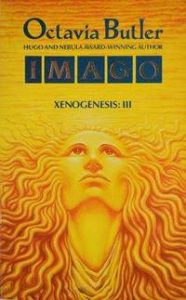
Imago (1989) is the final book in Octavia E. Butler’s Xenogenesis trilogy. If Adulthood Rites (1988) recontextualises our understanding of the Oankali and Human relationship introduced in Dawn (1987), then Imago goes even further. While the first two books in the series are narrated in a close third person, Imago is told in the first person, but from the point of view of Jodahs, the first ooloi construct born to a human mother. Butler gives us our most personal and intimate glimpse into the interior life of the most alien protagonist of the series. In Dawn, Lilith’s humanity underscores and grounds the tale of alien contact, and in Adulthood Rite, Akin, the first male construct born to a human mother, is able to partake of both the Human and Oankali world at least partially because before his metamorphosis he can easily pass for Human. Jodahs is ooloi, the Oankali’s third sex, which does not map onto male or female. Unlike Akin, Jodahs inherits the Oankali’s most alien tendencies: their ability to change shape, their tentacle-like sexual organs. While Imago is a love story and a coming of age story, it is one that gives us a dazzling insight into nonhuman ways of being, Butler’s most ambitious imagining of a truly alien perspective.
 We are first introduced to Jodahs as it is going into the first of its two metamorphoses before it becomes it imago, it adult sexually mature stage. Jodahs, like Akin before it, is the offspring of Lilith and her Human/Oankali family. However, rather than displaying the obvious signs of metamorphosis that would signal its maturing from the genderless child stage into a male or female construct, Jodahs begins to notice that all it senses have become remarkably heightened. It is not male, as it had been expecting its whole life, it is ooloi. It can sense and taste the individual elements of the environment around it, it can expertly manipulate genetic material, and it can please its partners in ways they had never imagined. This means its bonded sibling Aaor will be ooloi too. Jodahs and Aaor cause much consternation amongst the Oankali and Humans alike, who despite their different perspectives both fear the seismic change that an ooloi construct signals for them. But despite these warnings, Jodahs sets out on its own, falls in love with Human mates, and blazes a new trail for the posthuman descendants of both Humans and Oankali, one in which the rules will be new for everyone.
Imago is a remarkable feat of imagination. Butler embraces head on all the Oankali’s most alien characteristics, the ones that truly shape how they experience the world as being fundamentally different to Humans. The novel manages to convey how the Oankali’s ability to taste and sense everything around them, from Humans to other Oankali to animals to the water and the air, in a way that makes immediate and organic sense to the reader. We get to experience first-hand the way the ooloi appreciate the complexity of organic life, separating out each individual strand and appreciating how it all combines. We get to understand the intense sexual pleasure the ooloi create by linking directly into the nervous systems of their lovers. We get to see the way they are able to manipulate genetics in exquisite detail to shape their offspring. The fact that Butler is able to do all this whilst still making Jodahs and Aaor understandable and relatable as characters, without the whole thing collapsing into a synesthetic mess, is a tribute to the skill of her writing.
 In Jodahs’ relationship between Thomás and Jesusa, we get a love story involving three people, three genders and two different species. In this way, Imago demonstrates the extent to which the Oankali disrupt the traditional gender binary, and how speculative fiction can open up spaces to explore nonbinary and polyamorous relationships. But there is more than just three individuals’ relationships at stake here – the trio’s interactions also rewrite the rules for Human/Oankali interaction, finally toppling the power balance that was so much in the Oankali’s favour in Dawn. As its mother, Lilith loves Jodahs, even if she becomes suspicious watching Jodahs’ seduction of Thomás and Jesusa, which forces her to relive all the aspects of her relationship with Nikanj where her own agency was taken away from her. Whilst Jodahs’ battery of extra senses and chemical pheromones aid its seduction of Thomás and Jesusa, from inside Jodah’s perspective we understand simultaneously how irresistible he finds Thomás and Jesusa. It is its feelings alone that even out the power imbalance; Thomás and Jesusa fall for Jodahs before its second metamorphosis and are able to guide it through it, whereas Aaors winds up having to go through its metamorphosis alone. Thomás and Jesusa’s love and desires provide a template for Jodahs to cling on to, a means via which it can stabliise its physical shape. Poor Aaors, lacking this, suffers a metamorphosis that pulls it in all directions, causing it to become an amorphous mass, a mess of contradictory shapes and impulses. Thus while the constructs are able to offer Humans all the richness of the Oankali’s protean changing nature, the Humans are able to offer them some kind of anchoring and stability. It is this that allows the Humans and the Human/Oankali constructs to form a healthier, more stable relationship than that formed between the original Oankali and Humans of Nikanj and Lilith’s generation.
Thus, whilst Imago shares the complexity of Dawn and Adulthood Rites, and their pessimism about Humanity’s intelligence in service to its hierarchical nature, it also offers hope, especially for Humanity’s posthuman descendants. This makes it perhaps Butler’s most optimistic and hopeful novel. While it is in our Human nature to make mistakes and to screw each other over, perhaps to our own destruction, there is hope for our posthuman offspring if they can learn to subvert and escape the strictures of those hierarchies. It is a powerful and uplifting message, and one that can only deliver its true impact with the ambiguities and complexities explored in the previous two volumes.


[…] Jonathan @ the Hive: Imago by Octavia E. Butler […]