
THE BLOOD OF ANGELS by Johanna Sinisalo: 2011, translated by Lola Rogers 2014 (BOOK REVIEW)
“Bees can sense electrical charges in the air and feel magnetic fields.
It’s pretty obvious that if there are such things as portals, doors, thin places between parallel worlds bees are perhaps better equipped to find them than any other creature.
They’ve probably found myriad gateways over man millennia, endless untouched worlds, and colonized them without humans.
Their own Elysian Fields where angels’ blood is never shed. Immortal, forever young.
There’s more to these little winged creatures than meets the eye.”
The Blood Of Angels is Johanna Sinisalo’s third novel to be translated into English, although it is her sixth in her native Finnish. And for my money, it is her most powerful and emotionally devastating book. Focusing again on humanity’s troubled relationship with nature, The Blood Of Angels is both an ecological parable that imagines a world without bees and a haunting meditation on personal grief. Sinisalo expertly weaves the novel’s themes together, mixing in folklore and animal rights activism, to create a beautiful and moving story that shows just how compelling and unique speculative fiction can be. I knew when I read Not Before Sundown (2003) that in Sinisalo I’d found a new favourite writer, but in The Blood Of Angels I have found a new favourite book, up there with Nina Allan’s The Race (2014).
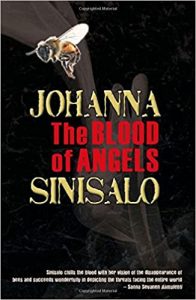 Orvo is an amateur beekeeper and professional undertaker in Finland, a country that has largely been spared the disastrous Colony Collapse Disorder that has resulted in the mysterious disappearance of bees, causing widespread ecological and agricultural collapse. He is in mourning for his animal rights activist son Eero, killed when an action at a slaughterhouse went badly, when he discovers that the problem might have spread to his own beehives. However in the attic above his barn he discovers a portal to another world, beautiful, Edenic and unspoiled. He initially fears that it may only be a hallucination brought about by his intense grief, but as he researches deeper into the folklore and mythology surrounding bees, he begins to believe another possibility. Bees have been seen in mythology around the world as messengers able to travel between worlds. Perhaps rather than dying, the world’s disappearing bees have simply migrated to another universe, one in which it may be possible for Orvo to contact his dead son.
Part of what makes Sinisalo’s novel so striking is the way in which it talks about two very different types of grief. Orvo’s grief for his dead son forms the heart of the book, and the novel movingly explores the sadness, despair and sheer sense of wrongness of a parent losing their child. However Orvo’s grief is set against the backdrop of a more existential grief – the knowledge that the human world is coming to an end. The spread of Colony Collapse Disorder means there are no more bees to pollinate crops, so the entire system of agriculture that feeds humanity is falling apart. Humanity is beginning to understand just how much its fate is intertwined with nature’s, and that the destruction we have wrecked upon our world is inevitably going to lead to our own destruction. Both of these griefs are united in the character of Eero, Orvo’s dead son, who haunts the text through his blog posts. Eero’s posts intersperse the chapters told from Orvo’s perspective, and contrast Orvo’s grief over his son’s death with Eero’s concerns with animal rights and his increasing belief that extremism is the only way address humanity’s horrific treatment of animals and the environment.
In The Blood Of Angels, grief manifests as a break from the consensus reality we experience, but is it one of transcendence or madness? Orvo becomes obsessed with the idea that the portal he has discovered will allow him to be with his son again, whilst Eero becomes fixated on solutions of violence. As Orvo researches mythology around bees and the afterlife, Eero discovers more and more about how humanity’s hierarchical and possessive view of the natural world is inexorably leading to our own destruction. As Orvo discovers, bees have a long history of being associated with the afterlife and other worlds. His reading takes him from Virgil to Indian mythology to the Finnish Kalevala, a journey across time and space to all the beliefs where bees have this special role:
“Our ancestors knew something about bees that we’ve forgotten or refuse to recognize, that bees, with their incomparable senses, can sense the thin spots between worlds and break through; use their efficient little jaws to nibble a hole from one universe to another.”
 This is inverted in the chaos caused by the disappearance of bees from our world – without bees to pollinate crops, humanity will follow the bees to extinction. In terms of species extinctions, the bees will act as a spiritual guide to all of humanity.
With its central image of Orvo crossing to the Other Side to rescue his son, The Blood Of Angels has echoes of both the Orpheus myth and legends of journeys to fairyland. As with all such tales, resurrection can only come at an incredibly high price. The two thematic strands converge in the novel’s powerful finale, in which Orvo must choose between allowing the bees’ miraculous new Eden to be colonised and plundered by humanity and never seeing his son again. Sinisalo asks us to consider whether the grief for the death of our planet can ever be more powerful than the grief of our own personal loss, forcing Orvo to make a terrible decision. In this way, the novel demonstrates the power speculative fiction has to help us confront enormous issues like human-created climate change and humanity’s destruction of the natural world and the other beings who share our ecosystem. By drawing the parallels between personal and existential grief, by showing us the unimaginable grief of the ecological collapse of our planet scaled against relatable, human terms, Sinisalo’s incredible novel challenges the reader’s complacency and complicity in late period capitalism’s ravenous destruction of the Earth. It offers the reader a space to grieve and gather strength, to consider what is important to us and how we may live a life less antagonistic to our fellow creatures and the ecosystems and environments that sustain us.

[…] Jonathan @ the Hive: The Blood of Angels by Johanna Sinisalo […]