
AN UNKINDNESS OF GHOSTS by Rivers Solomon (BOOK REVIEW)
“That’s what ghosts really are, Aint Melusine had said, the past refusing to be forgot. She’d been helping Aster scrub down X deck with ammonia and bleach, a failed attempt to rub out the stink of what had happened there. Ghosts is smells, stains, scars. Everything is ruins. Everything is a clue. It wants you to know its story. Ancestors are everywhere if you are looking.”
Rivers Solomon’s An Unkindness Of Ghosts (2017) is an incredible, powerful and unforgettable debut novel, immediately establishing Solomon as a key new voice in the genre. The novel takes on the tried and tested science fiction trope of the generation ship, but Solomon’s approach encompasses a metaphorical reimagining of the cruelty and brutality of the antebellum south’s slave plantations as well as queer and neurodiverse perspectives. An Unkindness Of Ghosts shows just how vital non-white and queer perspectives are in opening up what the genre of speculative fiction can do. Solomon’s writing is remarkably assured, faer characters are engagingly complex and well-drawn, and faer worldbuilding is rich both in astute social observation and hard SF technical detail. That this is only a debut novel is frankly astonishing. An Unkindness Of Ghosts boldly storms in and takes its place with the very best of the genre’s explorations of the generation ship motif, and makes the reader excited to see what Solomon will do next.
 The HMS Matilda has been travelling through the void for three hundred years, searching for a new home for humanity after the Great Lifehouse was reduced to ruins. Society for the inhabitants of the Matlida is heavily stratified, with the white, privileged upper deckers living a life of opulent luxury whilst the racially diverse inhabitants of the slums on the lower decks work back-breaking labour to keep the ship supplied with food and fuel. Aster is a woman from the lower decks who has taught herself the sciences and acts as a medic and assistant to Theo, the ship’s Surgeon. Her mother Lune committed suicide twenty years ago, shortly after Aster’s birth, leaving Aint Melusine to raise her. Aster helps out fellow lowerdeckers and tends to the plants in her botanarium that provide her medicines, in the time she can spare from working twelve hour shifts on the Field Deck with her traumatised best friend Giselle. A change in the power structure of the ship sees Lieutenant, a vicious overseer with a longstanding grudge against Aster, take control as the sovereign. As his reign of terror makes life even more horrific for the lowerdeckers, Aster discovers the secret behind her mother’s mysterious research, one that just might provide a way to improve life for her and the rest of the ship’s disenfranchised.
The rigid and exploitative social structure of the Matilda directly parallels that of the US’s slavery plantations in the South. Speculative fiction frequently uses estrangement to make the reader experience the horrors of our own history in a new, vivid light. This had the added effect of reminding the reader that the social and historical forces that led to the creation of many of history’s worst horrors are alive and well in our present society. This is exactly what Solomon does by reimagining the horrific abuses of slavery in the context of a future generation ship. The lowerdeckers experience abuse from the Guards in the form of corporal punishment and rape. They are subjected to forced labour and curfews, and denied the education, health care and access to food that the upperdeckers enjoy. An Unkindness Of Ghosts unflinchingly shows the reader all these horrors, bringing the abuses of slavery to vivid and uncomfortable life, and forcing the reader to confront the legacies of slavery that have led to the massive racial inequalities in countries like the US and UK that financially benefited from slavery.
But rather than simply recreating the horrors of the past, An Unkindness Of Ghosts is a story about resistance, even in the face of implacable power differentials. Aster and her fellow lowerdeckers resist the tyranny of the upperdeckers and the Guards in ways both large and small, whether planning open rebellion, finding ways to preserve their cultures, or in the kindness they show to each other, such as the medical aid that Aster gives to those who would otherwise have none. The novel never pretends that this is easy – Aster and her friends all suffer beatings and worse for their troubles – but it is the pervading tyranny and abuse that makes their acts of resistance so important. The novel can be a bleak read, but that just makes the acts of genuine human connection, whether between Aster and Giselle, who share a longstanding friendship in spite of their trauma, or Aint Melusine’s motherly love for Aster, or Aster and Theo’s burgeoning romance, all the more brighter by comparison.
At the heart of the novel are its remarkable characters. Aster is a wonderful protagonist with a compelling voice, a smart and compassionate woman doing her best in horrendous circumstances. Her neurodiversity means she takes things extremely literally and suffers from audial and visual hallucinations, but this never detracts from her intelligence or resourcefulness. She and Theo are both uncomfortable in their assigned genders, and manage to find ways to express their gender identities within this rigidly conservative society. Giselle’s trauma has exacerbated her mental health problems, but she is never simply just the crazy friend, she is a character with her own complexity and depth. Aint Melusine is a woman who is thrown into a nurturing role against her will, but does her best to do right by Lune and Aster. Though the novel is largely told from Aster’s perspective, each section starts with a chapter from the viewpoint of one of the other main characters, showing that they have as much depth, internal life and individual voice as Aster, and I would have happily read more from all of their viewpoints.
An Unkindness Of Ghosts would have worked just fine with these elements alone, but Solomon goes a step further with the depth and precision of the novel’s hard science fiction elements. The Matilda is brilliantly thought out, from the glowing ball of energy, Baby Sun, that powers it through to the Field Decks, rotating levels which contain the ship’s fields for growing and cultivating food. The effect of relativity on the ship’s journey, and the use of gravity wells to slingshot the ship, play an important role in the plot. Similarly, all the social science elements of the novel are rigorously worked out. Where most science fiction is happy to show us planets with only one culture, Solomon’s ship features people speaking different languages on different decks. These elements show just how much thought and consideration Solomon put into constructing the world of the novel, and the levels of scientific and philosophical rigour with which fae constructs faer novel. An Unkindness Of Ghosts succeeds as social science fiction, it succeeds as hard science fiction, it succeeds as an exciting narrative, and it succeeds as a character study. Solomon’s ability to excel in all these aspects of the novel demonstrate why fae is such a powerful and compelling talent.
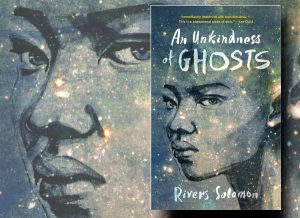

[…] on a generational spaceship, An Unkindness of Ghosts offers a speculative fiction take on racism, slavery, difference, and […]