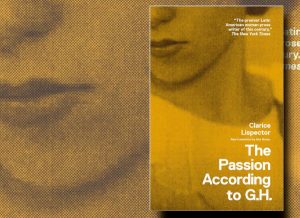
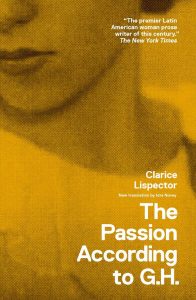
THE PASSION ACCORDING TO G.H. by Clarice Lispector, translated by Idra Novey (BOOK REVIEW)
“Give me your unknown hand, since life is hurting me, and I don’t know how to speak – reality is too delicate, only reality is delicate, my unreality and my imagination are heavier.”
“Humanized life. I had humanized life too much.”
Clarice Lispector was a Ukranian-born Brazilian writer of fantastically weird and strange fiction. The Passion According to G.H., written in Portuguese in 1964 but not translated into English until 1988, is a short novel – the edition I have comes to 189 pages – but what Lispector achieves in this short space is nothing short of remarkable. The book is essentially a mystical experience, brought on by the protagonist’s encounter with a cockroach. This encounter with the insect Other causes the woman G.H. to have an existential crisis, through which Lispector deconstructs language itself to poke holes in G.H.’s experiential consensus reality. The result is a transformative novel, one that takes the reader with it on the protagonist’s mystical journey, leaving the reader permanently changed by the end. Lispector’s unique use of language, in which linguistic structures collapse in on themselves and everyday dialogue is taken apart to find new hidden meaning, is unnerving, strange and beautiful. The Passion According to G.H. is Kafka’s Metamorphosis turned inside out and tied into a Moebius strip, so that the encounter with the insect makes the human protagonist more insectile AND more human. I have never read anything quite like it. Given the importance of what Lispector does with language and grammar to the way the book work, I highly recommend Idra Novey’s 2012 translation, which does a remarkable job translating such a challenging text. Novey’s translator’s note at the end of the book is a fascinating insight into how one might possibly approach such a daunting task.
 G.H. is a middle-class woman living in Rio de Janeiro who has been sleepwalking through her life. At the time the novel begins, she is reflecting on the incredible mystical experience that happened to her the previous day, when she entered the room of the maid who had just handed in her notice. G.H. recounts to an unnamed listener or listeners her encounter with a cockroach in the empty room which has a shocking and destabilising effect on the way she experiences reality. Over the course of the novel, G.H.’s reaction to the cockroach forces her to confront the shortcomings of her own life and the assumptions she has based them on. Her initial revulsion towards the cockroach is replaced with empathy, as the way her sense of self merges with the cockroach dissolves the false binaries of self and other, male and female, upper class and lower class, human and animal that so much of her understanding of the world and herself was built on. In the novel’s infamous climax, she physically destroys the final boundary between herself and the cockroach by eating the insect’s innards.
The Passion According to G.H. is a stunning example of what writing can do when it’s not tied to the strictures of plot, but is instead free to explore metaphysically and linguistically. The novel is structured into almost-discrete sections, each section a thought in and of itself that could almost be read as a short story. But each section opens with the closing line of the previous section repeated, connecting them all to the larger philosophical journey of the novel and creating a rhythm and rhyme to the text almost like a piece of music. This musicality is present throughout, in Lispector’s wordplay, the way she delights in certain phrases, drawing them round and round each other until the meaning either dissolves or is transfigured. This sets up the perfect scaffold for Lispector’s musings on the cockroach, and everything that this insect can signify. G.H. is drawn backwards into the past, through the geological time of millions of years of evolution through which the cockroach has endured, and through into the childhood poverty of her own personal past. The very inhumanity of the cockroach forces G.H. to experience Nature, and indeed life, simply on its own terms, in a space outside of time. The cockroach is heavy with meaning, but only by shedding all this meaning can G.H. approach the cockroach on its own terms.
By placing the reader in the position of the unnamed “you” to which G.H. addresses her account, Lispector draws the reader into the text, into a kind of personal complicity with G.H.’s experience. Thus the reader is invited to directly partake of G.H.’s mystical experience as she relates it, the reader undergoing a spiritual metamorphosis that echoes G.H.’s. We ourselves experience the mental transformation of G.H., as she approaches though the cockroach a space devoid of hope or pity, a space of physicality and eroticism, a space of immediate experiential embodiment. G.H. and the reader come through all of this to a place of revelation. Lispector’s revelation draws on her dual Jewish and Catholic heritage, but also exists beyond that, one woman’s attempt to know and experience what she calls God. The conclusion Lispector comes to is that to fully appreciate being in the world, one must embrace the lack of understanding, the fact that we can never know reality in its totality. One must embrace the Natural, the animal, the inhuman. In this space, G.H. can escape the structures and expectations forced onto her by society, can truly be herself.
The Passion According to G.H. is a challenging work, one that demands careful reading. But the rewards more than justify the effort put in. Does Lispector’s work have a place in the Weird or the Fantastic? I don’t think I can answer that question. But The Passion According to G.H. is most definitely disarmingly strange, and a key work of human engagement with the insect. Like the best Philip K. Dick, Lispector will rewire your sense of reality, and leave you questioning how the interplay of text, language and reality actually works. I can think of no higher praise for a book. I will certainly read The Passion again, and I will certainly be reading more of Lispector’s work.