Speaking with your fingers: How I constructed a fictional touch language – GUEST POST by Alex Thomson
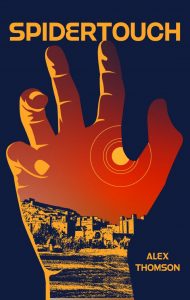
Today we have a special guest post from Alex Thomson author of Spidertouch which is out 14th December from Angry Robot.
We’re also bringing you a special discount on this title which can be used on Angry Robot’s brand new website, where you can now purchase physical copies as well as ebooks and audiobooks. Just use code ”fantasyhive” for 25% off until 4th Dec.
Below is a glimpse into how Alex created his language within the book:
Speaking with your fingers: How I constructed a fictional touch language
There are three basic techniques for creating languages in fiction. The first is what you might call the kitchen-sink approach, favoured by Tolkien, which sees an author creating a whole language in astonishing detail, often over a series of books spanning decades. The second, and most common, is the creation of a “micro-dictionary”, where the author invents a dozen key terms and sprinkles them regularly through the text, to give the reader a flavour of the language. In A Game of Thrones, for example, George R. R. Martin conveys a sense of Dothraki with just a handful of words – khaleesi, khalasar, ko – as well as a few translated phrases that hint at the language’s Otherness: “my sun-and-stars” and “it is known”. It was not until the television series that HBO brought in a language consultant to bulk it out, and formally create a detailed “conlang” (constructed language). But the third method, which I adopted in my novel Spidertouch with “fingerspeak”, is to come up with a new method of communication that is non-auditory, i.e. does not depend on the listener hearing the words of the speaker. There is a fine tradition of this in science fiction, especially when aliens are featured. But I had never come across a touch language before. We have braille and sign language in real life, not to mention a host of other ingenious systems in fiction. The sense of touch, however, is shamefully underused in human society. I wanted to write a novel that featured a touch language, with an interpreter as the hero, in a city ruled by mute enslavers who “fingerspoke”.
 When considering how to create a touch language, one key influence was my experience playing the bongos. I taught myself many years ago, even playing them in an acoustic band (Mango and the Chutneys, since you ask). There are lots of different ways to hit the bongos – taps, slaps, trills – and I thought this would be a perfect way to distinguish between words in a touch language. I decided the most natural way for a touch language to evolve would be by using each others’ arms, and it felt a very intimate way to communicate, two “fingerspeakers” holding forearms in an unbroken circle. Finally, I chose to use three silver bands on the arm to make further distinctions between words (“touches”), much like different frets on a guitar. The second key experience was having studied languages (French and Spanish), and ending up with a career teaching them to secondary school students. Trying to translate between languages word-for-word is a classic rookie blunder (try using google translate with a less well-known language, if you want to test how accurate that strategy is). All languages evolve differently, even close neighbours on the linguistic family tree, and what seems natural to us is nonsensical to others. This is partly why I found it more interesting to invent a new system rather than adopt the “micro-dictionary” approach. It was essential to consider how such a language might evolve differently from speech, and what grammatical and syntactic features would ensure it was just as effective as speech at conveying information. I decided it would probably be a big user of “compound touches”, or joining together two touches to form a new concept. So /CityWar/ for example, is “Siege”, and /MoneySoldier/ means “Mercenary”. I decided that the morphology of the language would be different, and there would need to be a clear way to express tone: so I included distinct modifying touches at the start of a phrase, to express features such as a verb’s tense – /(Future)/ – and the mood of a speaker – /(Disgust)/. I would have loved to explore the language further with more in-depth language geekery, but fortunately my editor advised against it: an appendix on the nuances of the subjunctive mood in fingerspeak might alienate the more casual reader.
The biggest challenges were often prosaic, and a matter of ensuring all linguistic developments were plausible. How would the touchers get each other’s attention at a distance, without the power of speech? I ended up creating high-pitched whistles that they carry with them. What about names? Normally we do not translate names – you just reconfigure them in a dodgy accent and your own phonetic system – bonjour Jean, hola Javier. When using speech instead of touching, the citizens of my novel would have to find a way to give names to the individual mutants: so they call one Eleven, because the name comprises of eleven distinct touches. Finally, no language develops without other variants, slang and creole versions – I invented Knuckles, a pidgin version of the language that some of the citizens would use to bring it closer in line to speech. One trap I wanted to avoid was trying to create a language that was perfect, or designed too well. Fingerspeaking undoubtedly has some advantages – impossible to eavesdrop on, and bringing an intimacy that speech does not always permit. But it can also be frustrating and irregular, as all organic languages should be. I am a huge admirer of artificial languages such as Esperanto and Volapük, that were created with the noble aims of uniting the world and bringing global peace. And yet, their sterile perfection, the regularity of their grammars, are the very reason they could never be adopted as a global tongue. The ur-myth of the Tower of Babel looms large in our collective memory, and many SFF universes have some kind of common tongue that unites the world. For me, however, the kind of language difficulties that separate natives and foreigners, or speakers and fingerspeakers, are what make us human. As online translation evolves, we are getting closer and closer to the Babel fish that Douglas Adams imagined (it is the reason so many of my students question the need to learn languages). What a loss, though, that would be.
Alex Thomson is the author of Death of a Clone, published in 2018. He lives in Letchworth Garden City – home of the UK’s first roundabout – and his day job is a French and Spanish teacher in Luton