
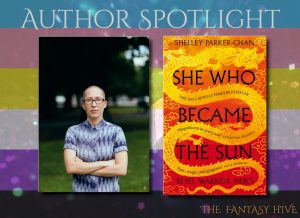
Interview with Shelley Parker-Chan (SHE WHO BECAME THE SUN)
Shelley Parker-Chan is an Asian-Australian former diplomat and international development adviser who spent nearly a decade working on human rights, gender equality and LGBT rights in Southeast Asia. Named after the Romantic poet, she was raised on a steady diet of Greek myths, Arthurian legend and Chinese tales of suffering and tragic romance. Her debut novel She Who Became the Sun owes more than a little to all three. In 2017 she was awarded an Otherwise (Tiptree) Fellowship for a work of speculative narrative that expands our understanding of gender. She currently lives in Melbourne, Australia, with her family.
Pronouns: she/they
Welcome to the Hive Shelley! We’ve been hosting a readalong of She Who Became the Sun so it’s a great opportunity to interview you!
Thanks for picking She Who Became the Sun for a readalong! Really hope it was enjoyable.
Firstly congratulations on the huge success of She Who Became the Sun! Did you expect to have such a great response?
Not at all! I had a lot of luck with the timing, the book just coming out when there was a rising interest in Chinese fantasy due to the popularity of various TV series and translated webnovels. You can’t expect that to happen. Books like The Poppy War also paved the way, for which I’m extremely grateful.
Just for a bit of fun, could you describe your book in five words?
Epic revenge of the genderqueers.
Ha! Perfect!
Ok, She Who Became the Sun has been lauded for both its queer rep, but also for bringing east-Asian stories and history into the western fantasy perspective. How important are both aspects to you?
There’s a long history of western SFF taking inspiration from Asia, from Blade Runner and Star Wars to your secondary-world-but-actually-Japan feudal sword fantasies. But as a member of the Asian diaspora, you definitely notice when stories present an aesthetic as opposed to a culture. It was important to me to show characters shaped by a culture and worldview—and the ways in which that culture is processed through individual perspectives that have been formed by personal history, personality, social pressures, trauma. I wanted to depict all that interiority, the experience of being Asian, which can be something to be proud of—but at the same time can come with shame, ambivalence, even outright rejection. It’s the same with queerness. I wanted to explore how queerness makes you see and understand the world in a particular way, how it makes you feel in relation to other people, how it causes you to move through the world differently. Queerness isn’t just the act of expressing your sexuality. It’s a perspective.
Were there any particular constraints you overcame in achieving this?
Most of the constraints are internal: the constant questioning of yourself as qualified to write about these topics, about this history, the feeling of whether you dare to criticise and express ambivalence about your own culture. It’s uncomfortable to know that if you do succeed in getting published, you’ll be a minority perspective and suddenly the bearer of this immense burden of representation. Readers who are like you desperately want you to get it right—but of course, there’s no one ‘right’ way to depict heterogenous experience, so of course one story can never satisfy everyone. And for readers who aren’t like you, perhaps they don’t get where you’re coming from; you have to do this tremendous work of making yourself relatable. Of explaining things that could otherwise have remained implicit. It was so important to surround myself with other authors experiencing the same, so we could support each other through the process.
I’m so glad to hear you had a support network throughout that process.
Let’s take a closer look at your characters! We loved following Zhu and her evolution through the story. Can you tell our readers more about her?
Zhu’s defining characteristic is the strength of her desire to survive. According to the values of the time, her life is worthless: she’s an ugly, illiterate peasant girl from the subjugated south of Mongol China. But Zhu rejects that judgement. Her life has value to her, and she’ll do anything to keep it. Part of how she survives is by refusing to be constrained by any one identity. She’s constantly slipping between names, genders, social roles. She learns to delight in that slippage, to find power in the interstices.
Her archetype is the underdog trickster king—she’s inspired by Dorothy Dunnett’s Niccolo, Kenshin Himura from the Rurouni Kenshin series, Gen from Megan Whalen Turner’s The Thief. The crucial difference being that those characters are men. Their character traits are entangled with the way they understand their gender, their masculinity, and how they consciously or subconsciously perform it to the world—and how the world reacts to that performance. Zhu is AFAB. You can’t graft character traits wholesale from a cis man onto someone who isn’t, and expect that character to feel coherent. Zhu might have the ambition and cynical ruthlessness of the OG Zhu Yuanzhang, and Kenshin’s combination of playfulness and deadly competence, and Gen’s hidden identity, but those traits have different expressions in her person, in her body, because of who she is and what she’s been.
When it came to Zhu’s adversary, Ouyang, he demonstrates incredible depth and complexity – his approach to his identity is the complete opposite to Zhu’s. Could you tell us more about how it was to create these two opposing perspectives?
Ouyang isn’t a historical figure. He arose a bit later in the development process, when I realised that if I wanted a protagonist whose story was about freeing herself from gender, from her assigned place in society, I needed an antagonist who was the other side of the coin: someone trapped in his gender, someone who was unable to see or accept the existence of alternative ways of being. Zhu and Ouyang are two queer people, they’re two people who aren’t cis, but they’ve been shaped uniquely by their experiences and environment—as are we all. But I also didn’t want to throw out the element of personal agency. I think Zhu and Ouyang’s differing understandings of their ability to choose, to have power over their individual situations, are one of the most interesting things about them as a dyad. (And it’s a big part of Book 2.)
Your prose is stunning and you really bring the world of 14th century China to life. Did it require a lot of research?
I love research—it feels very virtuous—but less as a means of acquiring Facts than for it filling my brain with sparkly inspiration. I read histories; I read the classics; I read about the lives of ordinary people and about art; I read the Secret History of the Mongols. I lived in Asia so I went to a lot of museums. I watched dramas and told myself it was research. I’d come across some fascinating minor historical figure, like the half-Mongol half-Chinese Prince of Henan who strove to be a perfect Mongol warrior and defender of empire, and whose Chinese enemies would scream out his Chinese baby name on the battlefield to piss him off, and I’d be like: him, I must have him in this book! But once I started writing, I stopped researching. I maintain that my book is no less historically accurate than a mid-budget cdrama, and I’m at peace with that. I’m here to have fun.
And how difficult was it to focus yourself to just one story whilst researching? In line with this, are there any other historical figures whose stories you’d love to tell?
Not so difficult, I’m not one of those people who have a million story ideas percolating at once. I wish I was! I have a lot of envy of people who seem to generate ideas spontaneously, while I have to scrouge around super hard to find something that seems like it’ll have enough substance and momentum to turn into a book. For a while I was considering doing a retelling of a particular episode in the Bible, but the idea of playing in that particular sandbox is daunting, so I think I’ll wait to level up in skills before addressing that one. I’m going to try a secondary world next—I want the freedom of just making things up!
A secondary world sounds exciting!
One of our favourite questions here on the Fantasy Hive: which fantastical creature would you ride into battle and why?
Battle lizard, for sure, preferably one with telepathic bonding (of course).
Obvs.
Did you always plan to write a duology or did this occur naturally as you began writing? And can you give your readers any teasers for the sequel?
It was originally conceived of as a trilogy, but Tor bought two, so two it is! Such are the ways of publishing. (To be honest, I’m thankful I don’t have to write three: I think two is the right length.) Book 2 is about the journeys of three main contenders for the throne, and what each of their identities would imply for the institution of empire were they to become emperor. Zhu is obviously one contender, and there’s a man, and a woman. One of the central questions of She Who Became the Sun was: what will you do to get what you want? The sequel asks: what are the consequences of what you did, to get what you wanted? How do you deal with those consequences, how do they inform your future choices, and what kind of person do you become because of them?
Finally, what is the one thing you hope readers take away from your writing?
I always hesitate to tell people what they should feel about anything, but I know what I wanted to achieve: a story that’s fun, immersive and cathartic. I wanted something that shows how what the world views as your weakness, and despises you for, can in fact be a source of strength. If you choose for it to be!
Thank you so much for joining us!

[…] https://www.liminalmag.com/interviews/shelley-parker-chan https://thenerddaily.com/shelley-parker-chan-author-interview/https://fantasy-hive.co.uk/2022/06/interview-with-shelley-parker-chan-she-who-became-the-sun/https://thequietpond.wordpress.com/2021/05/02/an-interview-with-shelley-parker-chan-author-of-she-who-became-the-sun-on-the-intersections-of-gender-and-culture-craft-challenges-and-writing-complex-characters/https://itsjustacoffeeaddictedbibliophile.wordpress.com/2021/10/04/interview-with-shelley-parker-chan-author-of-the-epic-queer-chinese-inspired-fantasy-she-who-became-the-sun/https://thenerddaily.com/shelley-parker-chan-author-interview/https://twitter.com/mariamarcelw/status/1432282868936429571/photo/1 […]
[…] Interview with Shelley Parker-Chan (SHE WHO BECAME THE SUN) […]