THE FLIGHT FROM THE ENCHANTER by Iris Murdock (BOOK REVIEW)
“You will never know the truth, and you will read the signs in accordance with your deepest wishes. That is what we humans always have to do. Reality is a cipher with many solutions, all of them right ones.”
Iris Murdoch published The Flight From The Enchanter (1955) a year after her remarkable debut novel Under The Net (1954). Like her previous novel, it is usually thought of as literary fiction, but Murdoch continues to explore ideas around the malleability of consensus reality and the impossibility of true communication with a flare and inventiveness that would make any SF author proud. However, The Flight From The Enchanter, as its title suggests, is enlivened with rather more touches of the gothic and the fantastic than its predecessor, whilst making strong use of a largely realist setting. At the centre of the novel is the inexorable presence of the enchanter himself, the fabulously rich Mischa Fox. Equal parts charming and sinister, Mischa is a magus-like figure who holds all the characters under his influence. Whether not Mischa’s control stems from his intelligence and charisma or something darker and more mysterious, The Flight From The Enchanter is a novel that revels in its gothic darkness, full of mysterious characters, doubles and doppelgangers, and a sublimated but ever-present sense of threat.
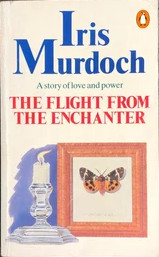 Whilst Under The Net was largely focused on the first-person perspective of Jake Donaghue and his various picaresque misadventures, The Flight From The Enchanter has a much larger cast, and is told in third person, switching between a number of characters’ perspectives, all of whom are caught in Mischa Fox’s seductive web. Rosa Keepe is a working woman at a local factory who turned down a marriage proposal from Mischa ten years ago, but now finds herself drawn back into Mischa’s sphere of influence as he proposes to buy the suffragette magazine Artemis edited by her brother Hunter to rescue it from financial troubles. She is currently engaged in an affair with two Polish immigrants, Jan and Stefan Lusiewicz, whilst academic Peter Saward admires her from afar when not absorbed in his arcane research. Naïve but precocious ingenue Annette Cockeyne has left her restrictive ladies’ college to learn from the university of life and is staying with the Keepes, and soon becomes infatuated with Mischa. Nina the dressmaker is another Eastern European immigrant who makes clothes for both Annette and Rosa whilst dreaming of a way to escape Mischa’s control over her life. Meanwhile John Rainborough laments his stalled career and lives in fear of his ambitious secretary Miss Casement, who is slowly gaining more control and agency at his civil service job than he ever has. All these characters are caught between desperately seeking Mischa’s attention and approval and trying to escape his influence, as Mischa, with the help of his sinister and feared right hand man Calvin Blick, manipulates them all behind the scenes.
The Flight From The Enchanter is a book full of doubles, starting most obviously with Mischa and Calvin. Rainborough notes near the beginning of the novel that:
“Blick is the dark half of Mischa Fox’s mind … He does the things which Mischa doesn’t even think of. That’s how Mischa can be so innocent.”
Calvin Blick physically embodies the nastier side of Mischa Fox, carrying out his threats and blackmail that are necessary for Mischa’s maintenance of power, allowing Mischa to be free to use his incredible charisma to attract his followers. Over the course of the novel, we come to realise that Calvin is utterly essential to the maintenance of Mischa’s little empire, that all his unpleasant underhanded doings are done entirely with Mischa’s knowledge and consent, and that he is as helpless a devotee to Mischa and his powers as anyone else in the book. But Calvin and Mischa are only one of the novel’s many co-dependent pairs of opposites. The nervous and timid Hunter is entirely reliant on his sister Rosa’s common sense and practicality, and is utterly unable to function without her supervision. Similarly John Rainborough, for all his self-importance, is an ineffectual figure compared to the ambitious, smart and practical Miss Casement. The novel reflects the anxieties at the time of women taking on a more prominent role in the workplace, something which Murdoch gleefully satirises with the book’s prissy and ineffectual men sharing workplaces with devastatingly competent and smart women. The Lusiewicz brothers provide another sinister image of doubling. Although Jan is revealed to be the slightly more malevolent of the two, both him and Stefan are so tightly bonded, even insisting on sharing lovers between them. With their stories of growing up in a small Eastern European village, they are figures infused with folklore, who exert their own almost magical pull over Rosa until she feels her only option is to allow herself to fall back under Mischa’s power and protection.
The Flight From The Enchanter is suffused with gothic intensity and a heightened sense of reality. Even more so than Under The Net, there is the sense that everything the characters experience is ever-so-carefully staged by Mischa and Colin in order to elicit their desired outcomes. There are numerous passages that tip over into the sinister and the strange, in particular centred around Mischa’s mysterious mansion, the seat of his power. A vast building whose geography never quite makes sense, the house is full of strange rooms that don’t seem to fit and has a series of hidden tunnels running underneath it. From a party Mischa throws where the tensions between many of the novel’s characters are forced into the open to Colin’s confrontation of Hunter in the tunnels beneath the city, all the scenes that take place there operate in a dream-like liminal space. Mischa exerts his power through the intangible forces that shape our modern society – money and political influence. And like all who wield money and political influence to their own end, he can be capricious and destructive in ways that spill over into everyday peoples’ lives, as we see when his terrible revenge against the Lusiewicz brothers catches Nina in its crossfire. But how much of his power is down to charisma and cunning? Is there a magical aspect to our Enchanter’s terrible and inexorable power? The closest we get to an answer is this exchange between Annette and Mischa during the party at his house, ostensibly about Mischa’s interior décor but more broadly applicable to his entire operation:
“’Was it magic?’ asked Annette.
“’No,’ said Mischa, ‘or only in the way in which magic can be part of ordinary life.’”
Like in Under The Net, no one can truly know anyone else’s subjective reality, and what we construe as the truth is only what we are able to perceive of it and interpret via our own perspectives and biases. To the characters in The Flight From The Enchanter, they have made Mischa their god, so for them his dark, seductive magic is very real, however mundane or sordid the real-life means he uses to achieve his desires.