ANIMALS AT NIGHT by Naomi Booth (BOOK REVIEW)
“They’re getting drunk and reminiscing about their old lives, about gigs and parties and festivals on faraway beaches where they’d danced and played like animals at night, nocturnal and wild.”
Naomi Booth’s debut novel Sealed (2017) was a thought-provoking and disturbing near-future climate disaster novel, and established her as an exciting writer who is able to tackle both speculative ideas and well-developed character meditations. Animals At Night (2022), Booth’s first short story collection, demonstrates her mastery of short fiction that crosses the genre/literary divide. The fourteen stories collected here defy easy categorisation, but each one is a sharp meditation on interpersonal relations and the vast impersonal forces that act on them. These are stories that are haunted by the gothic and the speculative, with themes like mortality and our relationship with the nonhuman world recurring throughout.
 The collection opens with the harrowing ‘Strangers’, in which the protagonist takes a final journey with her dead mother to visit the people in her life before her body is buried. The story uses the grim and unusual image of a woman carrying her mother’s corpse in the back of her campervan to explore the sense of alienation that comes with knowledge of mortality, that we are all growing apart from the people closest to us that we thought we knew. Although never making the transition into horror or the fantastical, the uncanniness and uncomfortableness of the story play an essential role in its impact. The same can be said of many of the collection’s stories. Alienation and distance are recurring images, with characters lamenting missed connections or reflecting on people who have fallen out of their lives, like the two young people in ‘Forever Chemicals’ who have grown up and grown apart, or the recovering drug addict in ‘Days Clean’ and her brief physical reconnection with a boy she used to know in school. Other stories are short, sharp character pieces, only extending across a couple of pages but vividly putting the reader in a heightened moment in a character’s life. ‘Plausible Objects’ delineates the messiness of human sexual encounters, whilst ‘Lovebirds’ is a harrowing snapshot of a loved one’s breakdown. ‘Intermittent Visual Disturbances’ is a moving exploration of one woman’s response to illness and trauma.
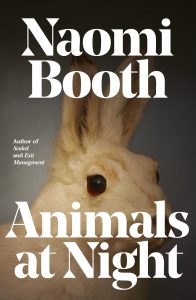
Many of the stories derive their force from their proximity to the animal. In ‘Cluster’, an exhausted young mother communes with the disturbing human and animal noises of the nocturnal city, as she feels more and more disconnected from her waking life. ‘Animals At Night’ contrasts the previous party life of two young couples with the stresses and strains of being a young parent, the new and terrible responsibility of care emphasised by a mother’s duty to a rabbit dying a horrible death. ‘Tell Me What You Like’ explores the curious ambivalence of grief, as a woman mourning the death of her husband has a profound encounter with a dying jellyfish. In ‘Clean Work’, a young mother struggles with the unpleasantness of exterminating a rat infestation. And ‘The Chrysalides’ explores the claustrophobia of lockdown and the responsibilities of explaining the harsh truths of the world via the metamorphoses of caterpillars into butterflies. In these stories, Booth explores the symbolic role of animals in how we understand our own mortality and place in the world, whilst refusing to use animals as merely metaphors for an anthropocentric understanding of the world, as one of the characters points out in ‘The Chrysalides’:
“No, Sam said. He was brittle in his response. I was making outlandish comparisons, he said. The change we had just witnessed wasn’t mammalian. Mammals were different. Mammals couldn’t make gold from shit. And why did I think that animal processes were metaphors? They weren’t. They were specific and real, he said, and to think that human change is inevitable is complacent.”
Whatever resonance Booth’s lost and damaged characters find in the animals they encounter, it is a reflection of their own human existence. The animals themselves are their own beings that stand outside our language, our cultural resonances, another form of strangers that we can never fully know.
The final story ‘Sour Hall’ is an elegant work of folk horror that ties together many of the collection’s themes and concerns. Set in an ancient farm in the countryside of Yorkshire, the story follows a lesbian couple, George and Ashleigh. who inherit and run George’s father’s dairy farm which is haunted by a boggart. The story is an incredible piece of writing, drawing parallels between the haunting of the farm and the past trauma that haunts Ashleigh. In the end, there is no escape from either, but through their love and mutual support, George and Ashleigh are able to build a life around the boggart and their traumas. The story is a fitting summation to the collection, drawing together the speculative and the fantastical with the deeply personal in order to say something striking and profound about both. As such it is an excellent example of what Booth achieves through her writing.