Neography with Worldbuilding in Mind – GUEST POST by Cheryl Bowman
Neography with Worldbuilding in Mind
by Cheryl Bowman
It’s always an awkward conversation when someone asks what I do. Not that it’s difficult to talk about, designing scripts is fascinating work! There is usually something related to it in either nerdom or the real world that people are happy to discuss with me. But those conversations are prefaced with:
“You make… scripts? Do you mean for movies or like as a programmer?”
“No actually, I make writing systems, or at least the visual aspect. You remember Elvish in Lord of the Rings?”
“Oh so like those alphabet codes we played with in grade school. Cool.”
“It’s more like… you know what, sure. Let’s go with that.”
And that’s why I like the word Neography. (I can’t claim credit for the term, I saw it first as the subreddit for writing systems for the constructed language community.) Sadly it will clear up zero confusion when introducing people to the art, because generally people are unused to sussing out definitions from word roots. But having a specific name for this genre of work that distinguishes it from everything else that falls under the ‘script’ umbrella solidifies its place as an art form and area of study. Or even as a thing that you can take interest in.
Besides, ‘neography’ better encompasses all of the interesting things you can include as a conlanger or worldbuilder or author. Your ‘new writing’ is about so much more than just what it looks like, it’s about how it came about and what caused it to look the way it does, and why your character is interacting with it. Your writing system will be rich when you develop it with and for your world.
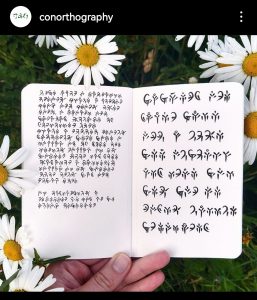 Pictograms and logographies are perhaps the most fruitful medium for your worldbuilding to shine through. Pictograms are drawings of the literal thing you’re depicting, and a logography broadens from that. It will include characters for concepts like “blue” or “feasible” that probably don’t have a single obvious image to go with it. But both of these systems start with the premise of drawing the world, and if your world contains impactful aspects unique to itself, you’ve got ambience and exposition all rolled into one. Do you need a character for “annihilation”? There’s a monster for that. Need a determinative to indicate “platonic intimacy”? There’s a telepathy magic for that. Need a fantasy “Warning Hazard Do Not Cross” sign accessible to the illiterate? I’m sure you’ve got a natural disaster you just needed the opportunity to introduce.
All these little developments in your written communication symbiotically feed into your cultural worldbuilding. As those concepts are solidified as prominent ideas in society’s psyche, the ways your characters interact with each other and the world itself changes. This applies to any writing system of course, not just logographies. Imagine if an orthography was visually based on a yin and yang style of balance. That would become a fundamental pillar of good poetry, and might affect other arts like rhetoric and theatre. Those in turn would change how the populace holds discourse, what the ‘important questions’ really are, and what their memes are like.
This kind of symbiotic relationship is available with any sort of contemporary visual art. Your script might share a shape language, symbolism, mythological association, or visual stylisation with whatever your people are using to express themselves. Maybe the leather worker made a messaging system with his round and square stamps that evolved into writing. Maybe the priest who inscribes the warding stones around his temple started making simplified versions for his children who suffer from nightmares, and the small stones hold the same curving serpents but are less ornate. Or maybe the calligrapher who is on the cutting edge of her craft spent a day dyeing cloth with her friend and now half the citadel wears pants with bold, sweeping patterns on them. The why and how are limited only by your imagination.
This doesn’t even need to apply only to a highly developed writing system either. There can be a grey area between writing and art, where the writing system is less word for word and more a collection of thoughts in an art piece. Note that this does not exclude complex concepts from being conveyed, it may just lack the specificity that other types of writing can achieve. You couldn’t use it to write a PhD thesis but you could use it to record stories and events, or posit any idea that has an established visual archetype. You can adjust your writing system anywhere on the spectrum between cave paintings and hieroglyphs by adding more and more characters to increase its specificity. Real world hieroglyphs are such a great example of the intersection of art and writing. Both Egyptian and Mayan writing are so gorgeously stylized, we consider the writings themselves art and can recognize their styles even if we have no idea how to read them.
You can take the same concept of adapting writing from art and apply it to your people’s magic system. Does your world have magical runes that are named for each of the sounds the people use? Those are perfect to start writing with. Do your characters have to draw magic circles? Circles are now shapes they’re familiar with drawing and they might use that as a foundation for their writing. Maybe they can straight up steal the magic circles used to conjure fire and draw those when they want to write about fire- except for the activating mark of course. But they could use a magically inert medium to prevent accidents like that from happening. Unless perhaps you don’t use the same shapes the magic system uses, but borrow the medium instead. If your magic needs to be pyro-inscribed into strips of wood, and has widespread use, maybe all of the people’s written correspondences are burned into the same strips since they have a stack of them laying around anyway.
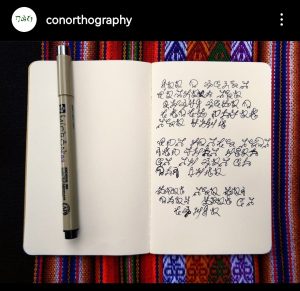 Deriving your writing from a magic system can allow you to have a very complicated script if you’re working with hard magic and a lot of nuanced rules. Maybe you’d like to justify an elaborate script you’ve worked hard on, but don’t want to be leashed by your magic. Well I’ve got a solution for you, IT WAS THE GODS.
“That sounds like lazy worldbuilding,” I can hear you say, “to have a fairy-god mother device that just grants you a pretty alphabet.” Nay, I say, it just needs some spice. Writing may have been stolen from a pantheon by a human servant and now humanity is cursed for it. It could have been revived from the past when the ruins of an ancient advanced civilization were adopted as a people’s new home. Perhaps it was gifted by a deity who will only allow it to be used by their patrons for important documents. Any of these have far reaching consequences for your worldbuilding, and by extension, your story.
And on the topic of deities and patrons, religion can have an astounding impact on the methods of writing or how widespread its use is, regardless whether or not writing was gifted by the respective belief system. I propose we divide that impact into two categories: Safekeeping and Gatekeeping. If a religion is gatekeeping writing, it may be because the sacred nature of the script is so entwined with the holy divine that no one except the religious elite are allowed to use it at all. And if that’s the only script people have, then the elite are the only ones with that method of communication between themselves, or at the very least, the only ones capable of performing certain rituals requiring writing. But religion may also be used as the last bastion safekeeping the sacred and economical art of writing. Everyone else might be poor and illiterate, or rich and illiterate, or their traditional writing and communication has been replaced with other communication. Whether it fell out of use thanks to the evolution of technology or by oppression of another means of writing/communication, traditional writing methods can be kept in a sort of living time capsule within religious sects preserving written artefacts and writing traditions.
After a period of careful preservation by a small group, eventually your people may find a renaissance of art and communication where writing is not only reinstated in society as the norm but is also standardized by either mass production techniques or a truly persevering individual. Standardization will streamline your script, but whether it becomes more or less complex can go either way. Take our own historical printing press and its effects. In the Latin alphabet we got extra serifs and terminals that make the letters look very nice and are too much trouble to bother with when writing by hand. But with Japanese Hiragana, characters that were once highly varied and expressive to reflect the mood of the writer had to be locked into a single shape for efficiency. Personally, I’ve been enjoying the freedom of working with fonts in my designs. I might initially start with a traditional medium but I know I won’t be bound by that, and I can add all the shapes and flourishes the script needs without them having to be possible with a pen.
If you’re feeling particularly ambitious, you can start with a chosen form of proto-writing and comb the tines of history through it until you have six eras of orthographies and a half dozen modern day scripts. You’ll end up with something that breathes its own life into your world, both refined and scarred by use. But for those of us without that kind of time, start with a single idea and one or two influencing factors. While I do recommend evolving it once if you can (you might be surprised with what you can come up with that wouldn’t have otherwise been possible working from scratch!), in the end having scripts as part of your story and worldbuilding are meant to enrich the emersion for everybody. Do what you’re comfortable with, and enjoy the process! Be awesome and make awesome, World Maker.