SIGNAL TO NOISE by Silvia Moreno-Garcia (BOOK REVIEW)
Originally published in 2015 and republished this year, Moreno-Garcia’s debut novel, Signal to Noise hearkens of old, new, broken, and mended love, of what it means to follow a passion and the bittersweetness of failure. It tells the story of Meche, her friends Sebastián and Daniela and their families, past and present, jumping between 1988 and 2009 and filling in the resulting gaps. Throughout, the vibrations of romance and the fantastic of Moreno-Garcia’s later novels reverberate and we feel hints of Mexican Gothic (2020) and Velvet Was the Night (2021) as magic slips into the real world.
We meet Meche in the present as a woman in her twenties travelling back from her new home in Norway to Mexico City for the funeral of her father, Vicente. Gradually, her past is hinted at before we’re dropped into it, with most of the novel taking place in 1988, switching character perspectives throughout. We learn about how Vicenta and Meche’s mother, Natalia fell in love and fell apart, ultimately divorcing. We see the trio of friends drift apart to the point that they are mostly no longer on speaking terms, and as the novel progresses we discover how magic and its misuse has shaped their lives.
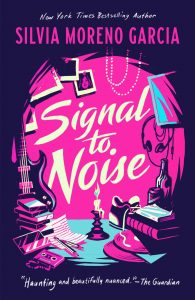 The group are your typical teenage misfits with a Breakfast Club-esque aesthetic, each with their own quirky interests—Meche is music obsessed, Sebastián a bookworm, and Daniela a chronic baker. They each have problems at home and fitting in at school, with their most prominent desires being romance-focused. Meche has a crush on a guy and Sebastián likes a girl. Both are unrequited loves and both spread into intersecting love triangles and conflicts. It feels a touch predictable as the Sebastián-Meche connection is blatantly obvious throughout, oftentimes feeling cheesy. They constantly interrogate one another about their love interests, with Daniela often thrust to the side into the position of mediator.
As with any good teenage misfit tale, music is at the heart of the story with Meche adopting the interest from Vicente. It fills her days as she walks about her school constantly listening to her Walkman, blocking out her problems through music, and in the present, she relives her connection with her deceased father by sifting through his vinyl collection. Paragraphs are speckled with music trivia as Meche touts the glories of relatively mainstream artists such as Ella Fitzgerald and The Kinks while also veering towards more niche Mexican musicians such as Agustin Lara. Thankfully, it never feels forced, and there is also the added bonus that the music can be accessed through a Spotify playlist Moreno-Garcia has made available on her website.
“Okay, now we hold hands and dance around it,” Meche said.
“Really,” Sebastián replied dryly.
“Yes. That’s what witches do. They dance around the fire. Only we don’t have a fire, so we’ll dance around the record player.”
Due to its centrality, it feels natural when Meche finds a connection between music and magic. Through playing specific records and dancing and engaging with the music, they discover that they can conduct different spells. It’s an interesting twist on spellcasting and isn’t too simple or straightforward. Rather spells are something that the characters must feel out and discuss together. For example, when wanting to get more famous, Sebastián quite naturally suggests David Bowie’s song Fame but is reprimanded by Meche, stating that it’s too obvious, “No, using that song is lame. There’s like zero effort.” Perhaps because of this ethereal nature, the magic system never feels as though it’s fully fleshed out, with just hints being given of how Meche’s grandmother previously used magic but through her sewing.
Through using magic, the three friends try to influence their lives in a variety of ways from the simplicity of both Meche and Sebastián trying to impress their love interests to Meche trying to keep her parents together, Daniela dealing with an abusive adult, and Sebastián trying to pull himself out of poverty. Meche begins to veer toward a darker more revenge focussed perspective with the other pair trying to reel her in. As with Mexican Gothic, the problems in the novel feel very much like a product of its time and place, drawing in aspects of Mexican culture, with colonialism acting as a backdrop to its events.
‘Mexico City was sinking. A city slowly descending into the muck from where it had come. The Spaniards had drained its Venice-like canals and filled them with earth, creating shaky foundations for their churches. Centuries later, their descendants paid for their folly with constant inundations which threatened to turn the whole metropolis into the lake it had been when the Aztecs made their way there.’
Moreno-Garcia asks how the past determines our life choices, with Meche being influenced greatly by her parents whose tale runs through the story. We see how Natalia and Vicente once loved one another and how this fades over the years as their lives change. Vicente starts as someone lovable, quirky and with a persistent ambition to write a book. However, once he gets married and has Meche, he becomes embittered, shirks his responsibilities, and turns to alcohol. Natalia is forced to deal with the practicalities of money, bemoans Vicente for persisting with his ‘worthless book’, and the two pull away from one another. It is your typical ‘fun dad,’ ‘strict mum’ situation, but it is fascinating to read, partly because for the most part, neither parent feels as though they’re completely in the wrong.
Unfortunately, we don’t get too much Natalia and it is Vicente who gets more attention throughout, but his character is fascinating and tragic. Despite or maybe because of his selfish and irritable flaws, I found myself wanting to cheer him on, and this is even with the present-day chapters letting me know that he is doomed to fail in his writing. We realise quickly that he never escapes to a peaceful land to ‘spend the end of his days on a beach, watching the waves come in.’ As Meche uncovers more of his life, we see how heartbreaking his final days were, and the connection that is established posthumously between daughter and father is truly beautiful. Vicente’s dreams are still present in his later life, and his music and desire to escape and find a new home within Meche and Sebastián.
I think my attachment to Vicente captures what I love about this novel as well as what alienates me from it. Maybe it’s just being older, in my thirties, but I found the teen romance elements were often cheesy, melodramatic and predictable. However, their presence does allow for more complex issues around social class, poverty, and fate to be explored in the story. We know Vicente will die of alcoholism and the trio of friends will split apart, but despite this inevitability, the gaps and paths show us that what is interesting and fascinating in life is not just the end result but what comes before and after it. Signal to Noise likewise shows how Moreno-Garcia’s work began and the buddings of her themes and voice that we see in her stellar work today.