THE TEN PERCENT THIEF by Lavanya Lakshminarayan (BOOK REVIEW)
Nobody notices anything because nothing has happened. Not yet, anyway.
This is how all things begin. And end.
Lavanya Lakshminarayan is a Locus Award finalist and is the first science fiction writer to win the Times of India AutHer Award and the Valley of Words Award, both prestigious literary awards in India, and her work has been longlisted for a BSFA Award. She’s occasionally a game designer, and has built worlds for Zynga Inc.’s FarmVille franchise, Mafia Wars, and other games. She lives in India, and is currently working on her next novel.
Originally published under the name ’Analog/Virtual,’ in South Asia, The Ten Percent Thief is the debut novel of Lavanya Lakshminarayan. Written as a mosaic novel, Lakshminarayan holds your hand and guides you through the world of Apex City, formerly Bangalore. Through the novels disorientating narrative, you are flung from time to time and learn about people from all walks of life, from the Ten Percent who are harvested for organs to the rich and famous Twenty Percent, who believe they are better than any other Virtual or Analog who happens to breath Apex City air.
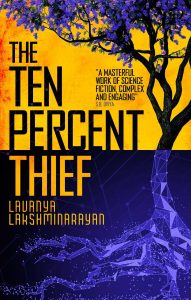 From the moment you open the pages of The Ten Percent Thief, you are faced with a great many technological details. As such, it took some time for me to navigate. Apex City is run by the Bell Corporation, who mathematically measure everything with the Bell Curve. This method measures a person’s productivity, emotions, weight, expenses and everything in between – from the material and physical to the psychological or inner mind. All of the Virtual’s can be measured in this way, Virtual’s are the individuals who live in the upper curve, with technological augmentations that make these measurements possible. Those at the top have the ‘correct’ image, values, persona and opinions, as well as the highest levels of productivity possible, these Virtual’s are the Twenty Percent, with access to the very latest and greatest technology, education and privilege possible. If you do not quite make the cut, but are still exceptional in every way, you will reside in the Seventy Percent, with many technological and educational advantaged, but made to feel mediocre and always striving to be the Twenty Percent. If you lack productivity, you will be demoted to an Analog. Analog’s live at the very bottom of society, with no running water, electricity, and a constant risk of being ‘harvested.’
‘Psychologists have found that Analog wards with a lower sense of personal identity are more Productive. They’re more eager to please if they perceive identity markers as rewards for good behaviour’
The novel follows a selection of Virtual’s and Analog’s, including an orphaned Analog who has been trained to be a professional pianist, various members of the revolutionary resistance who always linger in this type of novel, some of the most influential and wealthy of society, as well as the ‘corpse-climbers’ who try to climb in society – regardless of who gets hurt or harvested on the journey upwards. Whilst it is a challenge to connect with some of these characters, as they are often mentioned very briefly, some of their stories are truly intriguing. However, I do not believe the characters as individuals are supposed to be essential to this novel, they are more like wires that connect the stories together. The most important aspects of this novel appear to be the technological advances and augmented society that the characters live amongst. With too many similarities to other dystopian narratives with different layers of society. The most prevalent being Orwell’s 1984.
‘Productivity is Power. Passion is Priceless. Persona is Prime’
Doesn’t this mantra from Lakshminarayan’s novel ring alarm bells of familiarity? ‘War Is Peace, Freedom Is Slavery, and Ignorance Is Strength’ (Orwell, 1984). Whilst you may see no connections with Orwell’s work, all I could see was allusions. From seeing the Party members and the proles in the Virtual’s and the Analogs, the binary difference in the way of life in Apex City echoing Oceania’s divide almost exactly. Even Orwell’s NewSpeak (removal of certain words and concepts into a new language with simple syntax, void of certain emotive extremities like disagreement and discontent) can be glimmered through Lakshminarayan’s ‘Be-mojis,’ a technological holographic technology that allows a mask of an emoji to show on your face rather than using language. The similarities are hard to ignore, even though the narratives are drastically different.
‘Using BE-mojis leads to a 12 percent increase in Productivity. It’s hard to focus on work when your subconscious mind is thinking about how to communicate your wants, needs and emotions to people around you. We take this away, seamlessly integrating out technology with your Bell Biochip to relay instant messages. You will never have to say a word again’
In Apex City the most important currency is your productivity and your time. With similarities to Orwell, one might also sense similarities with Netflix’s Black Mirror, particularly the episode ‘Nosedive,’ where individuals score each other on a social media app. Productivity is all that matters in Apex City, which means that normal human emotion and biological activity is either discouraged or monitored (like in 1984…). One does not have time to grieve, one must have enough productivity and relationship points to get married or live together, and women are actively discouraged to carry children ‘the old-fashioned way’ and are encouraged to move the foetus into a ‘PregoPod’ within 90 days to safeguard their productivity and position. This is seen as a move towards ‘equal opportunity.’ But I found it HORRIFYING.
“Bell Corporation recommends the use of a PregaoPod transfer in order to safeguard a woman’s Virtual Citizen Report, inclusive of her Productivity Points, Social Persona – you know the list. However, should a woman choose to bear a child in-utero, she may do so, against the recommendation of the technarchy.”
Overall, I found this novel ambitious. Lakshminarayan is playing with concepts that have been done before, but sometimes trying to do something new with something old works out for the best. Whilst the novel is disorientating, confusing and has far too many characters to count, it is in this confusion and chaos that the lessons of the novel can be learnt. Lakshminarayan uses her novel to flawlessly confront constructed binaries built into the very fabric of contemporary society, and with the use of technological advancements and the Bell Curve, she shows us how important they are to destroy.