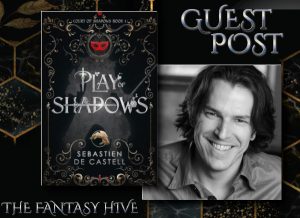
The Fantastical Magic of the Ordinary World – GUEST POST by Sebastien de Castell (PLAY OF SHADOWS)
Today, we’re delighted to welcome Sebastien de Castell to the Hive!
To celebrate the release of his first book in a brand new series, PLAY OF SHADOWS, Sebastien explores the process behind creating magic systems. Before we find out more, let’s check out Play of Shadows:
Swordplay, magic, intrigue and friendships stronger than iron: the first volume in the new swashbuckling fantasy series set in the universe of THE GREATCOATS.
Damelas Chademantaigne picked a poor night to flee a judicial duel.
He has precious little hope of escaping the wrath of the Vixen, the most feared duellist in the entire city, until he stumbles through the stage doors of the magnificent Operato Belleza and tricks his way into the company of actors. An archaic law provides a temporary respite from his troubles – until one night a ghostly voice in his head causes Damelas to fumble his lines, inadvertently blurting out a dreadful truth: the city’s most legendary hero may actually be a traitor and a brutal murderer.
With only the help of his boisterous and lusty friend Bereto, a beautiful assassin whose target may well be Damelas himself, and a company of misfit actors who’d just as soon see him dead, this failed grandson of two Greatcoats must somehow find within himself the courage to dig up long-buried truths before a ruthless band of bravos known as the Iron Orchids come for his head.
Oh, and there’s still that matter of the Vixen waiting to duel him . . .
Play of Shadows is available now, you can order your copy on Bookshop.org
The Fantastical Magic of the Ordinary World
by Sebastien de Castell
As a fantasy novelist, I’ve developed something of an obsession with magic. In the past ten years and across sixteen novels, I’ve spent countless hours concocting spellcasting systems in which tattooed bands of intricate metallic ink sigils spark to life when initiates perform the correct somatic gestures while envisioning complex esoteric geometries. I’ve designed mystical coins that must be flipped and spun just the right way to activate the magic contained within. Most recently, in my novel The Malevolent Seven, I devised twelve different forms of ‘wonderism’ in which the physical laws of other universes are made to leak through into our own, enabling war mages to conjure all kinds of rampant destruction upon their foes. Oh, and don’t get me started on magic cards; I’ve invented so many different decks for the Spellslinger and Argosi series that a string of talented artists have taken to cursing my name. Thankfully, none of those curses have taken effect . . . yet.
It’s only natural then (if one can use that word when discussing fantastical magic systems) that people often ask how I go about designing the various arcane arts for my books. I’ll try here to give a more satisfactory answer than the mumbled jumble of words that usually tumbles out of my mouth when asked the question at conventions.
There’s a certain fashion these days for what are sometimes called ‘hard’ magic systems and a mild disdain for ‘soft’ ones. If those terms are unfamiliar to you, think of ‘hard’ magic as the kind you find in a game of Dungeons & Dragons, where there are specific rules and costs and everything is detailed out so the player – or reader – knows exactly how it all works. Soft magic is often likened to Tolkien, in which none of us really have a way of predicting what spells Gandalf can or can’t cast until he tells us so, and the old grump never does explain why he couldn’t have just summoned some magic eagles to dump that pesky ring into the fires of Mount Doom.
For the longest time, I wondered why I could never quite see the magic systems of my own books as fitting into either of those ‘hard’ and ‘soft’ categories. I used to think it was because, at the end of the day, what interests me is the dramatic potential of any given magic spell or ability: what rules will most confound my wizards and mages, denying them the power they so desperately need just when they need it most? What spells will produce effects that shock the conscience of my heroes, forcing them to question whether they have the right to cast them at all?
But all that is just the price of admission for writing fantasy. We all aim to devise magic systems that meld together a sense of wonder and aspiration balanced by troubling costs and consequences. Make the magic too unpleasant, and you deny the reader the thrill of imagining what it would be like to wield those spells. Make it too easy, and your story loses its dramatic underpinnings.
What really fuels the creative process for me is finding ways to root the arcane arts of my books in sources of genuine wonder from our own world. In other words, I look for things in real life that feel as close to magic as possible to me, and then I ask how they might produce mystical effects in my fantasy worlds.
Coins, cards, tattoos . . . Heck, I once came up with an exhaustively researched magic system entirely based on postage stamps. Hold an antique sword in your hand and you’ll recognize instantly why so many fantasy plots have turned on possessing the right magic sword. In fact, pick up and stare long enough at any similar item and a tingle starts to come over you. Intricate objects or works of art or cultural practices become mesmerising, and soon conjure up visions of magical abilities. These are just the obvious ones, though; spend a few hours or days or weeks in nature and you’ll experience the sense of wonder responsible for so many druids in fantasy.
Stray a little farther, though, and you start to discover other experiences that ignite a sense of wonder in us. Travel is a huge one for me. My wife and I spend almost all our free time travelling, and it’s not because we enjoy airplane food. There’s something, well, magical about going to a new place, meeting new people and discovering points of cultural difference but also simillarities.
The Argosi Ways, born out of my Spellslinger series, are explicitly defined as not being forms of magic, and yet, the skills and abilities they develop certainly feel magical when I write about them. The number of letters I receive from readers wanting to know how to become Argosi could fill a dozen books. How can I explain to these aspirants (or teysan as they’re called in the books), that the four Argosi Ways of Water, Wind, Thunder and Stone, are all derived from learning to deal with other people and events while travelling? Or that the seven Argosi Talents that range from eloquence to resilience to swagger are those that I’ve had to learn (in my own admittedly not very magical way) while travelling? It wasn’t until Fate of the Argosi, the eighth book in the Spellslinger world, when I finally understood why I love writing about these wandering, gambling philosophers and the myriad ways they confound and defeat troublesome mages: the Argosi always reminds me of travelling.
Such sources of magic can be found everywhere and in all things that human beings experience and create. One of the things you find out fairly quickly from reading author bios is that most published writers have had an almost ludicrous number of jobs in their past. It’s as if they literally had to fail at everything else before finally becoming novelists . . . well, if not fail, at least fail to stick with any one career path for very long. Far from being wasted years, however, these vocations often fuel the creations of those authors. Every job, every hobby, every experience is another chance to find wonder in the world around us and then transform it into magic for our books.
I spent a few years as a touring musician playing small towns all over the place, my bandmates and I summoning up every ounce of ability and showmanship we possessed to cast musical spells over audiences. If you’re wondering where all the Bardatti magic in the Greatcoats comes from, it’s from trying to recreate on the page the wonder of being in such perfect harmony with a group of musicians that suddenly it’s as if the song we were playing took on the power to stop an advancing army in its tracks. Like travelling, music has often struck me as being so potent that there must be something happening under the layers of reality that we can perceive – as if there is, indeed, a formidable magic we could learn to cast if only we knew the words to the spells.
Some forms of everyday wonder take longer to transmute into a magic system than others. Years ago, I was choreographing swordfights for theatre productions when I encountered one of the most peculiar and mysterious of the arcane arts: the magic of the theatre.
Now, ‘the magic of the theatre’ is a phrase one hears bandied about often enough, but having experienced a little of it first hand, it quickly ceased to be something that could be dismissed as mere nostalgia. There’s an inexplicable phenomena that occurs when a troupe of players take to the stage and attempt to cast their spell upon the audience. The sets, the costumes, the lights don’t just come alive, they form a kind of occult ritual meant to conjure the spirits of figures real and imagined, channeled through the voices and bodies of the actors. Every night, the spell works a little differently, the incantations from the script summoning up something new and unexpected.
The audience, far from passive consumers of the performance, help shape it – not only with their applause (or boos on occasion), but with an impossible to measure yet undeniable energy transfered from their minds down to their feet, along the planks beneath the auditorium’s carpet to the boards of the stage and then up through the soles of actors’ feet, subtly shaping their performance, adding power to the spell.
How could that not be a kind of magic?
That thought – that feeling – stuck with me for years before I finally had the opportunity to create a system of theatrical magic for my latest book, Play of Shadows. I wanted mystical abilities that would be the province of players rather than mages or wizards, and I knew just where to begin.
Having seen actors get so lost in their performance that they seemed to lose their own identities, their bodies becoming vessels for someone else entirely, I came up with the notion of the Veristor: an actor so talented that they literally channel the spirits of the historical figures they’re performing on stage. They can’t do it alone, however; they need the assistance of the set and the lights, their fellow players and, most of all, an audience. Only then can the magic work.
What secrets might be revealed in such moments, when the lines of the script fail to deliver the truth of what those conjured spirits knew to be true in their own time? What long-buried conspiracies might be unearthed that could shake the very foundations of a society? Could a Veristor who’s summoned up the spirit of a legendary duellist find themselves with fencing abilities beyond compare? Or might excessive commitment to the role of a villain bring forth a notorious murderer who, using the body of the actor, rains terror and mayhem upon an entire city?
That’s the sort of magic system that excites me both as a novelist and as a reader: one that builds upon those genuine wonders and mysteries too often dismissed as mundane, transforms them into an intricate system of fantastical spells and incantations, and, hopefully, deepens the original sense of wonder when we turn the final page and return to our own world . . . Because this world of ours really is a magical place when you get to know it.
Play of Shadows is available now, you can order your copy on Bookshop.org