
ARBORESCENCE by Rhett Davis (BOOK REVIEW)
“What the fuck is wrong with us, Bren? Why can’t we just stop? We know we’re killing the planet, we’ve seen we’re killing the planet, and yet we can’t stop. We’re addicts. You and me too. We’re no better. Fucking pigs. Worse than pigs. Pigs are great. And pigs stop eating eventually. We keep going. Eating everything. Leaving nothing. We fucking deserve whatever hell we make.”
What is it about botanical body horror? Must be something in the air. Rhett Davis’s novel Arborescence (2026) is set in a near future Australia where a cult of people who believe they can turn into trees is beginning to spread across the world. From this simple but bizarre premise, Davis creates a moving and thought-provoking work of eco-fiction that grapples with our destructive legacy towards our own planet and imagines a radical way in which the desire to live more peacefully with the environment might take root. Arborescence is a deeply human book, full of sad wisdom. It’s a brilliant demonstration of how speculative fiction can be both powerfully relevant and deeply moving at the same time.
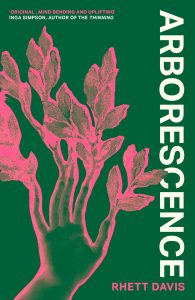 Bren and Caelyn are an average couple struggling to find meaning in the complexity of the modern world. Bren is working an increasingly dehumanizing job, and Caelyn feels directionless. However things change for them when they see a viral clip of a cult of people who believe they can turn into trees. Caelyn is instantly drawn to these people – are they deluded, or can they genuinely metamorphose into trees? Where Bren is horrified at what could drive someone to so completely turn their back on humanity, Caelyn becomes obsessed. She starts a PhD studying these groups of people as they start to spread across Australia. At first the people who believe they can turn into trees are treated as cranks, and Caelyn struggles to get her research taken seriously. Bren is supportive but skeptical, especially as Caelyn believes there is something more going on than meets the eye. She is soon vindicated when evidence of arborescence becomes incontrovertible. Across the world, humans are electing to become trees in huge numbers, and the people left behind are struggling to grieve for the loved ones they’ve lost but who are still alive. As Caelyn’s career takes off and she becomes the world expert on arborescence, Bren finds himself becoming more and more alienated from her perspective. Is turning into a tree a way to atone for the damage humanity has done to the environment, or is it just a way of opting out and abandoning one’s commitments?
Arborescence is told from Bren’s perspective, and he provides the reader with a close window onto the emergence of arborescence as a global phenomenon and on Caelyn’s descent into obsession. He’s the novel’s human heart, that anchors its speculation and provides a dissenting voice as Caelyn becomes more dogmatic in her beliefs. Davis does a fantastic job capturing Bren’s world-weary voice, which he uses to dispense Vonnegut-esque nuggets of wisdom. Caelyn’s struggles in academia are an effective exploration of the slowness with which academia responds to new ideas, and the gatekeeping enacted by older white male professors who are more concerned with protecting their own reputation than teaching and encouraging younger researchers. Bren supports Caelyn while she’s working on her PhD by working for a dispiriting tech job where the humans are being phased out in favour of AI workers and human actors who are paid to proxy for them. It’s a relatively minor part of the overall story, but it’s both darkly humorous and disturbingly plausible, and demonstrates Davis’ knack for cutting-edge satire. It’s relevant because it’s indicative of the bittersweet humour that Davis expertly aims at the material conditions we find ourselves living through. Both Bren and Caelyn feel powerless and alienated from a world that is spinning out of their control, particularly in regards to the climate and humanity’s destruction of the environment. The people turning into trees offer both an escape from the horrors of late-period capitalism and humanity’s destructive legacy.
Davis brilliantly captures the disorienting feel of modern life, making us understand why the quixotic choice to become a tree would be appealing. He also does an excellent job of building up the speculative elements of the novel slowly – at first it appears as if the whole thing might just be Caelyn taking a cult too seriously, until the narrative reveals that this is something that is really happening that has a huge impact on society. The replacement of large numbers of humans with trees manages to ameliorate much of the damage of climate change while causing unexpected new problems for society. Soon there are not enough people to keep all the systems of the modern world in motion. And more immediately, the people who choose to remain human suddenly find themselves dealing with a new and strange form of grief, as they mourn family members and loved ones who are still alive but in a radically different form. Davis takes the bizarre idea completely seriously, and much of the novel is a moving depiction of people struggling with this different type of grief and the little ways in which they try to keep the connections with their tree loved ones going.
But while there might be something utopian about beginning a new life as a tree, Davis isn’t afraid to confront the ecofascism that can hide behind sentiments like, “Wouldn’t it be nice if there were more trees than people?” While Caelyn becomes seduced by this idea, Bren points out that wanting there to be fewer people is always a dangerous thing to say, and that when environmentalists from first world countries say things like this they are eliding the real-world suffering of those in lesser economically developed countries who are already facing the very real and devastating consequences of climate change. The transformations in Arborescence have the potential to be utopian because in part they are entirely voluntary, and occur in all areas of the world equally. By engaging with the problematic elements of the set up and by explicitly critiquing ecofascism, Davis demonstrates the seriousness with which he takes his art and a willingness to follow through the implications of his world building choices to the fullest.
Arborescence is a profound and moving exploration of climate change and the grief we feel for a changing world. It’s a powerful demonstration of just how urgent speculative fiction can be, and an impressive work of characterization and storytelling depth. It manages the delicate balance of being both a celebration of the environment and plant life, but also of humanity even at its messiest. Davis is an exciting new writer, and I look forward to whatever he writes next.
Aborescence is available now, you can order your copy on Bookshop.org

[…] this month I’ve also read Rhett Davis’ masterful eco body horror Arborescence, which is a wonderful work of speculative fiction that I wouldn’t be surprised to see on next […]