
Interview with Adrian Tchaikovsky (SHROUD)
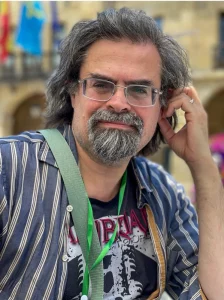
Adrian Tchaikovsky photo credit @CatSparkx
TO: We’re joined at the Fantasy-Hive today by someone described – by no less an eminence than Adrian Chiles – as “Science Fiction Royalty”. It is of course that other Adrian, Adrian Tchaikovsky, possibly best known for his breakout venture into Science Fiction with the brilliant tale of Children of Time spanning evolutionary timescales with the multi-generational Shakespearean spider characters of Portia, Fabian, Bianca and Viola.
However, Adrian is a famously prolific author who first appeared on bookshop shelves with his Shadows of the Apt fantasy series, investigating a fantasy milieu where the story arc doesn’t simply reset the world to the previous ‘Return of the King’ status quo. Having heard Adrian speak on panels at several conventions and listened to some of his recent interviews, I am sure we are in for a treat.
While Adrian may have started out as a fantasy author who branched out into Science Fiction, he is perhaps now perceived more as a science fiction author who dabbles in fantasy, but Adrian himself has said he’s just ‘gadding about’ across the genres the boundaries of which are ‘pretty blurry’ anyway. His upcoming paperback release Shroud (due out in the UK on 22nd January, although US audiences will have to wait until later in the year) is very much at the science fiction end of the speculative fiction genre continuum. So today we’ll be probing the stygian gloom of Shroud’s screaming depths along with some other questions about writing and being Adrian!
So welcome to the Hive, Adrian
AT: Thank you, it’s delightful to be invited.
TO: Your writing journey, like that of some other speculative fiction authors, began with games mastering for roleplaying games, which – with its inherent storytelling – was a kind of gateway drug into writing fantasy. From there you ventured into the final frontier of science fiction with Children of Time.
Is that fantasy-to-sci-fi genre progression one that originates at the start because fantasy RPGs were more accessible than Sci-fi ones ? (alas poor Traveler ?!)
AT: I never did play Traveler, and there certainly were fewer SF games on the market than fantasy ones. I grew up on SF books more than fantasy, for sure – and on the screen there wasn’t much fantasy that wasn’t extremely ropy and/or risque. Certainly in my later teens I think I’d shifted more to a general interest in fantasy more than SF but likely the availability of TTRPGs helped.
TO: You characterized your lifestyle in a recent interview by paraphrasing Tyrion Lannister “I go to conferences and I write things.” I’ve had the good fortune to hear you speak on a number of panels – always entertaining and erudite.
TO: You characterized your lifestyle in a recent interview by paraphrasing Tyrion Lannister “I go to conferences and I write things.”
Given that writing can be a lonely job, what do you enjoy most and gain most from interactions with fans and fellow authors at conferences and conventions and which one is your favourite? (<cough>Bristolcon?!<cough>)
AT: It is a solitary profession, and I value the company and support of my fellow writers enormously. It’s easy to detach from people if you’re just scribbling away in a garret on your own, and at the end of the day it’s a business about writing for other human beings. Meeting readers, and fellow writers, is a grounding experience. As for favourites, Bristolcon and Cymera are probably my favourite local cons, but I’m also fond of Eastercon and Fantasycon, the peregrinatory national conventions. Every con has its own particular flavour.
TO: Having listened back to a few of your recent interviews online – I must say the one I enjoyed the most was the one at Celsius232 where you were very expertly interviewed by your wife Annie. It was interesting to hear how early on you declared to her your identity as a writer and how patiently Annie must have waited for the 13 to 15 years before the first successful agent submission and the big break.
How big a part has family support played in your early writing journey and in your subsequent success as writer and fixture in the speculative fiction convention scene?
AT: Honestly I rely on my wife a great deal, both for emotional support and because she’s very good at things I’m not, such as holding onto money! Annie’s very good at giving me the space I need to get things done.
 TO: One might argue that murder mysteries are the most distilled form of story-telling in that there is a puzzle or secret to be unlocked, and there is enlightening information to be obliquely shared with the reader. In that Celsius interview Annie – in asking ‘why sci-fi?’ – also mentioned the much greater financial rewards that appear to be available in genres like Crime and Romance. Your eloquent response was to the effect that sci-fi and fantasy can subsume any story line, so if you want to write romance and/or mystery why not do so in a context that has spaceships or dragons?
To what extent do you set out to tease your readers with mysterious elements, unexpected twists, sudden reveals and partial shares of information and what challenges does this create in the writing process?
AT: I think that romance, mystery, wonder etc. are basic components of storytelling. Certainly most satisfactory plots in any genre are going to dip into most of them. As I’ve grown more confident in my writing I’ve certainly played more games with information – the triangle of author, reader and character, and who understands what’s going on at any one time. You can have a lot of fun conspiring with your characters to hide things from the reader, but on the other hand you can present things that your reader understands but that the characters, lacking context, do not, and that’s also an interesting exercise.
TO: At a panel I saw in Brighton at WorldFantasyCon, one of the panelists observed that “You can have a setting without a story, but you can’t have a story without a setting.” In your latest book Shroud the setting is arguably the most hostile – the life forms amongst the most alien – you have ever written.
Can you tell us a bit about what readers (and characters) can expect on (inside?) Shroud, and which came first – story or setting?
AT: Honestly, setting almost always comes first for me. Sometimes the setting inherently conjures certain characters who embody the key concepts – Nyr in Elder Race, or Rex in Dogs of War, say – but I’m always looking to introduce my readers to new worlds. This is particularly true in Shroud, where the starter concept was to work up a really alien world, with that particular life form and its curious capabilities. Once that’s done, the setting generally suggests the story as the best means of showcasing the world I’ve created.
the setting generally suggests the story as the best means of showcasing the world I’ve created.
TO: In Shroud – as with Alien Clay and the planet Kiln – you put a pretty dystopian human society in contact with an entirely incompatible ecosystem. On Kiln it was the rigid, inflexible hierarchical authoritarianism of the Mandate coming up against the evolutionary adaptability and symbiosis of Kiln’s flora and fauna. In Shroud you have the ‘rapacious capitalism’ of the ‘Concerns’ coming up against a world (well a moon) that defies attempts to exploit its resources in pursuit of capitalism’s holy grail of infinite growth.
Can you tell us a bit about what life is like for the human characters in Shroud under the Concerns’ control? Are there any other socio-political systems that you would like to extrapolate into space so as to test them to destruction?
AT: So life under the Concerns is exactly why you don’t give over your space programme to techbro billionaires. The crew are kept on ice until their skillset is needed, and maybe if they screw up they’ll never get woken up again. Everyone is measured and judged all the time, and you can’t make long term friends because you’ve no guarantee who’ll be around when you next get thawed out. I’ve written a lot of humans-in-space scenarios to date, many of which are post-tech settings where we’ve colonized a world but then lost hold of the technology we used to do it. There are a few books written that haven’t seen the light of day, yet that try some novel takes on how people might end up scratching a living on another world. And of course there’s the semi-utopian “panscpecific” culture of the Children books, where things kind of work out as long as you like spiders.
TO: In Children of Time, Alien Clay, Saturation Point and Shroud your human protagonists are not the kind of archetypal heroes. A bit like the iconic Avon from Blake’s 7, or Ryland Grace in Project Hail Mary they have heroism thrust upon them, rather than making a positive choice of it. While Juna Ceelander in Shroud may be less mendacious than Avon she is not a scientist like Grace, just an administrator.
Can you tell us what draws you into making those kind of ‘subsidiary’ roles into compelling protagonists and tell us a bit more about Juna’s journey?
AT: I think the literature has quite enough square jawed heroes without me sticking my oar in. I’m far more interested in fallible, fragile characters, or characters with unusual, nonheroic skillsets (this is also something I get from TTRPGs). So there’s an engineer in Shroud, but Juna, the administrator, has people skills that are actually more important in keeping them sane. Arton in Alien Clay is a scientist, but also a political activist, and also a coward who’s constantly tempted to roll over for the Mandate. Then there’s Idris in the Architects books, who’s 90% made of PTSD and never wants to be important again, or even Yasnic, the pacifist priest from the Tyrant Philosophers. I just find people like that have more interesting points of view.
I think the literature has quite enough square jawed heroes without me sticking my oar in. I’m far more interested in fallible, fragile characters, or characters with unusual, nonheroic skillsets
TO: You’ve published stories of almost every length but interestingly described writing novellas as something of a ‘palette cleanser’ because that shorter form (around 40,000 words) just has a beginning and an end, so avoids the difficult middle section that can present an author with problems. However, with the full-length novel that is Shroud the three phases of beginning, middle and end, are very discrete – almost separate stories.
Can you tell us a little bit about how you plotted out the sections of Shroud and did the perils of the extended middle section help the writing of that part flow more smoothly than you usually find?
AT: Shroud was quite tough to plot, because (a) it has quite a long starter section before we get to the meat; (b) survival travelogues are actually quite hard to plan because it’s a hard sort of structure to keep fresh (c) there’s a major information dissemination challenge in parcelling out info about what’s going on with the alien, which was tricky. So the middle part, whilst enormously satisfying, was very complex to plan out.
TO: You’ve said that you have always been drawn to the weird or unpopular/ unfashionable creatures like spiders and insects – an interest you pursued but could not quite satiate in your choice of Zoology and Psychology for university study. A measure of your achievement with Children of Time is how many readers ended up cheering for the spiders against the humans. In that same series you also managed to convincingly portray the distributed sentience of octopuses with a brain in each tentacle, as well as sentient DNA and an artificial awareness that somehow earned the right to exist.
However, the creatures of Shroud are quite different again.
Where there any earth organisms that inspired the shrouded and what problems and solutions did you find in trying to show how they ‘thought’?
AT: For Shroud I wanted to get away from Earth life as much as possible. Hence as well as the key weirdnesses of the alien life, they have a variety of other oddities that don’t occur on Earth, like their articulated, manufactured exoskeletons, and the offset pattern of their legs. Hopefully they don’t come across as echoing anything on Earth.
TO: As we have seen Shroud indites capitalism, Alien Clay indites rigid authoritarianism, and Saturation Point embeds a visceral warning about how climate change could make an inhospitable alien landscape of large swathes of our own world. Through all these works there is a powerful sense of connectivity and interdependence to set against the harshly individualised contemporary mindset that blames poverty on the poor, and ascribes worthiness to the wealthy.
To what extent do you see yourself as an activist writer, or are you just finding inspiration in the rather dystopian nature of our contemporary times?
AT: There are things I believe and those end up in my writing because that’s part of the well of inspiration I’m drawing from. If I tried to filter that out, then I’d water down the writing and likely lose a lot of what people like in it. Also, sometimes you have to find a way to speak what you need to, and it’s either write it or scream it out the window.
TO: You have always eschewed the Star Trek Original Series’s fondness for M-class planets inhabited by bipedal aliens so easily depicted by humans in masks on a desert sound stage.
Alienness has many dimensions. There is habitat – for example the high temperature Ammonia breathing aliens like Rocky from Project Hail Mary. There can be issues of language and communication like the twin voiced Ariekei in Embassytown.
However, while the shrouded are certainly among your most alien aliens, I gather that you still don’t feel you have hit your own holy grail of writing an absolutely totally alien lifeform in a way that makes them comprehensible to humans.
How much more alien do you think you can go to seize that holy grail? What elements of ‘alienness’ are left to you?
AT: There’s always an equivocation that goes on, presenting an alien creature (or a nonhuman animal that’s been uplifted or evolved, say). Even trying to be as rigorously true to the concept as I can, I’m a human writer writing for human readers. It bleeds in. I think I’ve crept up on that core of absolute alien-ness without just resorting to handwaving mysticism or random chaos, but it might be like Zeno’s paradox, just getting halfway close each time. I don’t know how far I’ll be able to go but I do intend to keep exploring the ideaspace.
TO: In terms of career holy grails, I guess for most spec-fic writers it is having your books turned into a TV adaptation or movie blockbuster.
Which of your works would you most like to see turned into a film or TV series? Do you have any ideas about the actors? and what challenges or compromises might the process entail?
AT: I mean there’s what I’d like, and there’s what would be feasible. I’d love to see a big Game of Thrones level stab at the Tyrant Philosophers but that seems enormously unlikely! I have in the past posted up dream castings on my website, as far as actors go. For challenges, the big one is that a lot of my SF work spends a lot of time inside the heads of nonhuman creatures, and in fact the nonhuman ways of thinking are key to the understanding of the book. I won’t say “impossible”, especially not since Villeneuve gave us Arrival, but it’s a major challenge to adapt that sort of book without letting go of its point and ending up with Arachnophobia in space or the like.
TO: In that Celsius232 interview Annie asked how you coped with disappointment and particularly the long (13-15 year) struggle of trunk novels and learning the craft of writing. You said simply that you coped ‘badly’ and that you still feel a sense of ‘imposter syndrome’ fearful that the next book will find you out, always too ready to internalize a single critical review than a dozen or more ones full of well-earned and justified praise.
Newbie authors might find it both reassuring and alarming that imposter syndrome never goes away.
Is there an element that your prolific work rate is about presenting a moving target to your anxiety? Can you think of any level of success that would lay those fears to rest?
AT: There’s probably a complex and somewhat unhealthy cocktail of psychology driving my writing pace, but at the same time it’s also what I enjoy doing, more than anything, which is one reason why I get so much done! I doubt that I’ll ever entirely be without the fear that the next book will be the bad/unpopular one. I’m not sure it’s even healthy to be without those fears, because if I ever start to believe that everything I write is a guaranteed winner I’d stop trying to improve.
There’s probably a complex and somewhat unhealthy cocktail of psychology driving my writing pace, but at the same time it’s also what I enjoy doing, more than anything, which is one reason why I get so much done!
TO: You’ve said that if you could be any ‘being’ from speculative fiction it would be one of the ‘minds’ from Iain Banks Culture series, benevolent spaceship-based AI nursemaiding humans in a (rare) science fiction Utopia. In your Radio five interview, Adrian Chiles used ChatGTP to summarise the plots of your novels in 50 words for him, and there are apparently some book-tockers who only read AI summaries before reviewing books.
Do you feel there is a disconnect between science fiction portrayals of AI and our current reality, with AI apparently on the verge of replacing readers as well as writers?
AT: The disconnect is as big as the human imagination honestly. Current generative large language models aren’t “intelligence” in any real way. They’re devices that can assemble an approximately appropriate-shaped response given a prompt. There’s no thought involved, just an exercise in probability. It’s bad for creation, it’s terrible for factual questions. It’s very good at human vibes without there being anything sapient behind it. But the idea of reviewing a book based on a LLM summary is spectacularly pointless. The whole industry is based on “product” whilst both writing and reading are process, the very thing the LLM is cutting out of the equation.
TO: You’ve said that your most efficient research involves contacting a renowned expert in the field and talking to them, but unfortunately that option was not available to you in what I believe is going to be Children of Strife.
How did you address that and, in the process what did you (and what will the reader) find out about Mantis Shrimps?
AT: As I couldn’t get hold of the scientist in question I had to do things the hard way, vis reading 40 years of scientific papers. And honestly I picked up a lot of things I had no idea of, so not in any way wasted time, but it did take a while! Mantis shrimps are crazy critters, basically. They’re probably one of the punchiest things in the world, insofar as power-to-weight ratio goes. Their visual apparatus is famously vastly over-engineered. But also, they’re antisocial animals that live in dense colonies because of limited real estate, which has likely driven their cognitive capabilities (in the real world now, before uplift) because they have to negotiate relations with all their neighbours, and as a species they’re very capable of killing one another. Hence they recognize other individuals, have elaborate ritual conflicts and can even lie to one another.
TO: Wow – crazy critters indeed. I’m looking forward even more to diving into my ARC of Children of Strife!
Quick fire round
TO: Best character in sci-fi by another writer (and if not Avon from Blake’s 7, why not?)
AT: I mean Avon is a very strong candidate. I’m going to pick Silk from Wolfe’s Book of the Long Sun, though, because he’s such a complex, multifaceted person, and because he always takes the hard path of trying to redeem those who really should be his enemies.
TO: Lord of The Rings is often viewed as the original source of modern fantasy. What would you consider to be the comparable original source piece of work for science fiction?
AT: Tough call. Maybe Rossum’s Universal Robots, the play by Capek.
TO: Best Film adaptation of a science fiction piece of work?
AT: Arrival, from Ted Chaing’s Stories of Your Life, dir. Denis Villeneuve
TO: Which of your books do you think deserves more attention than it’s got so far and why?
AT: Guns of the Dawn, still one of my favourites and with some of my best character work (and my best ever romance!)
21 TO: After the Face of Evil (with its stranded and degenerate survey team sevateen), which other Dr Who novelisation do you think has been most influential on you?
AT: The Cave Monsters (/The Silurians) – specifically the novelization by Hulke, where you get a lot of Silurian POV stuff, and they’re treated very sympathetically.
TO: Oh yes, great call! Malcolm Hulke was one of the best Dr Who novelisers (after perhaps Terrance Dicks) and I remember that one – the re-awakened Silurians being put out at the furry mammals having taken over ‘their’ world, the Doctor eager to find a way for both sides to share the planet, and the humans being just… er… human. Yup, I can see how that might influence you.
TO: Now, do any of those early trunk novels have ideas at least that you might recycle?
AT: Oh I already have, with a few, and I’m sure more have crept into later work without consciously noticing.
TO: Which conventions have you already locked in for 2026 (<cough>Bristolcon<cough>)?
AT: Probably not Bristolcon in 2026 – it’s a long way to go from Leeds on my own dime. I’ll be at Eastercon, Fantasycon, probably Cymera, then Octocon in Cork, Norncon in Belfast, Finncon in Finland, Fantastika Nys in Serbia and more. I’ve had a lot of invitations for next year!
And finally
TO: Were there any questions I didn’t ask that you would have liked me to, and how would you have answered them?
AT: You didn’t ask about the extraordinary sequence of containers I’ve placed my heart in so that I might live forever, but that’s just as well as I wouldn’t have told you.
TO: LOL! There’s a topic for a panel somewhere – representations of immortality in sci-fi. And with that it only remains for me to say thank you very much for joining us today and to wish you all the best with the launch of Shroud on 22nd January 2026.
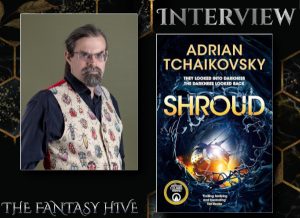
Shroud is released in paperback on 22nd January – you can order your copy on Bookshop.org
[…] 21: Shroud byAdrian Tchaikovsky (453 […]