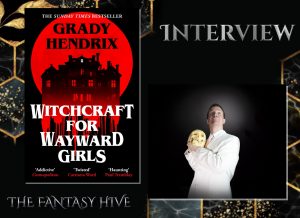
Interview with Grady Hendrix (WITCHCRAFT FOR WAYWARD GIRLS)
Grady Hendrix is a New York Timesbestselling novelist and screenwriter who owns too many paperbacks and not enough shelves. He’s the author of How to Sell a Haunted House, The Final Girl Support Group, The Southern Book Club’s Guide to Slaying Vampires, Witchcraft for Wayward Girls and many more, including Paperbacks from Hell, a history of the horror paperback boom of the seventies and eighties that won the Bram Stoker Award for Superior Achievement in Nonfiction. (All the paperbacks are for ‘research’ and he needs them.) His books have sold over three million copies and have been translated into more than twenty languages. He lives in New York City and will die there, too, probably crushed to death beneath piles of those paperbacks.
Grady Hendrix | Witchcraft for Wayward Girls | Panmacmillan.com
Welcome to the Hive, Grady! It’s great to have you here. Let’s start with you telling us a little bit about Witchcraft for Wayward Girls. What can our readers expect?
Witchcraft is set in 1970 and it’s about four pregnant teenagers who are sent to a maternity home in Florida to have their babies in secret. They have no idea what’s going to happen to them or to their babies, but then they discover witchcraft and complications ensue.
Fern is our lead protagonist and her whole story was emotional and raw. How did you find crafting Fern’s character?
Main characters are always hard because if you go too far in one direction they can be off-putting and uncomfortable for the reader, but go too far in the other direction and they’re boring. They’re tricky. In this case, I was lucky enough to find a 1970 photo from an Alabama high school yearbook that looked exactly like Fern so I had some visual reference as I tried to figure out what she’d be like.
 My favourite side character was Rose! I loved how wild and determined she was. What inspired her personality?
There’s a great non-fiction book by Blossom Elfman called The Girls of Huntington House based on her time as a teacher in a maternity home (it later got made into a very boring TV movie starring Sissy Spacek). There was a character in it who was angry, political, and took no prisoners and she became my inspiration for Rose. Incidentally, Blossom Elfman is the mother of Oingo Boingo singer and famous film composer, Danny Elfman.
Miss Wellwood was a really interesting character and though many things she did came across as cruel, she was more a product of her generation and I did begin to sympathise with her. How did you find writing her character with a balanced view?
If you’re writing an honest book, there are no bad guys. Everyone has their reasons, and everyone thinks they’re right.
You write your female characters with much respect and a sense of realism. How did you find writing about such a sensitive and important subject from a male perspective?
It was a lot of work. I had about 12 moms who not only shared their birth stories with me but let me ask a lot of very personal and invasive questions. I had three OBs who consulted with me, I had my Williams Obstetrics from 1968, I read midwifery manuals, I absorbed as much as I could and I probably still screwed things up.
Whilst I was reading I was filled with such anger at the lack of body autonomy and lack of empowerment these young girls faced. Yet by giving them the means of witchcraft you give these characters a sense of empowerment. How important was this for you to explore?
In real life, many pregnant women don’t have bodily autonomy, and in 1970 very, very few pregnant women did. If I didn’t inject a fantasy element like witchcraft it would have all been too depressing.
In the way that women were condemned and ostracised as witches and sinners throughout history this too parallels the way these young pregnant girls were also condemned and classed as sinners. Was this something you had always planned to convey?
I didn’t have a master plan when I sat down to write this book, I just knew there was a story in the maternity homes. After that it was a simple matter of writing 14 different versions of this book over two years, and weeping tears of blood as I slowly zoomed in on what was important and cutting the rest. All I want is to write books that feel like reflections of the real world with the boring parts deleted, so whatever’s out there in the real world should make its way onto the page if I’m doing this properly.
From reading your acknowledgments in the book I know that this story came from very personal experiences from members of your family. Was this book as emotional for you to write as it was for me to read?
Every single one of my books is really emotional to me. I cry, I get depressed, I laugh, I go on manic jags — they’re all dug out of my brain and stitched together from bits and pieces of my life, so they all wind up feeling very personal. Witchcraft was more frustrating than most because it took me so much longer to get it right.
Witchcraft’s themes and characters very much reminded me of the film, Girl, Interrupted. Was this at all also a source of inspiration to you?
I’ve never seen it, sorry.
I have to ask, how did you find writing a particular birth scene that occurred in the middle of the book? Because that was horrifying to read!
The way women had babies in 1970 was pretty horrifying! Mothers were tied down and drugged, they were induced to make their labor and delivery more convenient for their doctors, episiotomies were performed cavalierly, forceps were used without restraint. People give midwives a lot of flack, but without the big midwife revolution of the late ‘60s and early ‘70s we’d still be doing it that way.
What’s next for you Grady? Do you have any upcoming novels that you can share with us?
My next book will be out in January, 2027 (I’m on the third draft, hopefully it won’t take me 14 this time) and I’m getting ready to release Season Two of my podcast, Super Scary Haunted Homeschool, in February. This season…haunted houses!
Finally, what is the one thing you hope readers take away from your writing?
A burning desire to buy at least ten more copies of every single one of my books. I’ve got bills to pay!
Thank you so much for joining us today!
Witchcraft for Wayward Girls is available now, you can order your copy on Bookshop.org