WORLD FANTASY CONVENTION + FANTASYCON 2025 in BRIGHTON (Convention Review)
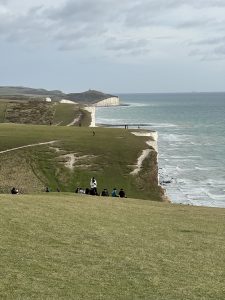 Having enjoyed BristonCon, a determined (and augmented) group of travelers reconvened after journeys by train, plane, car and bus in the delightful seaside town of Brighton. The convention itself kicked off on Thursday afternoon and arriving on the Tuesday evening left us plenty of time to explore the town and its surroundings before – as well as during – the convention.
A rainswept Wednesday was spent navigating various bookshops and enjoying the strange opulence of Brighton Pavilion. The Thursday morning gave a chance for some of us to travel out by bus past the impressive Roedean School to take a walk above and below the picturesque chalk cliffs of the Seven Sisters country walk. Others found themselves drawn into some convention voluntary work helping with the considerable leg work involved in setting up the art show. Noticeably bigger than BristolCon, but also smaller than WorldCon Glasgow, the convention hotel had divided its conference space into offered four main panel rooms with other breakout rooms for readings, talks and workshops.
The panels – as always – formed the spine of my convention experience, drawn in by eye-catching, intriguing descriptions and much-admired panelists. I will pick out some of my gleanings from different panels in the space below, but other activities and attractions were available.
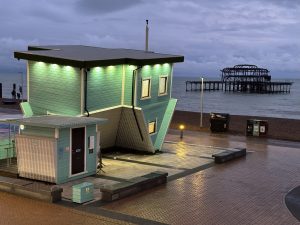
the upside down house
A vibrant dealers’ room offered not just books to read, books to display (loving those spredges) and books to make notes in, but also fantasy and SF themed T-shirts, jewelery and other artefacts. The art show included paintings and pieces of wood etched with entrancing images. The hotel also offered a variety of basic but nourishing refreshments so that there was no need to go outside. However, there is always a claustrophobic atmosphere to any windowless space and some of the convention doorways left no margin for error for those using a wheelchair – leading to some barked knuckles. So opportunities to take in other Brighton attractions were very welcome like the Upside Down House whose interior offered some counter-intuitive photo opportunities.
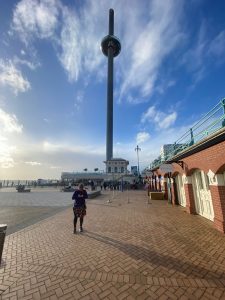 There was also the impressive viewing experience offered by the i360. Besides the chance to catch up with fellow fantasy enthusiasts at BarCons in and around the convention centre, there were also opportunities to ‘meet the author’ or hear a writer of much-admired fiction being interviewed on the stage. While the ‘meet the author’ event went well for those who tried it, the writer of admired fiction proved sadly more self-obsessed and less admirable than his writing. There is always this danger in meeting one’s literary heroes!
There was also a mass author signing event where half of the main auditorium was given over to trestle tables and piles of books as fans jostled to collect signatures. Unlike BristolCon, a large number of the attendees were staying outside the main convention hotel and a variety of local restaurants were tried, tested and found to be very high quality. Though the staff did struggle to work out the connections that bound some geographically disparate groups together (Germany, England, Ireland, Australia and the Netherlands for example) – but such is the joy of conventions and the fantasy community.
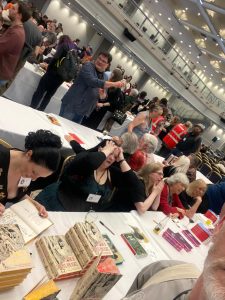
Mass book signing
But what about the panels, I hear you say? Well..
The Immortal Villain (Thursday)
Ruthanna Emyrs, PS Livingstone, Christopher Caldwell, Sarah Rees Brennan (Moderator)
Sometimes evil refuses to die. The shadow lingers on, reforms and returns. The making of a villain that sticks around in the mind of the reader and survives longer than the hero is an art in itself.
The panel opened with an observation on the conjunction in fiction between immortality and evil. “Acquiring immortality, getting to be immortal usually involves evil, eg stealing other peoples’ bodies.” The idea that getting immortality then chips away at your humanity resonated for me having seen this idea elegantly shown in V.E.Schwab’s Bury our Bones in the Midnight Soil. The panel felt that vampires get ‘everything’ they want but the question is always at what cost, and the price is always more than the would-be immortal bargained for. There was some suggestion that modern billionaires illustrate what extreme power (and/or immortality) can lead to with some well publicised examples of stunning exhibitions of pettiness and viciousness. I did like the idea of Trump or Epstein as latter day Saurons – and the Tolkien reference is further emphasized with Peter Thiel appropriating the Palantir theme for the name of his company. There is perhaps a deliberate irony in the tech-billionaire’s name choice, since Sauron used the palantir of Minas Ithil to weaken, demoralize and exhaust Denethor (aka Democracy?!), and effectively divide his opponents through the selective and carefully curated management of information!
The panel’s discussion also picked up the paradox that villains don’t see themselves as villains, so much as ‘entitled’ to whatever they have or can get or take. One panelist did declaim that ‘bad boys are hot’ but presumably not ‘bad billionaires.’
Epic Pooh and the Style of Fantasy Prose (Friday)
Lisa Tuttle, Lee Murray, John Cute, Farah Mendlesohn (Moderator)
Michael Moorcock’s article on Tolkien’s prose and his criticism of its childlike quality was first published by the British Fantasy Society in 1978. This raises the question, what is stylish fantasy writing? Is there a particular aesthetic to fantasy prose?
While this panel caught my eye because of the reference to Tolkien’s prose I hadn’t realized that the ‘Epic Pooh’ element in the title was drawn from a Michael Moorcock essay – and I found myself scanning the Wikipedia page on it while also listening to the panel. Moorcock’s critique of Tolkien and other fantasy writers was built around an alleged ‘comfort’ style of writing that harked back to a kind of imaginary bucolic non-urban past. The panel started by discussing what is good fantasy and what is bad fantasy and noted that authors write about and draw on their own pasts. So much of Tolkien’s own first world war experiences can be seen in the notion of a fellowship of (figuratively or literally) little people and might one not say that the Dead Marshes are an allegory for the corpse filled landscape of the Somme? As one critic of Moorcock’s attempted take-down, Madow Williams, noted – Moorcock tried to treat fantasy as distinct from folktale, legend, or myth, but all four of these are tightly interrelated. Indeed one of the panelists quoted Joseph Campbell’s observation on the penetration of myth into the literary psyche, “myths are public dreams, dreams are private myths.”
Paranormal Romance to Romantasy (Friday)
Ruth Frances Long, Amy De La Force, Anni Summerlee, Nadia El-Fassi, Sophie Jarrell (Moderator)
The phenomenon of Twilight changed the shelves in bookstores. Reclassification saw writers find a new niche and new audiences. Now ‘cosy’ is the new popular and Romantasy is on the rise.
The panel had a lively discussion about the growth of romance as a genre (with Romantasy now being a separate award category from Fantasy in the Goodreads book awards). One panelist noted how the big books in the genre are “not led by romance” and the genre has “pumped up the fantasy.” In defining what makes something romantasy the panel touched on notions such as “enemies to lovers” or “friends to lovers” before deciding quite emphatically, “It is the yearning “ and the slow burn. The “I want you but can’t have you” trope. Hades and Persephone got a mention here as archetypes along with other favourite tropes like “There’s only one bed” or “There’s only one horse” – circumstances that literally push the ‘yearning’ protagonists together. The website AO3 also got a shout out as a place where original works of fan fiction could play out some of the trope subversions and twists that added bite to the romantasy experience. And, though I’m not sure where it came from, I have noted a wonderful shout out from Nadia El-Fassi which was simply “Fuck transphobes!”
Landscapes of Fantasy (Friday)
Tiffani Angus, Elena Gomei, Mina Ikemoto Ghosh, Victoria L Bovalino, Brenda Carr (Moderator)
The vistas of impossible worlds that we will never see. The maps of invented places, the beautiful geography and geology that has been depicted so we can get a glimpse into the lives of the characters we journey with on their quests.
The importance of setting was neatly summed up by Tiffani Angus’s observation “You can have a place without a story, but you can’t have a story without a place.” Her own novel, Threading the Labyrinth delivered a palimpsest of landscapes in the layers within a walled garden and an associated landscape of ghosts rising within each layer. Another panelist was inspired by the quick changes in weather of Vancouver Island which enhanced the sense of isolation of the island community in their novel. When it came to naming places Victoria confessed “Sometimes I just keyboard smash and then I put vowels in it,” although she asserted “I do occasionally think about things.” Descriptions of landscapes that trigger the senses were important in helping the reader imagine the setting, although the advice was that one should “Shift along the senses according to the intimacy of what you’re describing – sense of smell is more in your face and visceral.”
To Trope or Not to Trope (Friday)
Andrea Morstabilini, Graham Austin-King, Juliet Kemp, David Cartwright (moderator)
Tropes: love them or hate them. Do we need them? How much trope is too much trope?
The central question here was when does a narrative device become a trope, is a trope simply a plot cliché? Enemies to lovers being a well recognised trope in romance/romantasy. Graham Austin-King felt that tropes were partly promises made to the reader – a concept to guide their choices and experiences. David Cartwright – as moderator – had a number of topical (tropical) puns to roll out during the discussion, including warning panelist against walking a tight-trope, getting hung up on the sameness of iso-tropes or finding themselves in the midst of a trope-ical storm!
Publishing Demystified (Friday)
Stephen Kozeniewski, Donna Scott, Amy Brook, David Thomas Moore (moderator)
The world of publishing is opaque and mysterious to writers, unless they choose to peek behind the curtain.
An eminently qualified panel was moderated by David, the Editorial Director of Rebellion Publishing, with panelists including Amy, a commissioning editor from Rebellion, Donna, a freelance Editor and Stephen, Chief Finance Officer of the new boutique publishing house French House Publishing. The panelists explained that the reason publishers come to conventions is to meet people – including potential authors – so this is a time and an opportunity to approach them. Stephen handed out business cards and urged people to approach him with “Hey Steve, nice to meet you” while David jokingly let everybody know that his favourite drink was a gin & tonic (as you can see I made a note of that detail!).
The panel discussed some of the difficulties in book selection which often, much to the finance department’s frustration, came down to conjecture around any forecast of hard numbers, such that persuading finance to back a deal often came down to ‘vibes and feelings’. Apparently 80% of published books do not make a profit, which is why finance officers throughout the industry are constantly asking “why don’t we just publish the profitable 20%” – ah if it was only that simple. Essentially publishing is a calculated gamble and 80% of the bets don’t come off, but the 20% that do pay for the rest and then some. It was interesting to hear the numbers being bandied about, with a commissioning editor estimating a book would sell between 6000 and 8000 by looking at comparators and the finance people moderating that expectation (and the advance) downwards. While we are used to the idea of million copy best sellers because they make the headlines the reality is most books operate at a much smaller volume of sales and consequently far tighter margins. (Which is why you shouldn’t pirate books as most authors are working fulltime and writing on the side to make ends meet.)
The panel also discussed those wanting to break into the industry on the publishing rather than the writing side. The observations were blunt. It’s very hard to break into, salaries are awful – especially given living expenses when most firms are based in London – and you’d have to expect to take on ‘weird shit’. Networking (at Cons and elsewhere) is important but it’s not going to be like the Agent/editor/Author love story in Emily Henry’s Book Lovers.
Given the inherent introversion of authors in general (and me in particular) it will not surprise you that – despite all the advice about networking – I barely approached a single publisher in the whole convention.
Writing Fighting (Saturday)
Steve McHugh, Christian Cameron, Juliet E McKenna, Anna Smith Spark (Moderator)
The literary art of writing fight and battle scenes. Expert authors discuss how they approach battles and duels in their novels.
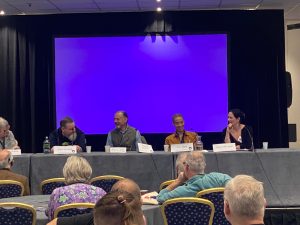
Writing Fighting Panel
A panel well versed in writing violence began with a discussion of the appeal of the subject matter. As Anna Smith Spark asserted “Conflict is the essence of drama” and in the twin human drives of ‘mortido’ and ‘libido’ writing fighting is like writing sex – the sublime wonder, or horror in taking wounds. The panel questioned the competing challenges of delivering combat accuracy but also literary effect; should the author strive to deliver a “reconstruction of the battle” or the “sensory experience of being in it.” Juliet McKenna strives for accuracy – often rehearsed with her husband in the garden since both are expert in Taekwondo (I think it was). She observed that real fights are short with sword fights being lost by the first person to make a mistake. She also noted that fatal wounds are not always instant. That same theme that had been addressed in a talk on Thursday where a Doctor had spoken from the medical perspective on writing injuries in fantasy. Dying people can still be dangerous for some significant time in a battle. Juliet also implored that writers avoid the “I’ve studied it so I’m going to show it” approach (Take note Herman Melville on whaling and Victor Hugo on Parisien sewers).
Christian Cameron pointed out that “unless combat teaches you about character or plot, it’s just titillation”. Steve McHugh followed “the rule of cool” in describing combat but also asserted that domestic implements or small animals should not be brought into descriptions of sex or combat.
There was some discussion around the morality of writing visceral bloody killing to which Steve noted “I don’t have any feeling about killing someone” quickly adding by way of clarification “IN A BOOK.” Christian noted that a lot of real war combat killing is a matter of “it was them or me” and advised that would-be authors would do well to read/research accounts of people who have killed. He also noted how in medieval times “war was a commodity” in that men needed war to prove their masculinity though sometimes they would find “we have more war than we need!” (Still true today!)
Do We Love or Do We Wait (Saturday)
Alexandra Beaumont, Anna Brook, Elian J Morgan, Catriona Silvey (Moderator)
The love scene in fantasy and/or horror. Do relationships need to be consummated or remain chaste, or somewhere in between? What are the excellent ways in which writers have considered how their characters feel about each other.
While the panel confessed to “loving the yearn… lots of yearning please” there was the question of when and how to show the protagonists taking their relationship to ‘the next level’. How to avoid such scenes being gratuitous and ensuring that they serve the story. The themes of C.L.Clark’s essay “Everybody’s in Love, but Nobody’s Horny” were very much in the panel’s minds. They discussed how romance heightens the stakes and exploring the extreme vulnerability of sex offers an opportunity for characters to discover stuff about themselves.
The panel felt a sense that authors are being pushed by the industry to write more sex scenes to ‘spice up narratives’ but they agreed that there was “nothing worse than reading a sex scene that you know an author didn’t want to write.”
The panel felt they were very much ‘possessed by their characters’ and what is shown or elided depended on that relationship between character and author. To an extent many felt they were ‘leaving the door half-open’.
In discussing how to avoid the cringe factor the panel’s advice was
- Exist within your own comfort zone
- Avoid weird metaphors, (‘throbbing members’ were mentioned as a particular example – though this can be a bit triggering for those with a very visual imagination to whom the mere mention of a phrase has the object itself popping up in the mind’s eye.)
- Understand and demonstrate the importance of consent
- Don’t necessarily be explicit but do be clear about what is happening
- Make sure that the characters find out about themselves – eg don’t use the Game of Thrones ‘sexplanation’ strategy of hiding chunks of exposition in a conversation between two naked characters in bed.
The Role of Reviewers (Saturday)
Ant Jones, Evan Leikam, Alex Hormann, Fraser Armitage (Moderator)
With more fantasy and horror books published every year, finding an audience can be difficult. Our panel discusses the role of reviewers and how to best manage being a reviewer in a crowded market.
Although the panel premise was about people wanting to start and develop a role as reviewers a quick show of hands suggested most of the audience were already well established reviewers. I suspect many were drawn to the panel because of the way its existence recognised their existence, and importance and offered a chance to discuss their experiences. The panel did have a breadth of experience and had grown their own platforms diligently. I have been making an effort myself to try to broaden my reading experience, by reading and reviewing a more diverse range of authors – particularly trying to get at least a 50-50 gender balance in my reading list. I was a little disappointed that this hadn’t occurred to the panel and – although one panelist did stress he made a particular effort in April which was Women in SFF month, that did get a slightly sardonic “That’s one month” reaction from the audience. My own gripes aside it was an entertaining panel that did give reviewers and reviewing something of the raised profile they deserve, along with a couple of website recommendations – sfbook.com and fanfiaddict.com
Older People in Fantasy and Horror (Saturday)
Jacqui Greaves, Juliet Marillier, Jenny Hannaford, Sarah Jayne Townsend (Moderator)
Why are so many fantasy and horror novels told from the perspective of the young? Is age and experience a hindrance for characters as they try to grow and change? Or is the issue the audience. We’ve all been young, but have we been old? Our panel will discuss the representation of older people in fantasy and horror.
Despite the cross-overs with Young Adult Fiction and the Tik-Tok sustained boom in Romantasy with its plethora of teenage/young adult protagonists, the panel pointed out that the mean age of Science Fiction and Fantasy Readers is 42 (a statistic that would surely please the late great Douglas Adams) and that 53% of those readers were women. The panel railed against the way older people were often the bad guys in novels, “the old devils,” and felt that fiction should show more appreciation of “the grace and the privilege of growing old.” Indeed it was felt to be “almost an insult to crave the (vitality of) youth.” There was still a call to writers to make older characters active – age and experience do not automatically have to go hand in hand with senescence. Given that old has been redefined (for government statistical purposes) as 70 or over, I am delighted to discover I am still young (and have been for some considerable time). At the other end of the spectrum the age at which brain development settles into the mature less-impulsive architecture of adulthood has been revised upwards from 25 to 32, emphasising that there is a wealth of character to be drawn on and depicted in people of more mature years.
Editing and Editors (Saturday)
Amy Boursah, Zhui Ning Chang, Ellen Datlow, Stephen Saffel (Moderator)
Sometimes writers struggle to see what to get rid of in their drafts, others get stuck using the same words, or don’t quite deliver in a brilliant idea. The work of an editor is a subtle craft that can make a story go from bland to brilliant, or good to exceptional. Our panel explores the craft of the editor.
The panel explored and explained the different types of editing – although confusingly these are given different names on each side of the Atlantic. Substantive or developmental editing is the big picture editing which involves working with the author and asking “the exciting questions” about plot, structure and character. This is about ensuring the novel draws readers in, keeps building momentum, and nails the landing. Amy talked about three rounds of “revise and resubmit” editing suggestions before the work would go off for external copy editing which is about checking sentence by sentence for clarity and accuracy of meaning, before finally proof-reading which is checking for the final typos and grammatical errors.
In the panel’s experience second books were where the editors’ work most obviously kicked in. Author’s first books are honed and polished to perfection, second books tend to be more rough-hewn hurried out to meet the popular two book contract approach from publishers. I had been curious for some time about Hugo awards for editors judged by readers who had only seen the finished product. So I did ask how readers could judge the quality of the editors’ work. The panel seemed to agree that – without seeing the annotations and the email exchanges – it is hard to assess what a good editor has done. Though bad editing was much easier to spot.
As a freelance editor the author-editor relationship also intersected that of the client-contractor. With “the author as boss” the conversations tended to be structured differently, but the author also was starting from a very different place, often a much early stage in the drafting process. In those case the editor’s work was about the breakdown and the context for example, having the strength to tell an author that their sprawling magnum opus is actually “three books in a trenchcoat.”
And Finally…
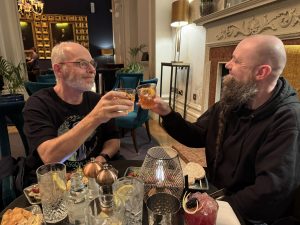
The Last Old Fashioned
As the conference wound down on a crisp Sunday afternoon there was even the 98th Veteran Car Rally driving ancient vehicles from London to Brighton for us to go and see and soak up the put-putting petrol-head fumes of vehicles that could probably be outrun by a modern lawnmower.
Sunday proved to be a day for few panels and several partings, although there was still a chance to scour the bars of Brighton one last time for the definitively best Old Fashioned cocktail. The Grand certainly had the most stylishly presented of the seven different examples we had taste tested.
And then it was time to head our separate ways after a ten day fantasy con extravaganza – a conjunction that was well worth exploring, but is unlikely to recur on quite that scale again!