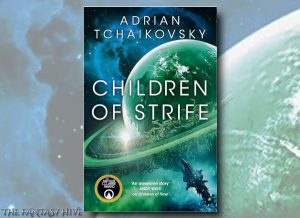
CHILDREN OF STRIFE by Adrian Tchaikovsky (BOOK REVIEW)
From the award-winning master of sci-fi Adrian Tchaikovsky, Children of Strife is the unmissable follow-up space opera to the highly acclaimed Children of Time, Children of Ruin and Children of Memory.
In this epic adventure, we visit a far-future after earth fell, where ark ships had hunted for a new home. They sought lost worlds terraformed in earth’s forgotten past. We follow a ship crewed by maverick humans, spiders and a spectacularly punchy mantis shrimp captain as they rediscover one such world, and an ark.
Then human crewmate Alis wakes to discover that she, her captain and the ship’s intelligence are the only ones left on their ship. But what happened to those who left to explore the ark . . . and the world below?
Children of Strife is the extraordinary next volume set in the Children of Time universe, featuring epic adventure, first contact and the nature of intelligence among the stars.
 I have just finished my ARC of this impressive fourth tome in the “Children” series which brings together Tchaikovsky’s creations from Children of Time (review here ), Children of Ruin (review here ) and Children of Memory (review here ). While I will try to avoid spoilers for Children of Strife there will inevitably be spoilers for the previous three books.
The Children up to Now
In his breakout excursion into sci-fi with Children of Time Tchaikovsky gave us an eons long timescale with two converging timelines. There was the flawed terraforming experiment led by hyper-advanced humans under the leadership of scientist Avarna Kern whose endeavour was compromised by rebellion at home. In consequence spiders became the dominant species on a planet intended to be developed for human colonisation. Converging on this misfiring experiment was an Ark ship populated by the humans who had risen from the dark ages of that great rebellion to find the Earth now too toxic for human inhabitation. Despite the technological regression from the age of the terraformers the survivors scraped together the means to send ark ships out to the worlds that the – to them – ‘ancient’ terraformers had prepared for them. They found no Eden.
Under the acerbic guidance of an ‘uploaded’ consciousness of that ancient terraformer Avarna, the spiders and humans formed an alliance and – in Children of Ruin – a team of them set out to explore a nearby star system where another of the ancient terraformer teams had been playing with a couple of planets when the echoes of the rebellion abruptly shut all their systems (including life-support) down. There, the humano-spider team found a water world populated by intellectually uplifted octopuses and – more dangerously – a planet ‘Nod’ infested by a parasitical microbial entity – the Nodal entity. The Nodal entity stored memories at the level of DNA and took over cells in human bodies (well in any biological body) in a frightening “find, copy, and replace” process – effectively erasing every being they tried to interact with. Like Invasion of the Body Snatchers only scarier. Disaster was only averted when the uploaded Avrana Kern consciousness found a way to engage the Nodal entity in a dialogue and showed them(it?) how copying without replace/erase would give the entity the opportunity to explore the universe in partnership with humans, spiders and octopuses. At the same time, a buried octopus discovery enabled the new panspecific civilisation to access a form of faster than light travel and accelerate their exploration of old terraforming sites.
In Children of Memory a team of the panspecific explorers came to the planet Imir where a colony of another arkship appeared to be scratching out a fragile existence. The explorers included an ‘instance’ of the Nodal entity buried in a specially grown human body and going by the name Miranda (while still carrying the collected recollections of the entire Nodal organism up to that point of physical separation). However, that entire colony was the invention of a powerful simulation machine that had drawn the explorers into a virtual Matrix-like world which it had extrapolated (in many different versions) from the failure even to land of the original Ark Ship – with the death on atmospheric entry of all its would-be colonists.
Where does Tchaikovsky take us from here
At the start of Children of Strife Tchaikovsky gives his own very helpful summary of the essence of the ‘universe’ that his ‘Children of…’ books have described, dividing history into three ages – that of the Terraformers, of the Arkships and of the Panspecific explorers.
Logically enough the book itself follows three separate timelines each filled with characters and conflict from a different age as their stories converge on another target planet of the ancient terraformers.
In the First Age timeline we meet a team of five terraformers led by an indignant rival to Avrana Kern, the billionaire ‘visionary’ Gerey Hartmand, as they struggle with many failed efforts to fill their target planet with vibrant self-sustaining life. In the Second Age timeline we follow Lamya Cosimir as she leads an Ark ship to the planet that Hartmand’s team have prepared for them. In the Third Age timeline we follow an eclectic team of Panspecific explorers as they encounter the consequences of Hartmand’s quixotic (chaotic) worldbuilding and Cosimir’s attempts at colonisation.
Each timeline is almost a book in itself, filled with compelling characters and intriguing dilemmas, but Tchaikovsky braids these three strands together with his customary aplomb to deliver a sharply twisting but satisfying denouement.
We see Hartmand through the third person point of view of one of his team members Redina Kott, and Hartmand is a delightfully awful character – a toxic mix of fragile ego, monumental arrogance and completely self-centred immorality. It is as if Musk and Trump had been projected into space (if only! ☹) and spawned some unholy love child – I did enjoy hating Hartmand. However, Kott is no saint – Hartmand has gathered around him a team of the obnoxious, the insane, the corrupt and the obsequious because why would such a colossal asshole surround himself with people more competent or moral than himself. Unsurprisingly their efforts to terraform their chosen world stumble through multiple failures. However, the mad hammock dwelling hippy Pils discovers a technique that turns the planet beneath them into something more malleable. It is a sort of real Gaia hypothesis – the planet in its entirety seen as part living organism, part programmable super-computer like the Douglas Adams’ vision of the Earth in Hitchhiker’s Guide to the Galaxy (until the Golgafrinchians mucked it up), and part Minecraft environment that the terraformers can personally insert themselves into to build and micromanage at an almost cellular level. If Hartmand’s world is a new Gaia, it is a Gaia with the multiple personalities and toxic traits of its five founding builders. And then, the rebellion signal arrives and shuts the terraformers down!
Cosimir’s arkship excursion gives us more insight than we’ve previously seen into the ruin of the world that the rebellion and subsequent wars made of our Earth. People for whom the ‘ancients’ were masters of impossible technology of which they can only build pale and unreliable imitations. As with the doomed planet of Adjumir in Claire North’s Slow Gods (review here ) the exodus of the Ark Ships cannot save everyone. Cosimir’s Earth bound dilemmas take place in the shadow of the salutary statue of “the seven hoarders” – people who pursued personal gain, enrichment and protection over the more important survival of the species. It struck a chord for me, in the parallel with our own crises where the ultra-wealthy hoard resources and wealth that could help us all to a poverty-free climate-crisis-evaded future. As we have seen, there is no crisis so dire (e.g. banking collapse, covid) that humanity cannot find someone sufficiently venal to personally profit by it.
The crew of the Third Age Panspecific explorer ship Dissenter represent both the most alien and intriguing of Tchaikovsky’s imaginative creations. Even within the broad envelope of ‘normal’ that the panspecific community encompasses, the crew of the Dissenter is ‘unusual.’
Indeed the whole premise of their mission is not so much a matter of going off ‘to explore strange new worlds, to seek out new life and new civilisations’ and more about ‘go into space you lot and don’t come back until you’ve sorted yourselves out.’ I loved all of the crew so I couldn’t possibly pick a favourite (not least because some of them are rather inextricably entangled with each other), but let’s start with Captain Cato.
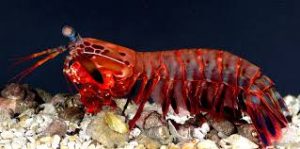
A mantis shrimp (from Wikipedia)
There is a logic to Tchaikovsky’s name choices – for example the Portiid spiders are all named for Shakespearean characters since the genus name is derived from Portia – the witty heroine of The Merchant of Venice. The original Cato (the elder) was an warrior statesman of ancient Rome renowned for pursuing military conquest with vigour and little mercy and for demanding the utter extinction of the rival city of Carthage. Tchaikovsky has grafted that austere uber-military persona onto the well-matched psychology of an uplifted Mantis Shrimp. The mantis shrimps hailed from the same world as the portiid spiders but, being wholly ocean based, had had little interaction with or interest in their also uplifted arachnid planet fellows. However, octopus technology has enabled the water-living Mantis Shrimps to ascend into the stars. Tchaikovsky had to do a lot of reading of original research into the psychology and physiology of the incredibly warlike crustaceans. He brings together their sophisticated visual senses and their trigger-happy lethality where there is infringement on their honour (or even intrusion into their personal space) and manages to create the still sympathetic persona of Cato. Like the portiids with their web palpation communication, and the octopuses with their shimmering colour changes, Mantis shrimp ‘speech’ does not convert easily into human language. The translation efforts of Avrana deliver Cato’s words in a clipped poetic form that borders on haiku, yet – behind his terse combative tone is a haunting ‘regret’.
Of course, there is an uploaded consciousness of Avrana amongst the crew of the Dissenter, but even Avrana is having something of an identity crisis and has begun to identify as a cousin of herself (her original self) and resist being reassimilated into the entirety of Avrana.
There are three spiders in the crew, two of whom (a research pair named Fabian and Portia) have their consciousnesses uploaded into a single robotic spider where they find themselves distressingly (and occasionally paralyzingly) entangled as a single corporate mind as Portafabian.
There is an instance of the Nodal organism – called just Mira, but presumably the Miranda from Children of Memory. While giving the appearance of human form, Mira is still that fundamentally parasitic entity – its appetites and ability to assimilate other living things held in check only by the persona of Mira tottering unsteadily at the peak of a mountain of genetically embedded memories and people from the Nodal entity’s previous existences. When the almost sentient biome of Hartmand’s terraformed (terribly formed?!) world converges with Mira in a moment of existential crisis the potential for planet wide disaster and/or Mira’s own personal extinction is huge!
The final member of the Dissenter’s crew is a woman called Alis (Note that name, for the poor woman ends up at the bizarre-est tea-party ever as well as briefly meeting a small treebound mammal with a toothy grin). Alis has a perception of reality problem – having ventured into the simulator of the great machine on Imir and got lost in layer after layer of virtual reality. Initially packed off in the Dissenter with Mira as her counsellor/therapist, she has aggravated her fellow crew so much that they sealed her up in a dream like cocoon like the one Neo wakes from in the Matrix – with Avrana and Mira working to try and tease out from her an awareness of where reality really begins. But then disaster separates the crew as they explore the system where Hartmund made his mark and where Cosimir’s descendants try to survive. In these dire circumstances Cato needs Alis’s assistance and that’s the point where shit really begins to go down.
Tchaikovsky weaves the three strands of his story expertly together, building all too credible worlds and making the strangest of biological, computational, psychological extrapolations feel not just accessible but comprehensible to the reader.
The pages are full of sharp observations and neat lines for example
A refutation that evolution is always about getting cleverer
Intelligence is not necessarily a great evolutionary boon. Large brains, complex neurologies and existential angst are expensive developmentally and energetically.
Cato and the alien concept not just of ‘friends’ but of ‘liking’
He doesn’t like anybody. In fact, the concept of liking – a positive attitude towards someone allowing you to be passively at ease in their presence – isn’t really a part of Stomatopod psychology.
Alis wondering whether reality is all it’s cracked up to be
She looks around her. The spherical, water filled space, beyond which is only the cold vacuum of space. In there with her: a robot spider, possessed by a millennia dead human woman who thinks she’s her own cousin; some kind of PTSD combat shrimp. Yes. Reality. How reassuring.
Alis lifts a hand tentatively. She looks at the hand. It’s not a friendly hand. Covered in blood and, she must note, vomit, but most definitely dried blood. If it wasn’t at the end of her arm. She’d want nothing to do with it.
In describing Hartmand’s unlikeable team of terraformers, Tchaikovsky manages to make them sound like a bunch of brogilarchs.
The point was that the five of them, despite Hartmand’s trumpeting to the contrary, hadn’t really made anything of worth in their lives… They hadn’t advanced the cause of progress so much as ridden it like a tick, growing fat on what they could suck out.
Mira’s unfortunate first encounter with the locals
The people inside the fortified settlement don’t seem impressed that she’s a therapist. Which is a shame, because they certainly seem in need of some anger-management techniques, judging by the way they keep shooting her.
Cato – the supreme kind of Tank that every D&D party would want on their side
Cato lives for times like this. In this modern age, they’re few and far between, which Hs led to regrettable things. But this time it’s different. A just fight. A real enemy. If he were human, he’d be grinning like a maniac. Instead, his mouthparts are scraping back and forth like a murderous chef sharpening knives.
And finally Kern – sharp and acerbic as ever
I do wish this was some formal employer-employee relationship, Kern remarks acidly, so I could fire you all.
No book is ever read, or written (or reviewed) in isolation. And while Avrana Kern was no angel, the misogynistic contempt that Gerey Hartmand has for her is sadly reminiscent of attitudes we’ve seen on the streets of US cities.
The man’s ego was like an enormous, engorged cyst. Prick it, and you were in for an almighty explosion of bile.
Kern’s sin ultimately as far as Hartmand was concerned, was not so much to think ill of him, as not to think of him at all. How many contemporary bloated male egos have been affronted in the same way?! ☹
Kern, of course, as one of the Ancients contributed to the devastation of Cosimir’s home world, a planet as ruined as the one in Nevil Shute’s The Beach.
At the same time, every single person on Earth was aware that their progressively grimmer existence could be laid entirely at the door of those same Ancients. The lost people, who’d had power and pride, but no foresight or charity.
Future generations, drastically affected by the outrun of unrestrained climate change and unfettered capitalism, may look back at those in our era with ‘power and pride, but no foresight or charity.’
Tchaikovsky did send my thoughts swirling into a few side alleys, points about the nature of humans, the power of simulations and as ever the meaning of consciousness.
The colonists navigating the lethal flora and fauna of their toxically terraformed home regard the world as a capricious and sadistic living entity – simply Life. Their humanity is cowed and battered by the intimidation and torture of their biome and it is a struggle to preserve those basic human values of compassion and empathy rather than always reaching for the pitchforks. How well does humanity survive oppression, not just by people – but by the planet itself?
The machine on Imir plays into the idea that our perception of our world is mediated through sensory inputs that could be manipulated to make us see anything, be anywhere. Like the ‘mechanisms’ in Mark Lawrence’s Library Trilogy, the ‘holodecks’ in Star Trek and the powerful illusions of the Talosians in the TOS episodes The Menagerie, they offer the ultimate fantasy of ‘living a thousand lives before you die.’ Indeed, Alis does have several simulated fatal encounters – which creates a dangerous complacency when the boundaries between virtual and reality become blurred. As Virtual Reality devices get more refined there may be real versions of Alis who need Mira style therapy to disconnect from the nested layers of simulated existences.
As with Avrana Kern, Portafabian and other uploaded instances of once living people, I wonder how far the process should be considered one of copying, rather than preserving, of replication rather than immortality. It’s a question perhaps for the Star Trek transporters which are – I saw somewhere – not so much as transporters as ‘scan, record, delete, and reprint’ machines. Even if every detail of memory and physiology is faithfully reproduced – this is surely a matter of ‘creating a clone’ not ‘moving a person.’ In the same way, an uploaded consciousness is no more preserving a person than the cloned Dolly the sheep was the preservation of her mother. Which is not say that these uploaded consciousnesses do not act exactly as the originals would – just that the self is surely the combined and indivisible entity of mind and body?!
But, for all the complexity of the setting and the distribution of his characters across aeons of time, Tchaikovsky draws the threads of story together to deliver a satisfying ending for all the characters. This book is an absolute treat and a fitting additional jewel in the crown of the “Children of …” series.
Children of Strife is due for publication on 26th March – you can pre-order your copy on Bookshop.org