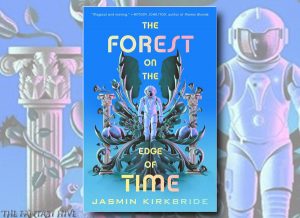
THE FOREST ON THE EDGE OF TIME by Jasmin Kirkbride (BOOK REVIEW)
“People can’t always see when they’re unfairly disgorging the things that have hurt them. It’s painful work, not letting your past determine your future, and everyone needs help with it.”
“Kassandra was still right. It is not her fault the men ignored her and died.”
The Forest On The Edge Of Time by Jasmin Kirkbride is a remarkable debut novel, an urgent work of speculative fiction that uses a smart time travel plot to interrogate humanity’s destructive relationship with our environment and to suggest new avenues for change. Kirkbride writes wonderfully, evoking the Athens of 514 BC, Covid lockdown-era London in 2020, and a dismal climate change ravaged far future with equal aplomb. Equally as impressive is her character work. The Forest On The Edge Of Time is a complex, ambitious novel that is full of hard-earned wisdom. It never shies away from the damage humanity has done to the environment, nor the size of the task ahead of us, but it is resolutely full of hope that we can still build a better world. It is both timely in its concerns and boldly ambitious in its artistic scope. Kirkbride has provided us with one of speculative fiction’s highlights for the year.
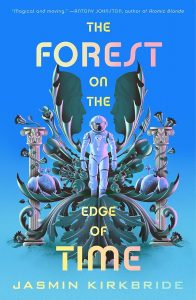 Hazel and Echo are time travellers. They have been recruited by the mysterious Project Kairos, which aims to save the world from anthropogenic climate change. Echo has been sent to Ancient Greece, where with the help of Kosmos, the estranged son of the tyrant Hippias, and the tyrant’s healer and Kosmos’ secret lover Nabu, she must help to seed the new philosophy of the divine-mundane duality paradigm. This philosophy will help shape humanity’s development so that we can interact with the environment without destroying it. Meanwhile, Hazel is sent to the far future, where with the help of an AI called CHARL1E and the robot Tinys, she must monitor the influence of Echo’s attempts on the timeline from a ruined future and give her guidance through the dreamscape that allows them to communicate across space and time. The catch is that the time travel process works by removing their memories, so Hazel and Echo are uncertain who they are and what they’re meant to be doing, and must choose who to trust in their doubly unfamiliar settings. Meanwhile, Anna, a teenager living with her single mum in London in 2020, is struggling with the normal pressures of growing up, compounded by the COVID-19 pandemic and her first encounters with climate activism. Over the course of the novel’s 350-odd pages, Kirkbride expertly braids together these narrative threads to create a powerful reflection on humanity, identity, and our responsibilities to each other and the planet.
The Forest On The Edge Of Time is dense with complexity. With its multiple timelines and numerous surprising twists, the novel has an ambitious structure. A lesser writer might have been happy to explore one of the many ideas present in the novel and could still have written a good book. But Kirkbride aims higher, and somehow pulls it off. The end result is a book that is unafraid to tackle the big ideas, but is squarely focused on the personal. The three time periods allow the novel to take what it needs from the genres of historical fiction, science fiction and literary fiction, while the depth of the three main characters means that its high-concept concerns remain grounded and believable.
Echo’s storyline follows her in Athens, where she becomes embroiled in Kosmos and Nabu’s ill-fated attempt to overthrow the tyrant. Although Hippias’ eventual overthrow will lead to the birth of Greek democracy, the attempt on his life that Kosmos and Nabu are involved in fails. Nabu and Kosmos both believe that Echo must be there to help them depose the tyrant, but Echo’s mission is not one of violence. Project Kairos aims to influence the timeline through ideas rather than political assassination. The historical section of the book is incredibly well realised. Kirkbride has clearly done a lot of research, and it’s a fascinating historical period, just before the birth of democracy. Pythagoras and his followers make a delightful appearance, amongst other historical figures. And the novel examines the period without sentimentality – Nabu is a freeman but he is also a Lydian, foreign to Athens, and there is a stark difference in privilege between him and Kosmos, the son of the tyrant, which interferes in their relationship. Echo is wary that if she were to help the assassins with their plans, it might not be as fair and just a democracy that gets installed as she would like. The novel also doesn’t shy away from depicting the genuine stakes the supporters of democracy are playing for – when the assassination attempt on Hippias fails, the conspirators are subjected to brutal tortures and execution, something that leaves the surviving Echo, Nabu and Kosmos frightened and traumatised.
Hazel’s storyline in the far future is just as vividly imagined and immersively described. The bleak landscape at the end of time shows the worst possible outcome, in which climate change has completely destroyed the Earth and nothing is living on it anymore. Hazel is directly confronted with the consequences of our current day inaction, a powerful admonishment to the reader that something needs to change. Unfortunately, while the Tinys are adorable, CHARL1E is clearly withholding information from Hazel, leading her to distrust him. Indeed, without her memory and any kind of context, it’s difficult for Hazel to know who to trust, especially when she is thrust into such an alien posthuman landscape. With CHARL1E and the Tinys help she winds up knowing more than Echo, and once she masters travelling in the dreamscape it is her who is withholding vital information from Echo in the hopes of ensuring the success of their mission. Hers is a difficult journey through responsibility and culpability, as she learns of the enormity of what humanity has done and the stakes involved in making Project Kairos a success.
Anna’s storyline might seem like the odd one out, in that it’s not immediately apparent how it relates to the other two stories, but the reveal is handled beautifully and is a masterful piece of plotting. It also anchors the speculative and historical aspects of the novel, relating them back to the near past in a way that anyone who lived through the pandemic will recognise. Anna is driven by a desperation that’s familiar to many of us these days, both young people realising the damaged world that has been left for them and those of us a bit older worried about the legacy we are leaving behind us. Anna’s relationships with her mother, her best friend and the boy she fancies are beautifully drawn, and Kirkbride brilliantly captures that feeling of being in-between worlds common to teenagers, where they are testing the limits of the world around them and keen to make their mark as their own person but also still yearn for the protection of their parents.
When Kirkbride brings her storylines together at the end, through a series of wonderfully handled twists, I defy any reader not to be impressed. The novel’s denouement is a powerful affirmation of love and family and the ways that even individuals can make a difference in the face of indifference and adversity. The Forest On The Edge Of Time is a brilliant and ambitious debut, a novel that effortlessly merges different genres and registers to explore our relationship to the nonhuman. It’s an excellent example of the vitality of speculative fiction, and a testament to taking risks with one’s writing. With this book, Kirkbride establishes herself as an exciting voice in speculative fiction, and I look forward to whatever she writes next.
The Forest on the Edge of Time is available now – you can order your copy on Bookshop.org