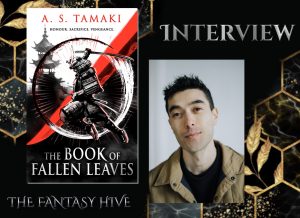
Interview with A. S. Tamaki (THE BOOK OF FALLEN ELAVES)
A. S. Tamaki grew up in Los Angeles, where he spent his childhood climbing trees and making short films in his backyard. After working in Hollywood for several years, he now lives in the Pacific Northwest, and when he’s not writing, spends his time routesetting at local climbing gyms. The Book of Fallen Leaves is his first novel.
Hi Alex, welcome to the Hive! Congratulations on your superb debut, The Book of Fallen Leaves. To get us started, can you tell us a little about it? What can readers expect?
The Book of Fallen Leaves is an epic fantasy retelling of a 900 year old samurai saga that follows two friends – one the heir to a warrior clan, and the other a lowborn peasant – who try to find their place in a world on the brink of cataclysmic war. It’s a story of duty, family, friendship, and fate, featuring historically-inspired political clans, warrior monks, conspiracies, schemes for the throne, prophecy, curses from the past… and just a few angry gods and demons… 😉
Think vibes like in SHOGUN and A SONG OF ICE AND FIRE meets PRINCESS MONONOKE.
It’s a big, complex story, but readers who like deep worldbuilding, complex political intrigue and epic war with heartfelt characters and subtle, numinous magic will find a lot to love.
Here’s the official blurb:
Sen Hoshiakari is an exiled prince of a clan that lost everything in his father’s failed rebellion. Deprived of his birthright, Sen is determined to restore his family’s lands and honour at any cost.
Rui is a peasant girl who saved Sen’s life the night his family were put to the sword. But now she is adrift and unsure of her place in the world, not knowing that the gods themselves have plans for her…
As civil war throws the empire into chaos, and demons seek vengeance on the living, Sen and Rui must fight for both their clan and their shared future…
… But vengeance demands a bloody price.
I had the pleasure of reading an early copy of your book and immediately I was impressed by the multiple POVs and how distinct and compelling they all were. How did you find writing such a large cast of characters? What inspired their personalities and traits?
Thanks!
I started my career writing screenplays, and as a result I approach a lot of the writing process from a dramatic standpoint: what do the characters want? What happens if they don’t get it? What is standing in their way? What is the dramatic question of the moment/scene/chapter?
Two of the most fundamental questions I ask myself are: What do they want to get, and what is the hole inside their heart? Playing with the answers gives me a lot to work with in finding out who these characters really are.
Writing a large cast of pov characters is always going to be a challenge, but for me, it’s all about what each character is going through, what they hope and fear, and where they end up at the end of the story (vs where they are right now).
As the old adage goes, “why this person? Why this day?”
In terms of their personalities, both Sen and Rui have lived in my mind in some form for a very long time. He is an idealistic boy who feels both pressure from – and longing for – the family he never knew; she is a young woman who must find a path in life despite terrible circumstances.
So, when writing I ask myself (sometimes subconsciously), what kind of voice speaks to those thematic ideas? Who is this person that we’re going to live with on the journey?
After that, I just start playing. Asking myself more questions, writing snippets of their thoughts and trying to inhabit them as fully as I can – almost as if I were an actor playing a role.
Did you have any favourites to write?
Rui will always hold a special place in my heart. But also, Yora! He is such a great conflicted character, trying to hold on to the peace he has lost so much in helping make, yet seeing where the cracks have begun to form and trying to find a way to save everything he loves.
And there is a certain ghostly girl who shows up now and then…
You’ve mentioned that the story is a fantasy retelling of a samurai saga that’s quite close to your heart. Can you tell us a little about the original tale and what drew you to it?
Sure! The book is based on a story called The Tale of the Heike, which is one of the most well-known epics in Japan. It is a fictionalized story of real events known as the Genpei War (1180-1185). Hard to avoid spoilers when the source is almost a thousand years old, but in short it is an epic, tragic tale of the rise of samurai power in medieval Japan!
In many ways analogous to the Iliad or the Odyssey, the original tale comes to us from an oral storytelling tradition, sung and performed by blind, wandering minstrels before it was eventually written down.
It’s known for its epic battles, complex political machinations, and tragic character moments reflecting Buddhist philosophies of the fragility and beauty of life. It opens with the epigraph we use in FALLEN LEAVES, which I’ll put here below:
“The sound of the Gion Shōja bells echoes the impermanence of all things; the color of the sāla flowers reveals the truth that the prosperous must decline. The proud do not endure, they are like a dream on a spring night; the mighty fall at last, they are as dust before the wind.”
(Tr. Helen Craig mcccullough)
Your book is set in feudal-Japan and so an aspect that I absolutely loved in your book was your philosophical exploration of warfare and what it truly means to be a samurai. Did writing about this theme come easy to you?
This thematic concept is in many ways the core of the entire project, so I’m really glad it came through! Of course, samurai stories and imagery have become quite popular in popular culture, but the truth is these people were soldiers, for most of their history, and were just as brutal as any conquerors throughout history.
My family is a samurai family, so I’ve thought long and hard about the philosophical and moral implications of this: culturally, historically, there is so much to love about one’s heritage, but at the same time, I have to reconcile it with the fact that, in the end, they were the oppressors; they were the ones whose job was to rule, kill, murder, and destroy. How do we balance those two sides of the equation?
Your book also contains fascinating mythology including that of Onryo, demon spirits, and the concept of one spirit, two souls. What drew you to including these within your narrative?
Thanks! Japanese folklore is full of strange, tragic, and haunting ghost stories, and often the line between beneficial spirits and monsters can seem a bit blurry! Demon possession is also a hallmark of Japanese folklore, as are the concept of Onryo – vengeful demons, who are essentially ghosts/spirits who must remain on this earth in order to fulfil a grudge and satisfy a need for revenge before they can pass on to the next life.
As a total history nerd, it’s also worth noting that many people from real history have merged with the folklore over time, and are considered spirits/vengeful demons themselves, in the canon of Japanese literature. So, this was something I really wanted to explore!
The idea of one spirit, two souls has some roots in the duality of east asian philosophies in general, ranging from Zen, Buddhism, Daoism, wabi-sabi aesthetics, and the Chinese idea of Yin and Yang, light and dark, positive and negative.
The story is all about that which is both light and dark within us, and it felt like a good device to manifest that concept in a more literal way into the story.
 There were so many lines I loved in your book but my absolute favourite quote was this:
“If you gain power on the merit of defeating a tyrant, who will you be when you take the tyrant’s place? You want to be a better ruler: good. But you’ll still be sitting in the exact same chair. That’s what I fear.”
Can you tell us any of your favourite lines to write?
That’s a good one! As for some others, hmm…. there are so many!
Yora has good lines for sure. I also love the crow monk Jobo’s strange philosophical ramblings…
I’ll add a simple one here. It’s not too flowery or poetic, but it reflects one of the core ideas of the series:
“You know the story of the war…”
“… If we ever want to prevent something like that from happening again, it will be up to each of us, individually, to fight for it. The sins of the past lie on our shoulders. And it will be our individual healing that adds together. Nothing more.”
I’m sure many readers will agree with me here but your book cover is absolutely stunning. Ella Garrett did a fantastic piece! How involved in the process were you? Was there a particular aesthetic you hoped would be portrayed?
The cover is amazing! I am so grateful to Ella and the whole Orbit team for putting it together. It’s gotten such a great response.
My editor, James, pitched me their ideas about what the cover might look like fairly early on, before they had an artist in mind, and asked for my thoughts. We sent a couple emails back and forth describing the general outline of the cover design, the concept of a single figure and a sword/weapon, and I gave them some concept images that helped inspire the writing. After that I got to see the cover much like everyone else! Ella’s design was pretty much exactly what we have now the first time I saw it!
What’s next for you Alex? What can you share about the sequel to The Book of Fallen Leaves?
Right now I’m in the thick of writing book 2! My deadline is only a couple weeks after book 1 comes out, so it’s quite a busy time!
Don’t want to give too much away, but I will say this about book 2 – if book 1 was about the beginning of / set up to the war, then book 2 *IS* the war itself.
And if book 1 is about how the line between earth and the realm of gods has begun to weaken, well, we might see a little more of that on the way, especially as we spin into book 3…
Being a debut author, how are you feeling about your book finally being in readers hands? And are you planning anything fun to celebrate your new release?
It’s been such a strange, nerve-wracking, and also gratifying experience to finally see the book in readers’ hands. I’m so grateful for the positive response we’ve been getting, and hearing directly from readers fills my heart. Sharing these stories is why I do what I do.
I have a few fun events planned for the release, but in all honesty, the most exciting thing for me is going to be finishing up the beast that is book 2!
Finally, what is the one thing you hope readers take away from your writing?
If anything, I would say this:
We live in a world that seems more and more to be full of problems, strife, war, and one crisis after the next… and I know, no matter who we are or what we’re going through in life, we all can’t help but feel a bit despondent at times. So if there’s one thing to take away from this book, it’s the idea that, no matter how hard things may be, no matter how dark the world seems it has become, it doesn’t mean we cannot also, somehow, find a way to do good – In fact, it probably means we must try even harder to strengthen the bonds that we have in our lives, because of it.
That’s what the characters in the story are all about. That’s what they’re trying to do, and that’s what I hope we can all try to do, as well.
Thank you so much for joining us today!
Thanks so much for having me.
The Book of Fallen Leaves is out today from Orbit! You can order your copy from Bookshop.org