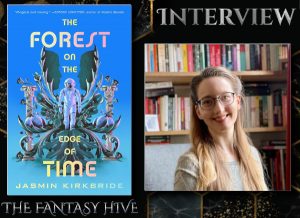
Interview with Jasmin Kirkbride (THE FOREST ON THE EDGE OF TIME)
Jasmin Kirkbride is an author and academic. Her debut novel The Forest On The Edge Of Time has been hailed by the Hive’s Jonathan Thornton as one of the most exciting science fiction books of the year. It uses time travel to explore climate change across a complex narrative that interweaves the ancient past, the present day, and the far future. Jasmin Kirkbride was kind enough to talk to Jonathan via Zoom about her novel and her writing process.
Your debut novel The Forest On The Edge Of Time is out now with Tor. Can you tell us a bit about it?
Yes. So it’s about climate change and time travel, but it comes at climate change sideways. The book opens with two women who walk through a mirror and travel through time. One of them ends up in ancient Greece working as a healer’s assistant in the house of the very dangerous tyrant of Athens, and is embroiled in political rebellion and philosophical scheming. There’s many symposia. And she has a good time and a bad time in equal measure, and is desperately trying to set up a school of philosophy to change the past and make the future dystopia that her counterpart is sent to two and a half thousand years in the future different. But our poor future time traveller is stuck with nothing but robots and a rambunctious AI and a singing plastic tree for company, and she misunderstands all of them egregiously for most of the first half of the book in the way that humans are wont to do with non-human creatures. And then there’s a third story line that weaves through both of them and comes to fruition at the end of the book that’s set in London in 2020 during the pandemic, during the lockdown.
I still get slightly that kind of sense of dread when someone asks me what the book is about, and I’m like, Oh God, because I got in the habit of pitching it when it was going out to agents and publishers, and then it’s been two years since then, and I just haven’t really had to pitch it to anyone, and suddenly I’m having to reawaken that part of my brain, and it’s still half asleep!
One of the things I love about the book is that it’s complex, but having to boil that down to an elevator pitch must be its own special kind of nightmare!
Yeah, I think all elevator pitches are their own special kind of nightmare. But this one in particular. I mean, time travel is always complicated, but I think I almost bit off more than I could chew. I made a lot of relatively naive narrative decisions very early on in writing the book that I then had to figure out later in the book. Like, for example, how do you write a book with two characters who have amnesia? It’s quite a hard thing to figure out.
 The book weaves three different timelines together, you have two amnesiac protagonists, and the third protagonist as well has something about her that is hidden from the readers. How did you negotiate all of this when you were writing the book?
It’s a really good question. The two central characters who travel through time are called Hazel and Echo. So when I started writing Hazel and Echo’s chapters, there was immediately a characterization difficulty. Because normally, half the characterization comes through being able to refer to your past. It’s not direct. It’s not like you’re telling people that your father was a fisherman, for example. You’re not telling them directly, but that language of understanding the world, of the water and of fishing will colour the way that they see the world. And suddenly I didn’t have that. And so that proved to be quite difficult. So for each of them, I tried to drop in something that they did remember. So for Echo, it’s the ancient Greek that she needs to survive, and bits of history. And for Hazel, it’s her coding. She understands the robots, and that’s what she got. And so I could tie their characters to those two things. Anna, the teenager trapped in lockdown in London, was quite a late addition to the writing process. The whole book took me four years to write, and she came about two years into the writing process. I wrote the book as part of my thesis, after a great deal of discussion with my supervisor, and he said, you need someone in the present day. And I was like, I don’t. And he said, you do. And it turns out he was right, because he’s always right! And so Anna came along, and her voice just sort of fell out of me. She’s very reminiscent of teenage Jasmine. I think that’s a lot about her that that felt very personal to the way that I used to be, or the way I look at myself as a teenager now that I’m an adult. So her character just fell out, and I couldn’t tell you exactly how. It just appeared on the page and was quite consistent.
The Anna character felt really well observed. I guess eventually you get enough distance from that age where you can write about it with some perspective, which is harder to do when you’re younger…
It’s much harder. I feel like I spent most of my 20s still being a teenager. It took me a long time to grow up. I don’t know if everyone feels like that, or if I’m just really slow! I think if I was writing this in my 20s, Anna wouldn’t have come out the same way. You know how it is when something gets published, everybody suddenly has an opinion on everything. And I’ve had some questions about, what’s Anna doing there? To me, she was really important, because I don’t think you can talk about climate change without talking about the difficulty of, intergenerationally, what we’re doing to the planet and what we’re handing on. And teenagers’ frustrations with that. I started writing the book in late 2019, when there was Fridays for Future, and all those teenage protests. Protests of literal children getting out in the streets and doing more about climate change than any of the adults around them were going on. There was something so painful about watching that happen and watching the adult world just fail them entirely. Anna’s kind of fuelled by my own anger at our adult failures of younger generations.
Living through the Covid pandemic left its mark on the book. It’s been interesting because a lot of the stuff that’s being published now was written during that period, so they’re dealing with Covid in quite interesting ways…
Yeah. I did write the first draft of this during lockdown, and almost none of it survived. I think I kept about five to 10,000 words, because it was dreadful. And the reason it was dreadful was that I was trapped in my house on my own, and I don’t write well if I’m not engaged in that feedback loop with the world. I need input in order to create output of any value. I mean, I wrote a lot of words, but they were dreadful. There are books that are about Covid-19 that are doing it really beautifully and really interestingly. But for me, the pandemic in this book is more like a placeholder for those massive overarching social and political forces that will come along and tear asunder any attempts we might do to address anything else, like the climate. And unfortunately, since then, watching the world as this book has been going through its publication process, which as you know takes a long time. It’s two years. The last two years have just been one blow to another in terms of any kind of climate action. So it could have been anything. If not for the way the characters have to interact, it could have been set in New York under a Trump administration that doesn’t believe in climate change. It’s a placeholder for a larger idea about the way that the political world can stop everyone in their tracks and make us powerless. Sometimes, like in the pandemic, with good reasons; sometimes, there’s some current political situations that have bad reasons!
I really liked the idea in the book that the solution is, instead of fighting someone, that they’re going back in time to implant this idea, the divine-mundane duality paradigm, which will change how we interact with the world for the better. Can you tell me a bit more about where this idea came from?
One of the things about me is I did my undergraduate in classical studies and my first master’s degree was in ancient history at King’s College London. And I got about midway through that MA. The studies were incredible, but I just wasn’t good enough to do a PhD in ancient history. I didn’t have the ancient languages that I would want to have to do a PhD with the kind of integrity I want to do it. And I kind of looked around and went, what can I do instead? I thought, well, I’m very bookish person. I’ll go into publishing. And then obviously went back and did my MA and PhD in creative writing at University of East Anglia some years later, which was wonderful fun. But the study of ancient history is very much present in this book and the divine mundane duality principle is a real historical thing that was present in what in historical circles we would call Near Eastern philosophy and Near Eastern religious outlooks for many hundreds of, if not thousands of years before the Greek philosophers came along and quote, unquote, started Western philosophy. Which we can take beef with, and, in fact, which I do in the book. So this book formed part of my PhD thesis, but it also very much contains my undergraduate and MA dissertation in ancient history. So I’d sort of been thinking about this philosophical stuff for a long time. It sort of bothered me that I think a lot of people in climate circles in particular place a lot of the guilt for the kind of dysfunction of our modern relationship with the environment at the feet of Christian religious philosophy. And I don’t think that’s true. I think the dysfunction started earlier than that. And if I’m really honest, I think ancient Greek philosophy probably laid the groundwork for Christianity to take off the way that it did, in the form that it did, where we’re not really stewards for the earth, if you’re a godly person, as God might have intended us to be stewards, but in that kind of other sense in which the Earth is sort of enslaved to us. So that’s been bothering me for a long time. And so I thought I might talk about that in the book, and then it became the whole heart of the book. The more I wrote, the more it became a thing. But I was quite intent in the book that I didn’t want them to make a change by killing each other and by fighting. I wanted them to be able to organize their problems in a different way. My favourite chapter of the book is probably the one where, I’ll try not to spoil it, but Kosmos and his father face off, let’s put it like that. There’s five drafts of that chapter where they have a big fight with swords, and it was rubbish. It was just not working. And my supervisor was like, this is really Hollywood. It doesn’t sound like you. It doesn’t sound like the rest of the book. And then I came up with something really weird, and it delighted me, and that’s what stayed in the book. And it didn’t have anything to do with swords. It just had to do with the difficulties of being human and communicating with other humans.
That becomes a recurring theme in the book, that difficulty of communicating. We see it in the ancient Greece section, but we also see it in the future with the difficulty Hazel has in communication with CHARL1E and the Tinys…
Yeah, absolutely. I’m really glad that came across too. I didn’t want CHARL1E or the Tinys or Tree to be, in any way, actually nasty folk. I wanted them to be nice folk who are just deeply misunderstood. Because they kind of represent this posthuman, non-human thing. I think the ancient Greece section is all about the humans’ difficulty communicating with other humans. And then I wanted the future section to be about humans’ difficulty communicating with non-humans in every sense that that might mean. So it was important to me that they didn’t have traditional ways of speaking. And of course, as I was writing this, LLMs came along talking very sophisticated human ways, scarily so sometimes, but then CHARL1E started sounding really like quite archaic. So I made that part of his choice. He likes speaking like that, and that’s why he does it. But you know, the Tinys can’t speak at all, and Tree only sings, which is not helpful for communication with humans. But I kind of wanted Hazel to have to step outside of herself and her own patterns of communication in order to be able to sort anything out in that world, because I think that’s kind of what we need to do, isn’t it? I make it sound like this book is me just being a raging activist – it is also a fun yarn! It does have a lot of my raging activist spirit in there as well.
And also, the Tinys are so cute!
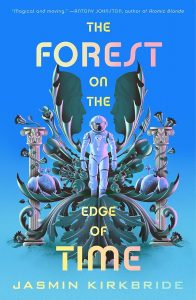
I had a really strange response to the hardbacks turning up, because it’s like I’d done this thing that I wanted to do since I was eight. And I don’t know if you’ve done this, but underneath the cover, my editor put a little foil Tiny in. And when I saw it, I literally fell to bits. I like just sat on the floor sobbing and cuddling a book for like five full minutes.
It’s also based on one of my original sketches of the Tinys from my notebook, that my editor sent to the design team. And it’s just a testament to what an amazing editor I have. So I’m going to namedrop Lee Harris, because he’s an amazing editor and has just made the whole publication process really joyous. We’ve got to give Lee some credit.
And you’re working on your second book now?
So it’s the second contracted book, but it’s not a sequel. I feel that The Forest On The Edge Of Time is complete as it is, and I don’t think there’s more I could do with it. Also I could do the break from time travel! But I’m working on my second book, which I’ve just heard from my editor in the last couple of weeks, it’s been given the green light. So there’s structural edits to do, but it’s gonna go out into the world. And it’s kind of a similar book, but it’s also slightly tonally different. It’s a dystopia again, but it’s just dystopia. And there are two timelines again, but they’re aware of each other. There’s no time travel. It’s about a mycologist living in the New Zealand mountains with her very difficult father after an apocalypse that’s caused by a bioweapon fungus that’s escaped and taken over the ecosystem. It’s not like a Last of Us fungus, where it takes over humans. It’s taken over the ecosystem. And her father falls ill, and she needs to go in search of medicine, but once she leaves the safety of their valley, her own past kind of starts surfacing, and she has some questions to answer. So that’s what that book is about.
Thank you Jasmin Kirkbride for speaking with me!
The Forest on the Edge of Time is out this week, 2nd April, from Tor Books. You can order your copy on Bookshop.org