
SEASONS OF GLASS AND IRON: STORIES by Amal El-Mohtar (BOOK REVIEW)
Synopsis: Full of glimpses into gleaming worlds and fairy tales with teeth, Seasons of Glass and Stories is a collection of acclaimed and awarded work from Amal El-Mohtar.
With confidence and style, El-Mohtar guides us through exquisitely told and sharply observed tales about life as it is, was, and could be. Like miscellany from other worlds, these stories are told in letters, diary entries, reference materials, folktales, and lyrical prose.
Full of Nebula, Locus, World Fantasy, and Hugo Award-winning and nominated stories, Seasons of Glass and Stories includes “Seasons of Glass and Iron,” “The Green Book,” “Madeleine,” “The Lonely Sea in the Sky,” “And Their Lips Rang with the Sun,” “The Truth About Owls,” “A Hollow Play,” “Anabasis,” “To Follow the Waves,” “John Hollowback and the Witch,” “Florilegia, or, Some Lies About Flowers,” “Pockets,” and more.
Over the last two decades, Amal El-Mohtar has written many short stories and poems, pieces that are always ethereal, breathtaking, profound. For the first time, El-Mohtar’s corpus has been assembled into her own anthology. The This Is How You Lose the Time War co-author, looking back on her career in the book’s intro, says that the primary throughline she sees is her love of writing about women and their relationships with one another. None of the book’s content is brand new, making the primary original craft at play here how the writing is ordered. It opens big with the titular entry, El-Mohtar’s magnum opus in the world of short fiction.
 “Seasons of Glass and Iron” is about the fateful encounter between Tabitha and Amira, two young women trapped by very specific fairy-tale punishments. Both Tabitha and Amira believe their circumstances are their fault, but the other sees it as ludicrous that they would think of their “once upon a time” in that way (in both cases, the melancholy interlude that explains the backstory ends abruptly with the other’s reaction). The women empower each other to make the simple decision to walk away, together, in the process redefining what a marriage can be. As Tabitha says:
“When I was a girl, I dreamt of marriage as a golden thread between hearts—a ribbon binding one to the other, warm as a day in summer.”
Tabitha then answers yes to Amira’s question, “Do you want to marry me after all?” but says, “not as a husband would.” The story does not strictly define the relationship as romantic (I see it as queerplatonic), but it gets down to the fundamentals of what a good partnership is.
After such a passionate beginning, the sequence turns to the more curious and unconventionally structured story of “The Green Book.” Academic men come across a woman, Cynthia, who is trapped in a book, in a setting where a seemingly sinister institution looms large. This organization is apparently matriarchal, with both the men and Cynthia beholden to the “Sisterhood of Knives” and things being dated to “Lady Year X.” However, Master Leuwin does “not concern [himself] overmuch with politics,” to which Cynthia responds that he is lucky not to have to. The crux of the story is that a cloistered, intellectual man can only conceive of Cynthia as a magical literary companion, not someone who has suffered a tragedy and wants to be a living, breathing person.
How a patriarchal world conceptualises and minimises a woman vs. who she actually is comes up repeatedly in El-Mohtar’s writing. Seasons of Glass and Iron further ventures into its own labyrinth, first stopping at “Madeleine”, which considers grief and memory as Madeline’s route to healing is one her therapist disapproves of; next “The Lonely Sea in the Sky,” showing a different side of institutionalised science not serving its protagonist or the environment (specifically, in this case, the latter on the planet Neptune).
Something I can’t help but notice at this point in the anthology is that women are consistently referenced as part of the system as well as the victims. There is the Sisterhood of Knives; Madeleine’s therapist is a woman, and so is the fellow researcher who reports Leila. But most are depicted as well-intended, and we should ask ourselves: What are these women’s stories? Why do they enforce the rules the way that they do? In “Seasons of Glass and Iron,” Tabitha compares her shoes to “shoes of iron heated red-hot; shoes to dance to death in,” clearly a reference to the Evil Queen in Snow White, designating her a fairy-tale character just as worthy of examination as the heroines.
Then “Song for an Ancient City” comes along, another classic in El-Mohtar’s repertoire. In premise, it is a poem about the Syrian city of Damascus (or Damishq). In truth, it is as perfect a veneration of a place and its history can be when put to writing. This is a love letter and a prayer to an ancient city, and El-Mohtar uses the motif of the dust in the air to represent how her speaker wants to ritualistically mingle with the place itself:
“Merchant, keep your attar of roses,
your ambers, your oud,
your myrrh and sandalwood. I need
nothing but this dust
palmed in my hand’s cup
like a coin, like a mustard seed,
like a rusted key.
[…] I
would spill attar from my eyes,
mix her dust with my salt,
steep my fingers in her stone
and raise them to my lips.”
Birds are also a recurring motif throughout El-Mohtar’s corpus, including the cardinal and Ultramarine Flycatcher fractured across the cover of This Is How You Lose the Time War. But “A Tale of Ash in Seven Birds” leans hard into imagery and similes surrounding various avians, as El-Mohtar draws upon their traits to serve as metaphors for how immigrants survive in a country set on exploiting and destroying them. This story is essentially a sequence of several free-verse poems, and the birds aren’t the only incredibly deft symbolism, as El-Mohtar argues that “Nations are great magicians; they pull borders out of hats like knots of silk.”
Perhaps the birds are all different people, or perhaps they are the same person morphing over and over again, trying different approaches to living in a system that is rigged, until they are as ruthless and destructive as the “wizard-nation” itself (in the form of a great horned owl) and then burn themselves away, rising from the ashes (as a phoenix) to something better: “We rise from the wizard-nation’s wreck. We are magnificent.”
Two more of El-Mohtar’s all-time bests come up towards the end: first “John Hollowback and the Witch,” followed by “Florilegia; or, Some Lies about Flowers.” The former is a story about accountability, memory, and what makes a witch. Its primary POV character is John Hollowback, who seeks help from a witch to heal the literal cavern in his back. While the text is initially steeped in John’s presumptions about what a witch is (ugly, prone to demand one’s firstborn for payment), it is gradually revealed how he has rewritten his past in his head to make himself the hero of the story; the witch, who “is a kind of justice in the world,” takes it upon herself to shift the burden of these events.
“Florilegia; or, Some Lies about Flowers” is a feminist spin on a tale from Welsh mythology. Blodeuwedd is a woman constructed from flowers to be a wife, who is miserable and constantly in pain in these circumstances. Her husband and his uncles believe she will never rebel because they only made her from the blossoms of the flowers, which allegedly give her only sweet, dainty qualities. But with the help of a visiting scholar, Blodeuwedd finds other floral characteristics in herself that the men have overlooked and turns the tables on her husband. El-Mohtar also bestows Blodeuwedd a spiritual kinship with her husband’s abused mother, Arianrhod, despite the latter not physically appearing in the story.
Seasons of Glass and Iron ends with “Pockets,” a story that hits a magnificent combination of whimsical, strange, and heartwarming. Nadia experiences a strange phenomenon of finding random objects in the pockets of all her clothes, and comes to see it as a loving connection with anonymous people all over the world. Each object is a glimpse into the peculiarities and struggles of someone else’s life. Such an oddly uplifting tale is the perfect conclusion—indeed, providing the anthology with a flawless final sentence.
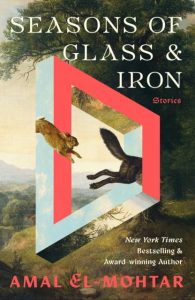
The cover of this long-awaited collection is a picturesque forested mountain landscape, broken up by a geometric element at its center that refracts parts of the image. You can read into that alone: Nature has a significant place in El-Mohtar’s writing, and she has her own lyrical yet analytical way of getting lost in humanity’s relationship with it. But also, leaping across the trapezoid is a rabbit, trailing after what seems to be the back half of a wolf. As far as I can tell, this image is drawn from an exchange in “Seasons of Glass and Iron,” after Amira finishes telling Tabitha her backstory:
“When Amira stops speaking, she is taken aback to feel Tabitha scowling at her.
‘That,’ growls Tabitha, ‘is absurd.’
Amira blinks. She had expected, she realizes, some sympathy, some understanding. ‘Oh?’
‘What father seeks to protect men from their pursuit of his daughter? As well to seek to protect the wolf from the rabbit!’
‘I am not a rabbit,’ says Amira.”
Such is the kind of thought-provoking logic that permeates this collection. Who is the rabbit, and who is the wolf? Are women best served by denouncing the label of “rabbit,” using it to their advantage, or changing its very definition? How do women come together to create something original, unimagined, and just? Conventions be damned, because El-Mohtar’s characters will always find something beautiful and unexpected in their stories, or will be clever enough to be a rabbit who chases the wolf away.
Seasons of Glass and Iron: Stories is available now, you can order your copy on Bookshop.org

