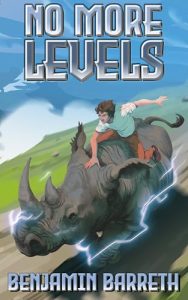
SPFBO 11 FINALIST REVIEW NO MORE LEVELS by Benjamin Bareth
Here at the fantasy-hive the SPFBO team have been reading through the nine other finalists that have been put forward by the other blogs alongside our own selection of THE HALLOWS and we are now ready to start posting our reviews, on an intended fortnightly schedule between now and December.
We do have to give scores at this stage and we’re also aware that the scores can tend to average out and congregate around the middle so we’ve tried to make a conscious effort to distinguish between each book in the scores we give and the implicit order that we are placing on them – which may mean some scores veer towards the upper and lower ends of the range.
However, we have been impressed by the professionalism and quality of this year’s finalists field and also how so many of them have done something different with their story ideas and maybe trodden into spaces where traditional publishers might fear to go.
Hopefully there will be enough in our reviews to give you a flavour of each book and a sense of whether it would appeal to you or not which – after all – is what reviews should be about.
So on to our second finalist review of NO MORE LEVELS by Benjamin Bareth where the judges will comment (as always) under the headings of worldbuilding, Prose, Character and Plot, before giving their pithy one line conclusions and scratching their heads to come up with a numerical score for this fortnight’s finalist.
Worldbuilding
Theo: LitRPG is, I feel, very much a niche sub-genre and one that I haven’t seen much of before either in my own reading or in SPFBO. The nature of Worldbuilding in LitRPG is largely around designing the ‘game’ that is the engine of the world. A lot of Barreth’s ‘Game of Gods’ will feel familiar to anyone who has played World of Warcraft (with characters’ powers advancing exponentially as they increase levels through adventuring in dungeons) or Dungeons and Dragons with its character defining attributes of strength, intelligence, wisdom, dexterity, constitution and charisma. I did enjoy Barreth’s twist on the levelling up preoccupation with his punning title about the bar his protagonist encounters to ever increasing his level. I also liked how all the characters dismissed charisma as the most pointless of characteristics which certainly echoed my own long ago experience of 2nd edition AD&D. With LitRPG being very dominated by game mechanics and the acquisition of multiple abilities and skills, the worldbuilding risks being expository and a bit overwhelming. At one point our hero Rin reflects So many incredible abilities. My head feels like it’s going to explode. And my marginal kindle note at this point is simple “you and me both.” However, one feature I particularly liked was the idea that the ‘cursed’ class were looked down on and despised for no other reason than their class and the assumptions people made about them because of it. In a world that is still riven with prejudice it is always good to see authors addressing the baseless banality of such prejudice.
Cat: I find LitRPG to be a very ‘love it or hate it’ genre, depending on the skill of the author in making the moving parts of the fantasy world seem plausible in a real, practical way. This seemed a little heavy-handed to me, with stats essentially appearing above a person’s head, the constant focus on Levelling and the different benefits and pitfalls of classes. I’m not a fan of min-maxing and this felt rather like that at some points, which threw me out of the story – it’s hard to suspend disbelief when a luminous ‘FANTASY TROPES LOL’ sign is flashing on the page. This wasn’t the worst I’d seen, but it did happen enough to frustrate me. I did like the variations on traditional themes to make this world unique, though, such as a ‘ring of holding’ rather than a ‘bag of holding’ (or ‘hammer-space’). This universe is very much its own, and I appreciated that.
Vinay: I mean it’s a LitRPG, so you know what the worldbuilding is going to entail. There are going to be opponents with their own scores and powers that will be used by the lead to powerup. What is interesting here is the nature of how the power and skills accumulate. The concept of the powers and levels that come up in a bit too out there in this world but works well. There are a couple of things that really differentiate this from some of the others in this genre. First (and extremely surprising) is that this is a done in 1 book, a STANDALONE LitRPG. How does that even happen? (I will get to that in the other section). Secondly, the way some of the power manifests is extremely interesting as are the limits and challenges on it. That definitely kept things extremely interesting (and also extremely busy). We do see a bit of the world as well with Rin traveling and some of the dungeon spots but again we don’t spend much time on it before we are whisked back to some of the plot mechanics. I found a lot of elements interesting, including who has the power and what they imbue. There is a decent amount of time spent on the “Gods” in this world and the particular God who takes an interest in Rin. There is an almost Cradle like allusion to specific things about the Gods but those are elements that are teased which adds to the intrigue of this world
Prose
Theo: There are some nice bits of descriptive prose and turns of phrase, of which these two most caught my eye.
But the most fantastic sight yet was when they walked beneath a soaring basalt pillar leaning crookedly against the mountainside… looking like a giant had propped his walking stick against the mountain and forgotten about it.
Or
He reached over and patted Rin’s hand. It was meant as a comforting gesture, but the deep furrows in the tinker’s brow emptied it of truth.
Cat: This seems to sum up the book pretty well for me: ‘“I’ve a few words I’m ‘sposed ta say… this ‘ere’s a stone dungeon, with lotsa rock monstas, so adapt yer fightin’ style accordingly. The dungeon’s a short one, with only ten rooms an’ most of ‘em styled as some sort o’cavern. Once ya kill a monsta, they typically respawn within ten minutes… Oh, and don’t die.”’
Vinay: The prose has a nice easy writing style to it without being very memorable. It never feels heavy despite so many things happening and you are pretty much dragged into the easy flow of the book. I don’t however have too many memorable quotes from the book but I never felt that I was making slow progress. One thing though that is mentioned is the penchant for some dry jokes for the characters and the author does inject a few of them, a couple had me chuckling as well
“That’s the thing about ghost companions”
“What?”
“People are dying to be one”
Characters
Theo: Rin is engaging enough and Trixie, when she makes her appearance, proves a fun foil to him. The strength of the story is in its gameplay aspects and Rin’s accumulation of skills and attributes rather than in his personal development. The bad guys, despite their lofty levels, are not particularly deep – but we see enough of their arrogance to enjoy their eventual defeat.
Cat: Again, sadly a little frustrating for me. Rin and his family are lovely, but he’s so innocent and naive at the start of the book (Level Zero), and while I understand this is ‘real life’ reflected in game mechanics, it grated a little. The humour that each character shows is a relief, as you can almost feel the author winking at the reader through the page.
Vinay: I think the evil characters are just evil for the sake of it which was a bummer as Rin is written as an extremely likeable, if naive, character. It is also interesting to see how Rin finds himself in a pretty bad situation and pivots to a different path. You always want to root for Rin (not surprising given he’s the lead) but the author also makes it very easy. Rin’s growth (as much as it can be for a standalone LitRPG) focuses on his grit & ability to want to do the right thing and also shaking some of his naivety off
Plot
Theo: In my limited experience of LitRPG I don’t know how far the genre goes in for accumulating books in a series almost as rapidly as the protagonists accumulate levels, but Barreth in his acknowledgements sets out how he explicitly wanted to deliver a stand-alone story and the plot does bring us to a very satisfying yet definite conclusion (and one that was honestly foreshadowed). However, once you accept that the story takes place inside a game designed by gods (game designers as gods?!) with characters who all have free will and can face a real death, it rattles along pretty comfortably (I mean what are Greek and Norse mythos if not mortals as playthings of the Gods). I read it all in less than 24 hours and enjoyed the gameyness and the twists. Furthermore, as is clear in the title, Barreth sends Rin shooting off at a tangent to the normal modes of progression in this ‘Game of Gods’. Thrown on the mercy of the trickster god Craven, he is discovering the rules of Craven’s version of the game alongside the reader. Add in the peril of a long standing family feud with an arrogant cheating aristocratic duellist and the evil matriarch behind him and you have quite a few elements of conflict. And conflict is the essential heart of a good story.
Cat: I definitely appreciated the rarity that is a standalone book in an often-serialised field! It allowed the story to have a beginning, middle and end, and everything flowed along nicely. Unfortunately it was pretty predictable to me, and while there were aspects that had me wanting more (such as Craven, because ‘baddies’ are interesting!), I found this one a bit of a slog.
Vinay: I loved this concept of a done-in-1 LitRPG, even if I felt that does hurt the book a little. The start is a little slow and has a ‘done before’ vibe to it but the moment the book hits the twist on Rin, it becomes unputdownable. The pace is blistering and the plot points are thrown in, and like Rin, you can barely react and you go with the flow. It is interesting all the way through and while he does realize he is a pawn in this game of Gods, he also has enough agency and free-will to make it very interesting. Which brings me to the end – the ending just got done very quickly and without too much struggle. That’s where I felt the need to finish as a standalone came in the way of delivering a great conclusion. It maybe needed 50 more pages if we were doing it in such a way. I definitely had a good time with this (I am increasingly liking this genre a lot) but I also just wish we got a great ending, rather than a rushed one
Conclusion
Theo: A fun immersive story taking the reader and the protagonist through a deadly ‘Game of Gods.’
Cat: ‘Knightmare’ for adults.
Vinay: A standalone LitRPG that almost makes a great argument for standalone LitRPGs
Score |
/10 |
Theo |
6.5 |
Cat |
6 |
Vinay |
7 |
Average |
6.5 |
Final score (rounded to nearest 0.5) |
6.5 |