Influential Themes in the Book of Fire Series: Guest Post by Michelle Kenney
The Book of Fire trilogy follows two communities – a village of survivors recovering after a Great War and a sealed, domed population cut off from the outside world. It’s a world where neither knows the other exists, until a chance encounter prompts Talia to enter the Lifedomes and discover a civilisation where humans are the monsters, and the monsters remind us what it means to be human.
Book of Fire also asks whether we should do something just because it is scientifically possible, and is inspired by the ever-growing conflict between science and nature in our real world.
What themes have influenced the Book of Fire series and why?
Science vs Nature
 I’ve always enjoyed reading a wide range of genres, especially fantasy, mythology, historical & dystopian fiction, where just about everything and anything is possible, so when it came to writing the Book of Fire series, it felt natural to try and combine all my interests in one big colourful world.
I’m also a big believer in writing the book of your heart, the one that really won’t let you go, and after working in environmental PR for a while, it felt important to try and write something that captured the ever-growing conflict between science and nature in our real world. As the Book of Fire world grew, this key science vs nature theme became absolutely central to the books, and is represented from the outset by two conflicting communities: a genetically enhanced community living in sealed domes, and a wild girl trying to survive in a recovering world. The outsider community, Arafel, goes on to become the living embodiment of symbiotic living with nature, and Hunters must live eg knowing their place in the forest and only taking what they need to survive; while the domed, genetically enhanced population combines everything that is controversial about science – including one or two mythological secrets of course!
I’ve really enjoyed feedback to this key theme throughout the series, and most reviews still relate to this very real world conflict, which has shown me just how important it is to be to readers.
Ancient Rome
In addition to the science vs nature conflict, there’s a strong Roman world vibe running through the series, and the inspiration for this came from a trip to the Colosseum nearly twenty years ago. My partner and I were backpacking around Italy, and joined a tour group around the ancient site, and as we walked between the rows we noticed torches of burning lavender were filling the air with a very distinctive, pungent smell. When asked, the guide went on to explain it was an authentic detail they’d begun replicating from the original Games, when the herb was burned to cover the scent of bloodshed in the arena! It was such a tiny gruesome detail, but one that lodged itself in my brain and grew, because there was something in that human action that felt like the roots of a story. Nb This tiny, specific detail may have also found its way into one of the books later on in the series too 😉
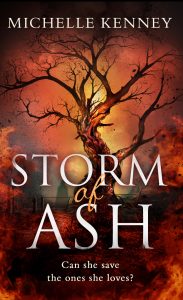
 As this ancient Roman world theme grew, the real challenge became not overloading the story, and dropping in just enough of the right details to make the theme realistic, eg the Order of the Aquila and Roman Equite Knights. The Aquila Eagle was a prominent symbol in ancient Rome, while Equite knights were sworn, mounted soldiers. These types of details helped to define Book of Fire’s elite soldiers (especially the Commander-General Augustus Aquila) and charioteers by the time we reach Storm of Ash, but there was always a balance to be struck to ensure they didn’t slow the pace. Thankfully, I had a very patient editor!
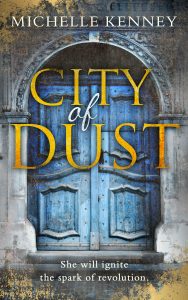
The Roman theme also gave me the perfect opportunity to tap into Exeter’s rich vein of history, and I’ve really enjoyed reader reactions to some of the local landmarks – albeit 200 years in the future and after an apocalyptical war! I don’t know of too many dystopian novels based in and around the historic city, and Book of Fire’s Augusta legion were actually based in Isca Dumnoniorum (old Roman Exeter) nearly 2000 years ago. Much of the action in City of Dust (Book two), is also based in and around local landmarks such as Rougemont Gardens, the Royal Albert Memorial Museum and Exeter Castle, and readers often mention a certain scene at a ghostly, ruined Cathedral halfway through the book. Again, no spoilers, but I’ve really enjoyed reader reactions to some of the fictional scenes based around these well known local landmarks.
Mythology
A fantasy world in which science had gone one step further to recreate ancient mythological creatures felt a little different to what had been done before, and Book of Fire’s mythology theme quickly became one of my favourites (spoiler: there *may be one of two legendary nightmares running around in the tunnels beneath the Flavium!) Given the popularity of Greek mythology, I had to be careful not to mix my creatures – though of course the Romans borrowed most of theirs from the Greeks while adding their own individual twists, so as not to be accused of complete plagiarism, eg Greek Satyrs & Roman Fauns – and of course, I had to consider Pantheon’s own scientific agenda too.
Looking back, the ancient Roman world/mythology really grew with the series, but one thing I’ve learned about fantasy readers is that once they invest in your world, they’re with you for the journey, and tiny authentic details can make all the difference. I now start a glossary whenever I’m writing something new, so you could say peppering worlds with historical and real world details has become a bit of a habit.
History
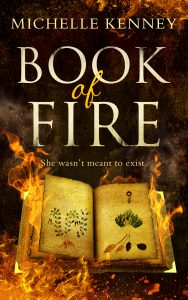
 Last but by no means least, I should probably mention the ancient Voynich Manuscript – the actual Book of Fire in my series – which is also depicted on HarperCollins HQ’s brilliant first book cover. This ancient book links the two conflicted communities in Book of Fire, and is actually a real medieval book on display in Yale University.
Written during the Renaissance, the Voynich contains hundreds of medieval pages filled with coded text and coloured ‘nonsense’ diagrams, linked to botany and astronomy. Until a few months ago, scientists were completely baffled as to their precise meaning, but the latest widely-accepted theory, is that it is a unique book written by Dominican nuns in a blend of medieval languages, for Catherine of Aragon’s Great-Aunt!
Clearly, the Manuscript is worthy of a story in its own right, but the real magic for me is that even though we live in a world of sophisticated technology, there are still some ancient mysteries that elude us because they require human intuition and ingenuity more. This captures the spirit of Book of Fire so well, that it felt natural for this mysterious medieval manuscript to end up entwined with Talia’s feral world too.
I’ve tried to cover most of Book of Fire’s core themes above, but there are more including dystopia, feminism, and coming of age #why run when you can fly, so if you’re currently reading any of the series, or simply want to ask a question, please do come and find me on any of the social media channels listed below. It would be great to hear from you.
Thanks for reading!
The Book of Fire series is available as ebooks and paperbacks from most retail outlets including HarperCollins, Waterstones, WHSmiths, Blackwells, Amazon etc. Follow THIS LINK for full list.
Or chat all things bookish/Book of Fire with Michelle at:
@mich_kenneyauthor – Instagram
Michelle is a firm believer in magic, and that ancient doorways to other worlds can still be found if we look hard enough. She is also a hopeless scribbleaholic and, when left to her own devices, likes nothing better than to dream up new fantasy worlds in the back of a dog-eared notebook. Doctors say they’re unlikely to find a cure any time soon. In between scribbling, Michelle love reading, running, attempting to play bluegrass and beach treasure-hunting with her two daughters (dreamers-in-training).
Michel
le holds a LLB (hons) degree, an APD in Public Relations and is an Accredited Practitioner with the CIPR (with whom she’s won awards for Magazine & PR work). But she’s definitely happiest curled up against a rainy window, with her nose in a book.