The Memory Librarian and Other Stories of Dirty Computer by Janelle Monáe (BOOK REVIEW)
“Ain’t just about prospering, it’s about progressing, connecting, tappin’ into something larger than yourself, so you can really see. Can’t build nothing if you can’t feel nothing. Community comes from feeling and feeling comes hand in hand with creation.”
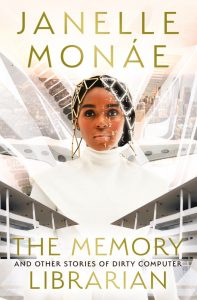 Since the 2007 release of her debut EP Metropolis: The Chase Suite, Janelle Monáe established herself as one of the most innovative and fascinating music artists of her generation. From the start, Monáe’s project incorporated elements of narrative and of SF. Metropolis was a concept-suite, introducing Cindi Mayweather, an android in a dystopian future who is hunted by the authorities for breaking the society’s biggest taboo – falling in love with a human. The EP’s future narrative was inspired by the cinematic visions of Fritz Lang’s Metropolis (1927) and Riddley Scott’s Blade Runner (1982) as well as the social science fiction of Octavia Butler and Ursula Le Guin, whilst Monáe’s music drew on everything from afrobeat, funk and soul to rock, electronica and R’n’B to create a unique mix. The project also always had a multimedia aspect, with the story and worldbuilding continuing through Monáe’s next two full length albums, The ArchAndroid (2010) and Electric Lady (2013), as well as on the cover art and in her striking music videos. Her third album, Dirty Computer (2018), set outside the Metropolis world of Cindi Mayweather, appeared with a new cyberpunk dystopian vision and was accompanied by an “emotion picture”, a narrative film that further elaborated on the story and worldbuilding of the album. This time, the concept was based on a near-future dystopia in which the thoughts of humans, AIs and robots could all be edited and rewritten by the oppressive New Dawn regime, allowing the authorities to directly control the population’s identity through their memories. The narrative focuses on Jane 57821, who remembers her true identity and breaks free. The Memory Librarian and Other Stories of Dirty Computer (2022) continues the project as a linked series of short stories. Collaborating with a series of talented, up-and-coming Afrofuturist, science fiction and fantasy authors, Alaya Dawn Johnson, Danny Lore, Eve L. Ewing, Yohanca Delgado and Sheree Renée Thomas, Monáe expands her vision of hope and resistance in an oppressive cyberpunk dystopia in a powerful and vividly imagined story cycle.
Monáe’s creative vision directly relates its SF elements to real-life social and political struggles. As a queer bisexual Black American woman, Monáe’s cyborgs and unprogrammable people represent those who are outcast in mainstream white American society, and her authoritarian dystopias reflect the systematic racism and homophobia ensconced in the US. Dirty Computer the album is a particularly pertinent celebration of Monáe’s intersecting identities as a queer, nonbinary person of colour in America in the face of the populist right-wing as exemplified by the then-current Trump presidency. Her songs explore black and queer pride whilst refusing social control. They are also about how love and creativity transcend boundaries of nations, race, gender and sexuality. These ideas also inform the linked short stories in The Memory Librarian. Monáe has chosen her collaborators wisely, a talented roster of writers who share her queer, sex-positive Afrofuturist vision and do an excellent job of helping her bring her ideas to the page. The end result, like Monáe’s music, is a cohesive whole born of collaboration and sharing of creative ideas.
Following a short introduction in which Monáe briefly introduces the world of Dirty Computer, the collection opens with the story ‘The Memory Librarian’, co-written by Monáe and Johnson. Telling the story of Seshet, New Dawn’s first Black Memory Librarian, in charge of enforcing New Dawn’s control by monitoring, editing and erasing people’s memories, who is brought back to her roots when she unexpectedly falls in love with Alethia, a beautiful trans woman who is also a creator of illicit dreams. The story effectively introduces the rigidly socially stratified world of New Dawn and how it is built on social control and oppression, as well as showing the deeply ingrained racism that Seshet struggles against on a daily basis. ‘Nevermind’, written with Lore, introduces the reader to Jane 57821, the protagonist of the album and film, and her friends and lovers Zen and Ché. The story is set after the events of the film, where Jane, Zen and Ché have escaped from New Dawn and are living together in Pynk, an off-the-grid hotel that acts as a refuge for those who want to live outside of authoritarian control. Jane and her nonbinary friend Neer have to save the hotel from an attack by New Dawn and from those spreading prejudice inside the hotel. ‘Timebox’, written with Eve L. Ewing, Raven and Akilah, two women struggling to make their relationship work across a stark class divide, find their relationship further tried when the discovery of a room in their new flat that enables time travel leads to conflict over how they should use it. ‘Save Changes’, co-written with Yohanca Delgado, is a brilliantly constructed time-travel tale about two sisters, Amber and Larry, who are ostracised because their mother Diana led a rebellion against New Dawn, until she was captured and her mind wiped. Amber feels the responsibility of caring for her family, whilst Larry responds by going out, making friends and falling in love in the cracks where New Dawn can’t see them. Soon Larry’s girlfriend is captured in a raid, and Amber must decide whether she will use the mysterious gift left to her by her father to save her sister. The collection closes with ‘Timbox Alter(ed)’, written with Sheree Renée Thomas, in which the children Bug, Ola, Trell and Artis are able to imagine an escape from their bleak and brutal upbringing under New Dawn thanks to the power of creativity and their imaginations, which allow them to see how to build a better life for everyone outside of New Dawn’s control.
Taken together, the stories build an impressively detailed portrait of Monáe’s future vision, an Afrofuturist milieu in which cyberpunk technology exists side-by-side with magic. Monáe and her collaborators show how ordinary people with marginalised identities manage to stay true to their identity and find their own happiness and love, however temporary, despite the all-pervasive power of New Dawn. The stories highlight the importance of hope, creativity and love, how trusting these emotions and being true to ourselves can be a powerful act of resistance in and of itself, but also that they allow us to envision better futures outside of authoritarian control. The Memory Librarian is full of memorable and believable characters struggling valiantly against forces of oppression. It confirms Monáe’s incredible power of imagination and creativity whatever medium she’s working in, and the ability and talent of her co-writers in bringing her vision alive on the page.