
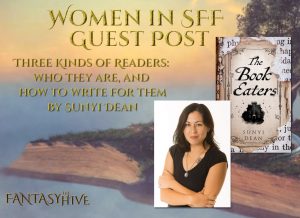
Three Kinds of Readers: who they are, and how to write for them – GUEST POST by Sunyi Dean
Three Kinds of Readers:
who they are, and how to write for them
by Sunyi Dean
INTRODUCTION
What motivates readers to pick up certain books, and writers to create certain stories? A complex question—for which I’m going to offer an uncharacteristically simplified answer.
Both readers and writers fall into three very broad categories: escapists, projectors, and communers.
As a sidenote: these are categories that someone once explained to me in brief on the Absolute Write forums, but I’ve never been able to find the original source despite copious searching, and have since added to the idea in my own time. If you do know the original source, feel free to write in and correct me!
Enough waffle, and on to the categories! Even if you disagree with all I’ve written below, perhaps it will still fuel some interesting discussion.
CATEGORIES
Escapists
John finds his job very dull, so every lunchtime he dives into Conan the Barbarian to alleviate the day’s tedium with some fictional adventures in a fantasy land. Reading takes him far away from his spreadsheets and office desk.
This one is straightforward. Simply put, escapists look to ‘get away’ from real life through their books. Fantasy in particular has an unkind reputation for being escapist, but there is absolutely nothing wrong with trying to envision a reality more exciting than our own. (To paraphrase JRR Tolkien, it is the duty of prisoners to escape.)
Most readers seek some degree of escapism from books, but for escapist readers this is a paramount aspect. They are also likely less interested in the author as a person, and may have less patience for message-heavy stories or convoluted characters.
Escapist authors are similarly trying to create stories which focus on immersive experiences and absorbing settings. Again, that doesn’t mean other types of books ignore immersion or world-building; every book should aim for a certain level of both. But for escapists, the quality of immersion will be a defining aspect that makes or breaks the reading experience.
Projectors
John likes reading Conan the Barbarian on his lunchbreak and imagining himself in Conan’s place: swinging the sword, killing the baddies, saving the guy/girl. If he could somehow be transported to Conan’s world, he’s confident they’d get along well.
The concept of projectors, or reader/consumer as hero, is likely familiar to anyone who plays video games. Projectors are looking for themselves in a story. They want to relate to the protagonist, and/or imagine themselves as the protagonist. Projectors are (I believe) probably the most populous type of reader.
The importance of a connection to the protagonist can vary for escapists and communers, who might stick with a novel for other reasons. But projectors are actively looking to create an emotional connection with fictional characters, and are likely to value that connection above other craft choices.
For projector authors, the concept of relatable protagonist is paramount. Writer communities frequently debate whether or not a main character has to be likeable or relatable. Realistically, most characters in most stories benefit from having some relatable traits, but as above, honing relatability will be crucial for writers of projector novels.
Of course, actually defining the concept ‘relatability’ is a whole other minefield—something I’m very aware of as a mixed-race, neurodivergent writer. What is relatable to me will not necessarily be relatable to the mainstream, and vice versa. But we’ll leave that specific discussion for another article.
Communers
Whenever John reads Conan the Barbarian, he finds himself thinking a lot about Robert E Howard. What was the author himself like, as a person? Are Conan’s traits and actions reflective of the author’s own personality? He combs repeatedly through the text, seeking riddles in Conan’s story that will reveal hidden meanings in Howard’s words.
If escapists can be described as story-focused and projectors as reader-focused, then communers are author-focused. Communers may enjoy immersion or relatability, but above all else they want to pierce the veil between author and reader.
Communers sometimes manifest as superfans, ones who know everything about the book, who spend time speculating on an author’s intentions or meaning, who seek out other communers, and who will try to recruit new readers into the fold. They can be an author’s most devoted supporters, but also an author’s worst nightmare.
Communer authors, in turn, have a strong drive to be heard. I’m very much in the communer category, for example. As a reader, I want to know the mind behind a piece of fiction, and can’t separate art from artist very easily. As a writer, I want to be heard through my fiction, and to communicate deeply with other people, at a profound level that remains elusive in my day-to-day interactions.
The difficulty with communer writers is a tendency to slip into message mode, and to focus on lecturing or expostulating at the expense of a good story.
WRAP-UP
These categories are not meant to be restrictive or fixed, and it should go without saying that most people are a mix of these categories, even if one of them tends to be dominant. They are intended only to describe general trends in vague ways. I’m also very aware that writers in particular have a tendency to baulk at these kinds of hazy classifications.
However, in very broad terms—and when we write commercially, we must sometimes think in broad terms—it’s still a useful framework for examining the relationship between authors and readers, and sometimes rethinking one’s approach to books from a fresh angle.
I also think there is merit in judging a book on its intentions. A book that is trying to attract communers is going to shoot for different criteria, for example, and at least in my own writing that’s a useful distinction. (The Book Eaters was a ‘communer’ book, but my current WIP is an escapist book, and that means I have to evaluate them differently at every stage.)
Questions for readers and writers:
- What do you think of the categories? Do you feel that you are predominantly one or the other, or are you a creature of chaos and a complete mix of motivations?
- When you evaluate whether a book is good or bad, what kinds of criteria are you using, and do any of them align with the categories above?
Sunyi Dean (sun-yee deen) is an autistic author of fantasy fiction. Originally born in the States and raised in Hong Kong, she now lives in Yorkshire with her children. When not reading, running, falling over in yoga, or rolling d20s, she sometimes escapes the city to wildswim in lonely dales.
Her short stories have featured in The Best of British Scifi Anthology, Prole, FFO, Tor Dot Com, etc., and her debut novel, THE BOOK EATERS, will be published Aug 9th, 2022 by Tor (USA) and Harper Voyager (UK). Available at all good bookstores, in ebook, hardback, and audio – Pre-order HERE
Considero que se debe profundizar en esta clasificación y ampliarla. Hay una enorme varidad de tópicos, autores y por tanto de lectores; por ejemplo, me considero lectora persistente y en estas caracterícas no me encuentro identificada o caracterizada. Y, considero muy interesante y hasta importante que esa clasificación de desarrolle y se amplie, porque entiendo que hay más tipos y no sólo tres, de modo que le exhorto a continuar con este trabajo ya que será un buen aporte.
As a reader, mostly escapist, with occasional projectionist tendencies. Every now and then I’ll think about the author as I read. If I know something about his or her life and see bits of it in the book, I’ll start leaning toward communal.
A lot of times, if I find something really enthralling, I’ll go back to the book afterward and try to figure out what drew me in, but that’s when I read as a writer.
I certainly self identify as an escapist reader, but will say that certain writings will draw me into projection for example, most recently The Murderbot Diaries series. I also barely can stand communing with myself let alone anyone else! (Or is that just more Murderbot projection)?
As a reader, I think I’m a mix of escapist and projector. If I want to know more about the writer behind the book, it’s generally for clues as to How Did They Do That??