Male Gaze in the Mythic Foundations of Fantasy Fiction – GUEST POST by Juliet E. McKenna (THE CLEAVING)
Looking at the male gaze in the mythic foundations of fantasy fiction from a 21st century perspective.
by Juliet E. McKenna
In brief, the term “the male gaze” emerged in the 1970s from artistic analysis of women’s portrayal in paintings, advertising and cinema, as objects to please heterosexual male onlookers. From this perspective, a woman’s value is assessed in terms of her physical beauty and sex appeal. The consequences of such attitudes were soon identified in narratives. When a woman’s only role is to be admired, she need not take action. A damsel in distress can wait for her knight in shining armour to turn up on his white horse and save the day. It’s a short step to seeing that a woman’s role is to be in distress, so the hero can save the day. He’s the focus of the story. The girlfriend dead in a fridge is disposable.
Still more briefly, further discussion found these assumptions underpinning patriarchal attitudes, where masculine interests define ‘right’ and ‘normal’. If the ideal woman is passive, those who speak up, who take initiative, and especially those making their own sexual choices, are doing ‘woman’ wrong. Therefore, stories tell us, they are dangerous and frequently ugly. Tragic consequences inevitably punish them while obedient, beautiful girls are rewarded with marriage and a man to make decisions.
Victors don’t only write history. They significantly influence which narratives are promoted and prioritised. Evil stepmothers, wicked queens and treacherous seductresses go back as far as classical Greek myth, in Hera, Clytemnestra and Helen of Troy. We see variations on these women in Lady Macbeth, in Victorian novels like East Lynne, and in modern cinema and TV. Powerful women in history, from female pharaoh Hatshepsut to medieval queens like Eleanor of Aquitaine, are condemned by masculine scholarship. We see these patterns unconsciously reflected in many modern fantasy novels.
Women have pushed back at the male gaze. Paintings show influential noblewomen in gorgeous gowns and jewellery, surrounded by luxuries provided by their male protector’s wealth and power. Portraits of women asserting their independence, from Mary Wollstonecraft to artists such as Gwen John, show them wearing clothes that don’t require a maid’s assistance, with simple hairstyles and few cosmetics. A woman who doesn’t spend hours on her appearance can use that time to think for herself. No wonder people who dislike that prospect continue to promote unattainable ‘perfection’ as a goal for young women. This includes women who benefit from the patriarchal status quo, or who fear the personal consequences of anyone else rocking the boat.
SF and fantasy authors have confronted these narratives for decades. Nevertheless outdated ideas persist. Recurrent ‘Best of’ lists praise books repeating unquestioned story patterns, and the only novel by a woman will be A Wizard of Earthsea. Ursula Le Guin herself said later in life, how rereading that story showed her the patriarchal priorities she had absorbed without even realising.
This is why we must examine classic tales still underpinning the epic fantasy genre. We encounter these stories as children, long before we read novels challenging patriarchal attitudes. Whether it was Aristotle or Ignatius Loyola who first said ‘give me the child until he is seven and I will show you the man’, modern child psychologists tell us that’s when children start to distinguish between fantasy and reality. Before that, children accept what they see and are told as ‘normal’. Most of us have encountered King Arthur by then.
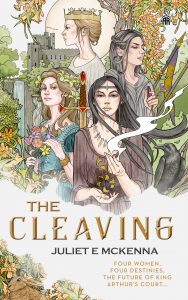
Reimagining foundational stories directly challenges unconscious assumptions. Familiar narratives look very different from the viewpoints of overlooked servants such as Nimue. We see women’s traditional roles are vital to keep everyone clothed and fed. We realise who rules a kingdom is less important for ordinary people than not being slaughtered by invaders. When queens like Ygraine cannot escape being pawns in powerful men’s struggles for dominance, their choices can show a different heroism. It can take more courage to live than to die when other people depend on you.
Independent, powerful women like Morgana can show us subservience to male authority is taught and learned, not some immutable law of nature. The hostility Morgana provokes can reveal the arguments for that authority amount to ‘because I say so’. We see Guinevere is ultimately no better off even though she submits and conforms to expectations. When she dares to seek happiness for herself, she is condemned to death or a nunnery. She has no way back. Meanwhile, the patriarchal double standard means Lancelot’s repentance, for offending Arthur by sleeping with his wife, sees him forgiven and restored.
These elements and more are already there in the Arthurian mythos. What draws them out is telling the familiar story from a different perspective. Setting patriarchal priorities aside swiftly reveals their inherent unfairness to women. We can also see these attitudes do men no favours either.
Prioritising physical prowess in competition can very easily become counter-productive. Constant rivalry doesn’t encourage cooperation. Envy doesn’t promote loyalty. When personal honour is defined by other men’s opinions, offences against personal honour must be seen to be avenged. The princes of Orkney are constantly fighting Sir Pellinore’s sons because he killed their father King Lot.
Where victories measure merit, personal failings are too often excused. Uther was a great war leader. He was also a vile individual. Contrast Ygraine and Gorlois’ marriage with her forced union with Uther. Seeing women as trophies not partners seriously damages any man’s ability to form successful relationships. Arthur’s marriage to Guinevere is a tragic failure because what she represents to other people as his queen matters more than who she is as a person.
Few things are more dangerous than a man who thinks he knows best. When a man – or Merlin – has the power to enforce his opinion, he becomes a serious threat. Patriarchal attitudes define success as not merely prevailing. All challengers must be eradicated. This ultimately leads Arthur to the Field of Camlann, where his story ends surrounded by dead friends and foes.
Women don’t fight battles but they bury the dead. From their perspective, everyone has lost. This is merely one example where abandoning the male gaze can transform a traditional tale into fresh inspiration for epic fantasy.
Website: www.julietemckenna.com
Twitter: @JulietEMcKenna
Juliet E. McKenna is the author of 15 epic fantasy novels set in the world of Einarinn, as well as several novellas and countless short stories ranging from SF to steampunk and alternate history. Her contemporary fantasy Green Man novels, published by indie Wizard’s Tower Press, have sold over 28,000 copies since 2018. She has been a judge for the World Fantasy Awards, the Arthur C. Clarke Award, the James White Award and the Aeon Award, and has, herself, been shortlisted for the British Fantasy Award and the BSFA Award for Best Novel. In 2015 she was awarded the Karl Edward Wagner Award for special achievement by the British Fantasy Society. She is a regular at science fiction conventions, and is a 3rd Dan Aikido black belt.