
The Dangers of Writing Faith into Fantasy Worlds – GUEST POST by Sarah Mughal Rana (DAWN OF THE FIREBIRD)
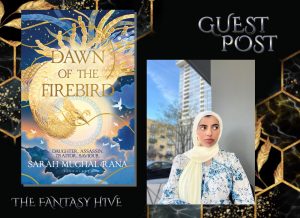
Today we’re thrilled to welcome Sarah Mughal Rana to the Hive on the publication of her epic Muslim-inspired high fantasy novel DAWN OF THE FIREBIRD. She’s written a fascinating article for us on writing faith into fantasy, but before we read that, let’s find out more about Dawn of the Firebird:
The raven, crane, and firebird each chose a tribe of man, granting humans heavenly magic.
But power in man’s hand caused endless wars for land.With mankind’s destruction, the birds perished taking with them their magic.
Magic is now rare, war common.The discarded daughter of an emperor, Khamilla Zahr-zad is raised with her mother’s nomadic tribe until a violent raid ends that peaceful life. Amid the chaos of death, the heavenly magic of nur awakens within her, granting her the power to wield a cosmic light.
Khamilla suddenly goes from outsider to weapon, finally accepted into her father’s court. Now worthy, she trains in combat and poisons, pledging loyalty to his throne. But tragedy strikes again and when her clansmen are defeated by a rival empire, Khamilla vows lasting vengeance as she escapes. However Khamilla is not alone – for something shadows her, feeding her darkness…
Hiding her identity, Khamilla infiltrates the enemy’s army academy. She studies jinn, magic, and martial arts from cutthroat mystic monks in a bid to bring down an empire from within. However, through her studies Khamilla begins to question her father’s teachings of war and rule.
With war escalating across kingdoms and a twisted magic spreading, Khamilla is torn between two impossible choices: revenge or freedom.
With gorgeous prose and a captivating magic system, layered with morally grey characters, Dawn of the Firebird embraces rich Islamic culture and raises provocative questions about individual power, choice, and the cost of war.
Dawn of the Firebird is out today! You can order you copy from Bookshop.org
The Dangers of Writing Faith into Fantasy Worlds
by Sarah Mughal Rana
I was scared, as a young Muslim writer, while I was working on my adult fantasy debut, Dawn of the Firebird. I feared that my story would offend, misstep, or do my faith injustice. I remember searching for articles on fantasy inspired by religious systems, and I came across this question: is there a case for a fictional Islam in fantasy literature?
Over the years of writing fantasy, the conversation around this topic has drastically shifted. So I say, before answering that question, we must examine what speculative fiction has historically attempted, and at times, failed, to do.
For decades, fantasy has drawn almost exclusively from the same well of cannon: Judeo-Christian frameworks and regurgitated Western mythic archetypes that shape how we structure stories themselves, and the mediums we convey them. When the canon becomes a cage, it causes an unintended injustice: both we and our worlds become trapped inside it.
Fantasy’s landscape is often celebrated because it is seen as “boundless,” yet the traditions that populate it rarely extend beyond familiar Western motifs: fallen angels, chosen ones, messiahs. Meanwhile, the rich literary, and spiritual traditions outside the Judeo-Christian sphere remain intellectually colonised, under-engaged, misunderstood, or entirely ignored. The question is not only whether we have enough literature that draws from non-Western cosmologies, but whether our current frameworks even allow such stories to be told without being distorted into recognisably Western shapes.
This is the paradox that I explore: writers from Muslim, Asian, Middle-Eastern or broader Islamicate backgrounds are often frustrated by misrepresentation, yet simultaneously warned away from creating fictional analogues of their own traditions. We are told not to offend, and not to risk getting representation“wrong.” But to write at all, especially in fantasy, is to take risk! Writing fantasy gives us the permission to make mistakes in building new worlds while trying to honour the real ones that shaped us.
That is why, in the world of Dawn of the Firebird, my adult fantasy, I chose a different approach: I invented a world from the ground up, yet rooted it in the moral questions, aesthetics, a monotheistic system, and philosophies found in pre-Islam stories, told through Islam’s lens. My fantasy novel was not written as a “fantasy Islam,” but as a literary space that acknowledges the ideas and moral questions explored in traditions of faiths without being bound to it. Respect can occur through imagination, not replication.
I want to challenge you—not just to think differently, but to imagine differently the role of religion in fantasy. As literary theorist Northrop Frye pointed out in his scholarship: much of the classics in fantasy from Tolkien to C.S. Lewis relied on the cosmology of Judeo-Christain templates. Even their invented worlds followed a Messiah figure, a cosmic battle of Light versus Dark, a hero’s journey modeled on sacrifice and resurrection. These aren’t accidental patterns, they reflect a Western canon that treats Christian-coded myth as the default template of narrative itself. Critics like Northrop Frye helped entrench this view by arguing that biblical narratives underpin all Western literature. Whether or not one agrees, the effect is clear: fantasy continually returns to the same well of acceptable motifs.
But imagination is much wider in scope than what our fantasy canon permits.
This is where my own novel, Dawn of the Firebird, comes into the picture. It exists not as a rebuttal to other novels, but as an attempt to see what becomes possible when we build fantasy worlds from other cosmological traditions. And crucially, Dawn is not inspired by the Islamic Golden Age or historical Islamic societies. Its foundation lies in Islamic interpretations of pre-Islamic stories—famous tales shared across Abrahamic traditions but understood differently through Islamic thought. The tale of Nuh’s flood, for instance, or the story of the raven; or Adam and Hawwa, which Western readers know as Adam and Eve.
Through this lens, motifs become different in my novel. Consider death. In dominant Western archetypes, death is a corruption, a feared endpoint that must be defeated. But in Dawn of the Firebird, death is literally sacred: a passage into martyrdom, divine justice, and the second life. The raven symbol I use, drawn from Islamic interpretations of Adam’s story, marks not punishment but death, revelation, and intelligence.
Or take the Great Flood: in many Western retellings, it is a global apocalypse. In Islamic understanding, Noah’s flood is localised, and centered on moral accountability. I built my world in Dawn, around this interpretation as a reminder that mythic events have multiple genealogies and versions, but fantasy has long chosen to honour only one… the ones from Judaeo-Christian understandings.
Yet writing this way requires confronting what the famous Pan-Africanist W. E. B. Du Bois called double-consciousness: the problem of seeing oneself through the eyes of a dominant culture while trying to speak from one’s own. Decentering our gaze is an act of taking creative agency. Ironically, writing fantasy fiction is political, because constructing a world from scratch, with its own laws, geographies, social realities, and moral spectrums, is always an inherently political act. For me, it meant giving myself permission to build a world where monotheism is the default; where jinn, the idea of Heaven, and even flora, fauna, and nature are tied to faith-driven forces.
This is why I argue that fantasy needs new frameworks. Not because Christian-coded stories lack value, but because they cannot remain the only acceptable pattern that we tell stories. When we imagine through other cosmological systems across different faiths, we expand what fantasy can be.
The act of imagining differently is, always, an act of reclaiming narrative space.
Dawn of the Firebird is out today! You can order you copy from Bookshop.org
Sarah Mughal Rana is an MPhil candidate at the University of Oxford, studying at the intersection of economic policy and human rights. Beyond the page, Sarah co-hosts the On The Write Track podcast, where she spills the tea with bestselling authors. When she’s not writing, you can find her diving into historical rabbit holes or honing her skills in traditional martial arts. Her short fiction has appeared in romance and fantasy anthologies, including My Big Fat Desi Wedding, Owl Crate’s inaugural Monsters & Masquerades, and Home Has No Borders. Sarah is the author of the YA title Hope Ablaze. Dawn of the Firebird is her debut fantasy novel for adults.
Her YA debut was selected as Librarian Mychal Threet’s debut book club pick and earned a Junior Library Guild Gold Star standard. Her work has been spotlighted by CBC Books, Book Riot, and Indigo’s “Best Books of the Year” lists.

I love how in-depth each section is.