IT’S HARD TO TELL YOU THIS by James Kinsley (BOOK REVIEW)
Regrets, Memories, Confessions and an Empty Flat…
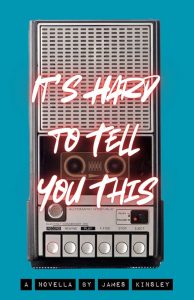 It’s Hard to Tell You This is a novella of regret, as Michael is prompted by his father’s death to face the mistakes he has made in his own life and relationships. It is Kinsley’s fourth book, and third from Deixis Press after the fantasy Western Greyskin and the sci-fi thriller Parallels.
His debut novella, Playtime’s Over, was published by Propolis in 2021.
He also self-publishes science fiction under the name Ray Adams. To date there have been five Ray Adams books published (including From Within, A Darkness, review on The Fantasy Hive).
Outside of writing, Kinsley has an interest in books, classical music, film and the environment. He collects postcards, sci-fi paperbacks from the 50s/60s/70s, comics and Lego. He is a paid-up member of the Green Party and a practising Christian.
You can find Kinsley on Instagram @unclekins.
Each of Kinsley’s novellas are artistically different to the one that preceded it. Kinsley sent me a copy of his latest publication, It’s Hard to Tell You This, when I settled down to read, I had no idea what to expect. Historical Fiction? Science Fiction? An exploration of mental health? Sexy Vampires? One is never quite sure what narrative Kinsley will present. His latest novella is stained by undeniable regret, whilst the protagonist juggles his grief, guilt and shame, whilst seeming to hunt for redemption in the continuous and performative penitence that fills the novellas pages.
“But I swear, in all of this, I never meant to hurt anyone.”
Michael (our protagonist) is given a box. He is in his pedestrian flat, furnished with everyday furniture, objects and technology, having been presented with the box by his brother. He considers the box, absorbing every minor detail about the box, before he dares to open it. From the moment you begin to read, Kinsley presses on the quotidian aspects of life. The lumpy, barely used sofa. The fat brother who seems fatter and fatter every time he is mentioned. The endless cups of tea and coffee we consume and offer to others. Where should one ‘entertain’ in your home? Kitchen Table? Sofa? Kinsley makes a space within his fiction for every trinket of a home, or insignificant aspect of daily routine and life, hyper focusing on the tiny and potentially inconsequential things in life that we often don’t think of or overlook.
“He fixed himself a cup of coffee, then sat on his sofa and considered the box. For a while, he didn’t open it. Just sat, looking at it. Watching, almost as if expecting it to open. It was in a reasonable condition. Not battered, as if well-travelled, though not in the pristine condition you would expect a sneaker fiend to keep it.”
But what is the importance of the box?
“It was, in all ways, an entirely normal shoebox.”
Kinsley’s Michael seems to be hurtling towards an ending, trying to manage the banal of the everyday whilst tackling his own grief and regret, triggered by the box to look into his own past. As mentioned in another reader’s review, Michael’s pain is ‘raw but normal’.
“The ghost of your past finally laid to rest, leaving only the spectre of my behaviour to haunt me.”
The novella uses the abstract and uncanny feelings surrounding grief and death to play with our expectations. Whilst the story trundles along, we are constantly expecting something bad or supernatural to happen, a ghost, a death, a disease, or something unusual. The novella teeters on the precipice of an ending, you can feel it coming, but you don’t know what it is.
“For the sake of the love I realise now I had for you, the very least I can do in return is to leave you be.”
The most noticeable thing to mention when reading this novella, is the narrative voice. There is something uncannily ordinary about it, whilst seeming a little unhinged, meta-fictional and emotional. Reminiscent of the voice in the video game ‘The Stanley Parable’. Michael, like the game’s narrator, seems fixated on what he can control and construct, whilst seeming volatile and emotional. Like the narrator, Michael doesn’t avoid his mistakes, or his incompetence, whilst he might have tried to run away from them or forget them, he makes space for them in his life, allowing them to haunt him every day.
“There were others. The girl I accidentally once kicked in the head and subsequently named the family cat after.”
Michael acknowledges his faults, and spends much of the novella recording tapes, confessing his mistakes with women, very ‘Ghosts of Girlfriends Past.’ The confessionals grow increasingly emotional and volatile, as he slowly gives away his possessions.
“(Lucy) [click] I treated you badly for years. It’s not an easy thing for me to say out loud. But I did. I treated you shamefully.
For years.”
As Michael coughs, splutters, and sobs his way through his confessions, the end seems to be increasingly nigh.
“There was no internet, no ready way to track the whereabouts of your peers. By the time there was, you were a phantom, lost completely to the past.”
The novellas momentum reminds me of The Travelling Cat Chronicles, by Hiro Arikawa, in which a cat is travelling from place to place with his owner, as the owner seems to be hunting for an appropriate new owner / home for his cat. The owner seems to be heading towards his own ending, the ultimate one, sadly dying and leaving his cat behind. The sadness that freckles Arikawa’s novel, seeps through Kinsley’s novella too, leading me to conclude that our emotional, spluttering protagonist must be dying too.
I read this novella with not only the expectation that something terrible or supernatural was to happen, but also Michael’s death. There is sadness. There is an ending. There is a twist. There could be a death, but I won’t tell you what it is.
Michael’s story is relatable, raw and real. His existence influenced and tainted by his past. Like us all, Michael is haunted by his actions, and those he has hurt in the past. He appears to search for absolution within his confessionals, resolute in his efforts to try and repent, giving away all his belongings. Even his beloved kitchen table. Everything except the tape, the shoebox and some clothes.
“The kitchen table was, he realised, the hub of his existence now.”
Kinsley engenders emotive responses and expectations with ease, making something out of the nothingness, of the ordinary. He pulls pain from the everyday, intentionally making the reader recognise their own pain and question their own purpose, whilst we hurtle towards an ending.