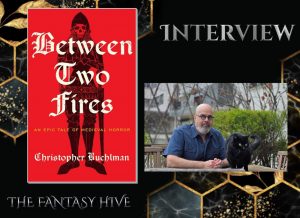
Interview with Christopher Buehlman (BETWEEN TWO FIRES)
Christopher Buehlman was born in Florida in 1969 and grew up in the suburbs of the Tampa Bay area. A poor fit for these surroundings, he anesthetized himself with horror and fantasy fiction, arcades, role playing games, and the temptations of late night cable TV until he could affect an escape onto a university campus as a French language major and then onto the renaissance festival circuit as Christophe the Insultor, Verbal Mercenary.
He spent his twenties writing poetry and insults, his thirties writing plays, and now seems to be a novelist. Pastimes include Muay Thai, weight training, primitive archery, foreign travel, romance languages, horror movies, cooking, and chess. He lives with a very understanding and talented wife, and a ragtag assortment of wee rescue beasties. He neither sides with aggressors nor complies with oppressors.
Welcome back to the Hive, Christopher! We’re here today to chat about your historical horror novel, Between Two Fires.
To start with, could you please tell us a little bit about the book? What’s in store for readers?
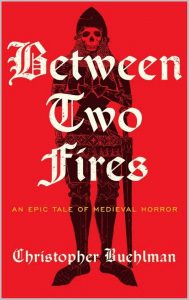
As the slugline promises, this is an epic medieval horror story, one that imagines that the Apocalypse of St. John actually happened in 1348 during the pandemic of the Black Death. Real-life historical events, which firsthand accounts already describe as terrifying, are blended with a supernatural narrative involving a new war between Heaven and Hell.
Can you tell us more about our main character Thomas and the young child he meets and journeys with? How did you find crafting their personalities?
Thomas is a warrior, a French knight who was wounded at the battle of Crècy two years before the action of the story, and robbed of his property, title and family. He is a man outraged at life’s betrayals and upsets. We meet him at the bottom of his moral arc––when he still lets external forces dictate his inner landscape. He is a brigand, and his fellow thieves are even worse, not scrupling to prey on young women they encounter in the lawless countryside. When the orphan Delphine approaches this dangerous quartet to ask for help burying her plague-stricken father, Thomas is presented with a choice––will he continue his descent into amorality (damnation in the understanding of the day), or will he take his first wobbly steps toward redemption by helping this enigmatic young visionary undertake a quest she believes the angels of God have mandated for her?
 We also meet many other characters along the way and one of my favourites is Père Matthieu, the priest. Did you have a favourite to write?
Honestly, no. They were all challenging and satisfying to animate. They all have internal struggles, ideas about their place in the world, and, I hope, three-dimensional personalities and backstories. I particularly enjoy writing dialogue, and their voices were all distinct for me. Delphine is hopeful and fearful at turns, but always the voice of non-violence, forgiveness, acceptance. Her father had been a lawyer, and she’d precocious and challenging; far more educated than her gruff, bellicose escort. Thomas is a man quick to insult or blaspheme, but slow to give his word. Père Matthieu is perhaps the most relatable for modern readers––a flawed individual just doing his best to survive and do right by others while external forces beyond his control seem to punish him for any misstep. He can be self-indulgent but he never means harm.
This is set in a grimdark plague ridden world that holds some rather nightmarish moments. Did you find any particular scenes difficult to write? Ordid you find writing this world cathartic?
Many scenes were difficult to write, but some were cathartic. Trying to come to grips with what hell might be like for a medieval person damned there was both.
Religion, specifically Christianity, is an important theme you explore. You’ve said before that you wrote Between Two Fires because you “wanted to express a deep disappointment in the church when it judges, when it advocates violence, when it seeks wealth or encourages its flock to do so.”
Could you tell us more about this and how you convey this within your narrative?
The first directive the possibly divine Delphine gives Thomas is “Don’t kill him. Don’t kill anyone else again.” That’s every bit as clear on the subject of violence as what scripture reports Christ’s instructions to be. And yet here we are surrounded by ‘Christian Soldiers’ who believe one can kill righteously, that there are times when it isn’t sinful. One can argue, successfuly I and most others would say, that violence is at times necessary to preserve innocent life, to defend vital interests, et cetera. But arguing that there’s anything Christian about it seems misguided to me. Full disclosure––I consider myself an agnostic, but I was educated in church doctrine and have great respect for the ‘red-letter words,’ especially the Sermon on the Mount, which seem to share a lot of semantic overlap with Buddhism, which I also respect without considering myself an adherent.
Were there any other themes that you felt important to write about?
I wanted to explore forgiveness and redemption. “Everyone falls short…Can we only forgive those who have sinned against others?” Delphine asks Thomas when he struggles with the harm he believes someone he loved did to him. I think that’s an important question for everyone.
From this novel being self published to now being traditionally published have you made many revisions? Will anyone rereading this edition find new scenes or characters?
Readers will not find new events or characters, but I have omitted one scene I have always felt uncomfortable with, and which I have come to feel was not worth activating trauma in people with bad experiences in real life. Not in a fictional story meant for entertainment and perhaps reflection. When I was younger, and I started this book more than 15 years ago, it was so important to me to make a scene believable that I sometimes forgot to ask whether telling that part of the story was necessary or kind.
You’re quite the prolific author with published works as a playwright, poet and novelist. Which of these do you find is your favourite genre to write in? Which do you find yourself drawn to the most?
I don’t know how prolific I am! After experimenting with the book-a-year schedule Penguin wanted me to follow, I’ve figured out that it takes me a good 1 ½ – 3 years to write a book I’m really proud of. No shade meant to The Suicide Motor Club or The Necromancer’s House, both of which were written in a year or so––I think they’re fun books, and I’m glad I wrote them, but I’m capable of going deeper.
Right now I’m getting the most satisfaction out of writing novels. When that changes, I’ll write what’s calling me. I’m grateful to be able to make my living this way––I know very well how difficult that is to achieve, and, unfortunately, how rare. As a society, we too often reward the wrong talents and priorities.
What’s next for you, Christopher? Is there a new novel in the pipelines or can we expect any more of your horror novels to be traditionally published in the UK?
I’ll soon be starting work on a new medieval horror novel, and I’m really eager to jump back into that vibe.
Finally, after finishing Between Two Fires, what is the one thing you hope readers take away from your writing?
If I can help people feel curiosity, wonder, catharsis, and maybe have a laugh or two, that’s all I can hope for.
Thank you so much for joining us today!
Thank you for your interest, Nils. It’s always a pleasure to chat with you!
Between Two Fires is out today from Gollancz – you can order your copy on Bookshop.org