THE PRICE OF FEAR by Miles Lyon (BOOK REVIEW)
Full of grotesque, hyper-violent bloodshed and philosophical asides with dollops of melodrama that Gabriel De Leon would be proud of.
“Funny thing about books is that they’re quite like people. Until you open them up, you never know what’s waiting inside”
I am thankful to the author, Miles Lyon, for my ARC of this fantastic book. I was blown away by the cover and am always a sucker for a book that has a condemned prisoner narrating their story just before their execution. The Price of Fear treads down the path laid out by Empire of the Vampire and The Name of the Wind, but provides its own indelible spin, aided with some fabulous storytelling, an interesting magical system and a compelling melodramatic lead.
“Do you understand the severity of that crime? We’re in an armistice. That’s… punishable by death”
“Darling, I am death”
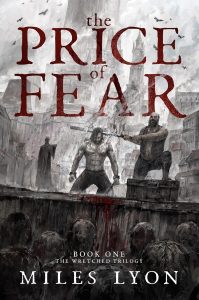 The Price of Fear opens with Anamaria Lestrade, The Memory of Crime, and the greatest interrogator of Inath, confronting the imprisoned and about to be executed Azreal the Wretched, an infamous mage of the North. Inath and North share a bitter war-filled history, but the tenous, fragile armistice of the last decade has been shattered by Azreal’s botched assassination of the wrong yet important royal target. Ana has a few hours before the execution to get to the truth of this assassination, while Azreal seemingly wants to do the same, but in a roundabout, melodramatic manner filled with verbose angst, poetic, tense confrontations, and razor sharp to and fro exchanges. Given the element of unreliability and pressure of time, The Price of Fear heads down convoluted, intricate, and exquisite paths.
“ You have so little foresight that I have to wonder if you even have the part of the brain responsible for it”
This pretty much sounds familiar. Empire of the Vampire went down this path, as did Whispers of the Storm in the recent times. This one does hew much closer to Empire of the Vampire in the spinning of the yarn, but there are enough differences that make Miles Lyon’s book stand out. The nature and cost of magic is one of the key elements in this book. The cold, foreboding North (Reviewer’s aside: in which book is the North never cold) has ancient magic that takes a toll on the wielder, a unique cost for every wielder, with the magic manifesting differently for each. An almost X-Men-ish kind of power manifestation, fueled by magic. In Azreal’s case, the magic feeds on his emotions, strips them away from him permanently to fuel the offensive he wants to mount. Which means Azreal has to be careful with the emotions he wants to be stripped away from him, and he often uses the emotions of other people to fuel his weapons as a first resort. What that also does is make Azreal a man with many acquaintances and connections but very few with whom he shares a deep bond. He treasures the ones he has, but has to be careful about being very open with them, as the weapon may feed on it. The Godless, as these magic wielders are called, are an interesting aspect of this book as well. While their powers are unique, they have a hierarchy amongst them, a hierarchy of numbers. The lower the number, the more dangerous the Godless is, and each number has a bloody and violent story and a cost incurred, physically and mentally.
“You know Roman hates you. He’s gone so far as to offer to have you hunted down. To stick you full of so much steel that you’d die from metal poisoning before you bleed out. You must be desperate”
Which brings us to the other differentiating element of the story from the aforementioned comps. This is a retelling of Azreal’s life history to an audience. However, the story doesn’t start with his childhood. It starts with an Azreal fully in his powers, a few months before the events of his capture. We do get flashbacks and slices of history when he meets other people and Godless, but this is a fully formed Azreal, warts and all. It is an indicator of how the author is aware that he is treading down a worn path with his narrative choices, but he would still do it in his own way. Azreal isn’t a blank canvas; the layers get unpeeled with every action and interaction.
“Speaking of theater, let’s get something straight right here. Monologues, voices and screams are all just dramatic for the crowd. When a villain goes angry, they get loud and they throw their expressions in large movements. They make threats and unleash their intentions on the protagonists with a vociferous vocabulary to inform the audience of what they plan to do. But in real life, the biggest, hardest motherfuckers just get quiet.”
The writing is easily one of the biggest strengths of the book. The melodrama of the lead can often veer into tiring territory if not done well. Similarly, the shallowness of Azreal’s interaction, given the cost, can also be formulaic. The Price of Fear relies on some fantastic writing to steer through all that. Azreal is melodramatic to a fault, and Ana, as an audience surrogate, throws it in his face when it tips over, and there is almost a duality at play when Azreal interacts with Ana at her most frustrated. He becomes almost playful, teasing and bandying words as if they were the actual weapons. The writing also does the heavy lifting for Azreal’s character as a charmer. This is especially important given how Azreal cannot get positively emotional lest the weapon take it away from him. So the charm has to be genuine to get people to do things for him, while he cannot form deep bonds. This is a theme that gets repeated as he encounters a lot of familiar faces during the course of his mission.
“If there’s anything you leave so consistently in your wake, it’s messes, after all”
This focus on character doesn’t detract from the pacing of the book. The imposed urgency of the execution acts as an audience mechanism through Ana to bring Azreal back to the relevant story, and that is rather well done throughout. While Azreal does spin a yarn, it is in a way a tour through his greatest hits, regrets, foibles, and relationships. The relationships, especially the one with capital R, do drive a lot of his motivations. The other relationships throughout the book are with some of the other Godless, every bit as complicated as the past they share, and serve as major inflection points in his story.
“What is love, if not action in the absence of reason? If not perseverance in the face of sense?”
Writing apart, this is a grimdark fantasy book that sticks to its genre – the action sequences are brutal, violent and fast, the combat sequences especially among the Godless is frantically inventive and bloody, the humor is dark, gallows-like in some cases but always black and drawing more than a few chuckles as well; the locations are often almost the seedier sides of the city and there are enough colorful swears and creative abuses thrown in with a fantastic sense of word-play. This is almost a perfect package, but where the book does falter is towards the end. It almost feels rushed after everything that we had, and seems concerned about setting the sequel up. It almost felt a bit too easy after doing all the hard work. The book’s ending action sequence is fantastic to make up for some of this rush, and the setup for the next book comes with a neat twist as well.
“That’s the way of the world, isn’t it. Having to face your past when it’s most inconvenient”
“Naturally, it’s the way of things. The future cannot be conquered without the lessons of the past, and there is no lession like one learned in blood”
The Price of Fear is a fantastic debut, a book that is so assured in its style of narration and delivery that it feels like a seasoned author at work. It does wear its inspiration on its suitably scruffy, grimy sleeve, but displays more than enough differences to make it stand on its own. The writing is gorgeous and has a fantastic sense of pacing and pausing to help in the narration. This is a series and an author I would love to follow and wait breathlessly for their next output.
Rating – 4.5 Magical Weapons on 5