
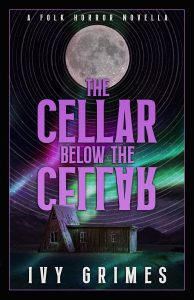
Interview with Ivy Grimes (THE CELLAR BELOW THE CELLAR)
Ivy Grimes is originally from Birmingham, Alabama, and she currently lives in Virginia. She has an MFA from the University of Alabama. Her stories have appeared in The Baffler, Vastarien, hex, Maudlin House, ergot., Potomac Review, and elsewhere. She is the author of the collection Glass Stories (Grimscribe Press) and The Ghosts of Blaubart Mansion (Cemetery Gates).
RSL: Tell us about The Cellar below the Cellar. What was your process, your inspirations—or even general kind of narrative goal, if there was one?
IG: I was using the structure of the fairy tale “Vasilisa the Beautiful.” As a final gift from her mother, Vasilisa received a doll with the mother’s magic, love, and good wishes. Many of the story elements have been twisted beyond recognition in my story, but the doll remains intact. The main antagonist in Vasilisa is the stepmother, who tells Vasilisa to get some fire from Baba Yaga. Her hope is that Vasilisa will die on this journey, since Baba Yaga is an unpredictable and powerful woman. She’s witchy, in touch with elemental forces. So Vasilisa visits Baba Yaga as asked, and she sort of charms her in a way. As in many fairy tales, Vasilisa is assigned labors that would normally be impossible for one person, but she relies on the help of her magic doll. The absent mother’s love saves her in the witch’s house. One thing I appreciate about Baba Yaga is that she’s not necessarily evil. She’s powerful and dangerous, just like nature.
RSL: Both your novella and the source text have this strong connection to old, folkloric images, but without a direct correspondence. Do you think this haziness in definitions lets you move around more conceptually?
IG: Instead of retelling the story, I’m trying to explore the implications and how they might map onto other situations. In my story, the girl’s grandmother is a type of Baba Yaga, and she’s trying to initiate her into some very old knowledge about the cellar below the cellar. The protagonist is a character who doesn’t want to know, and it’s a slow process for her to say, “Okay, maybe I can handle this information.”
RSL: Did you purposefully avoid that apocalyptic trope a lot of writers have sort of relished, the end of civility and the conservative notion that without society as we currently know it, we’d have disorder and murder and chaos? You mentioned The Road as an inspiration, you see, and I feel like your novella responds interestingly to that.
IG: Great question! I didn’t have a particular angle when I started writing, but I was curious, writing my way into it. The community I’m portraying is sparsely populated. Mostly women and children. And I wanted to explore the stress of community, but also the necessity of community.
 RSL: Do you think you’re narrativizing how an apocalypse is essentially a lack of narrative? Perhaps you’re proposing that the narratives we choose matter, and that we always build meaning together?
IG: Whether we like it or not! That’s a great idea, and I hadn’t thought of it that way. I think narrative is weird in general. Some people deliberately plot out their lives and their stories, but I haven’t really done that. I don’t think consciously about plot beats. But there’s something about working with another story. It’s sort of like a brace for my own narrative. And folklore is a very old and stable scaffolding for a community of narratives.
I deeply love stories that don’t have traditional plots, though mine generally do. Variety in making meaning is the essence of community, and I love to read stories by someone who doesn’t care about plot at all. They just get on the page and go where they go. I guess that’s what we all have to do in our own ways. We all have to answer our own call, even if not everybody will understand or appreciate it.
RSL: That brings me to another big question. Do you find that Cellar had to be told or written a certain way, to fit the core themes about history and generational knowledge? It really felt inviting, even when the story might turn dark—it was like you were asking the reader the same questions that Jane was facing.
IG: That’s really kind of you, and that is how I feel. I love Barbara Comyns (I’ve talked about her a lot), but what I love most is her voice, which is somewhat whimsical and optimistic. Her protagonists face these horrible things that make you really worry for them, and yet (for me anyway!) her stories give me a strong sense of optimism, that in spite of all the horrible things that might happen, you can still enjoy life. That’s something I want to do as well. I want readers to walk away with a sense of power in weakness, and of connection.
RSL: That rounds us nicely to the burning question: What were you thinking about when you finally approached the eponymous cellar below the cellar? There’s a lot involved there.
IG: I believe in supernatural forces, and I believe in God, but to me, they’re very mysterious. Some people of faith will get very specific about heaven and hell and angels and demons, and that’s really fascinating, and it’s how we collectively come up with interesting mythology. And maybe pierce the veil of truth, too! But what feels most true to me, as far as my knowledge goes, is the mystery itself. When I explored the cellar below the cellar, I wanted to explore the edges the mystery of life and death. And speculate a bit on, you know, what could potentially be the point of the whole thing?
RSL: That’s an important question, I think, that you touch on a lot. Since the novella involves a Miyake event, so all tech is wiped out, what was your main thesis in that?
IG: It’s common to hear criticism of contemporary society, perhaps sometimes unfairly since it’s all we really know. But we are in a position to be more self-focused because we’re more isolated, and we rely on technology more than ever. We’re not forced to spend time with the same group of people or rely on them.
I think it’s really interesting to have to make do, and to learn to appreciate people who you don’t initially like. You probably won’t ever understand each other, but there can be something beautiful about forging an honest connection with someone you don’t really like at first. That’s returns us to fairy tales. Life, like fairy tales, gives us strange labors. We have to do all kinds of busywork and things that seem pointless to get by, and sometimes to attain greater knowledge. These labors help us build patience, which is also necessary for community. I’m trying to build up my own small store of patience, and it’s an annoying process!
RSL: Would you class this novella as a post-COVID novel? Where we’re suddenly aware of our immediate surroundings and dangers?
IG: That’s a good question. I wasn’t consciously thinking about that, but I’m sure I was affected by the fear we all felt during that time. That sense of not being prepared enough.
What started me off on this story was a tension between curiosity and fear about life’s mysteries. As I went along, it also became a story about community. Sometimes community means grunt work for a common cause, like when my protagonist has to weed the garden. And other times, it means putting up with people when they smell bad or they’re in a bad mood. Sometimes it means acknowledging beliefs that you don’t necessarily think are real, like the youth pastor and his demon jars.
RSL: You mention the demon jars, which involves the opening scene where Jane, the protagonist, is on a date with Pastor Dan, who believes he’s got demons taken from the evilest beings. The Ted Bundys and all that. Later on, he reveals a confession Jane made during a service, which seemed sinister of him. Were you trying to unpack religion as we want it to be, and how it often manifests in communities?
IG: I know what you mean, and I can see how it would seem awful of the pastor to have revealed Jane’s anonymous prayer request. To me, Pastor Dan essentially means well, but he lives in his own world. I guess I’m an apologist for Pastor Dan. Like, I wouldn’t want to date him. I think his demon jars are interesting but also kind of evil. But so are most people. So am I.
RSL: One thing the novella excels at is this hazy interstitial positioning of right and wrong, good and evil—do you try and purposefully evoke those concepts, or is it a result of this ‘wandering’ you said you like to do when writing?
IG: It’s something I’m really interested in, so I’m always returning there. I find it very hard to classify things as good and evil, which is strange in a way since I come from a religious background. It’s easy to say that some quality like cruelty is evil, because it causes clear pain and destruction. But it’s much harder for me to look at a person and say they’re good or evil. Maybe I’m wrong! I’m always trying to answer these questions for myself. That’s one of the mysteries I find frightening but fascinating, the mystery of good and evil. When I was a kid, my Grandmother Grimes would often tell me (seemingly out of nowhere), “There’s a little evil in everyone. But there’s a little good in everyone, too.” She didn’t go around giving me this kind of advice all the time! This was something special. Like the grandmother in the story, she wanted me to be prepared.
You can find out more about The Cellar Below the Cellar on Ivy Grimes’ website

